

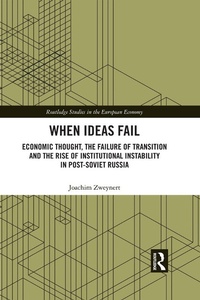
When Ideas Fail
Economic Thought, the Failure of Transition and the Rise of Institutional Instability in Post-Soviet Russia
Published on 1. November 2017
154 pages
978-1-351-36384-6 (ISBN)
Description

In the history of Russian economic ideas, a peculiar mix of anthropocentrism and holism provided fertile breeding ground for patterns of thought that were in potential conflict with the market. These patterns, did not render the emergence of capitalism in Russia impossible. But they entailed a deep intellectual division between adherents and opponents of Russia's capitalist transformation that made Russia's social evolution unstable and vulnerable to external shocks.
This study offers an ideational explanation of Russia's relative failure to establish a functioning market economy and thus sets up a new and original perspective for discussion. In post-Soviet Russia, a clash between imported foreground ideas and deep domestic background ideas has led to an ideational division among the elite of the country. Within economic science, this led to the emergence of two thought collectives, (in the sense of Ludvik Fleck), with entirely different understandings of social reality.
This ideational division translated into incoherent policy measures, the emergence of institutional hybrids and thus, all in all, into institutional instability. Empirically, the book is based on a systematic, qualitative analysis of the writings of Soviet/Russian economists between 1987 and 2012.
This groundbreaking book makes an important contribution to Central Eastern and Eastern European area studies and to the current debate on ideas and institutions in the social sciences.
This study offers an ideational explanation of Russia's relative failure to establish a functioning market economy and thus sets up a new and original perspective for discussion. In post-Soviet Russia, a clash between imported foreground ideas and deep domestic background ideas has led to an ideational division among the elite of the country. Within economic science, this led to the emergence of two thought collectives, (in the sense of Ludvik Fleck), with entirely different understandings of social reality.
This ideational division translated into incoherent policy measures, the emergence of institutional hybrids and thus, all in all, into institutional instability. Empirically, the book is based on a systematic, qualitative analysis of the writings of Soviet/Russian economists between 1987 and 2012.
This groundbreaking book makes an important contribution to Central Eastern and Eastern European area studies and to the current debate on ideas and institutions in the social sciences.
More details
Series
Language
English
Place of publication
London
United Kingdom
Publishing group
Taylor & Francis Ltd
Target group
College/higher education
Illustrations
4 Tables, black and white
File size
1,23 MB
ISBN-13
978-1-351-36384-6 (9781351363846)
Copyright in bibliographic data and cover images is held by Nielsen Book Services Limited or by the publishers or by their respective licensors: all rights reserved.
Schweitzer Classification
Other editions
Additional editions
Joachim Zweynert
When Ideas Fail
Economic Thought, the Failure of Transition and the Rise of Institutional Instability in Post-Soviet Russia
Book
12/2019
1st Edition
Routledge
€54.46
Shipment within 15-20 days
Joachim Zweynert
When Ideas Fail
Economic Thought, the Failure of Transition and the Rise of Institutional Instability in Post-Soviet Russia
Book
11/2017
1st Edition
Routledge
€215.41
Shipment within 10-20 days
Person
Joachim Zweynert is Professor of International Political Economy at Witten/ Herdecke University, Germany. He studied economics and political science at Hamburg University, Germany.
Content
Table of Contents
1 Introduction
2 The Role of Ideas in Great Transformations
Transition as functional differentiation
Constructivist institutionalism and the structure/agency-problem
What is special about Russia
What is special about Russia I: Lack of liberal underground discourses
What is specific about Russia II: The struggle between two thought collectives
What is Specific about Russia III: Deep ideational backgrounds
3 The Legacy of the Brezhnev Period: 1971-1986
Why deal with the Brezhnev period?
Self-organization versus mobilization
The economics of developed socialism
The origins of the concept
The economic mechanism
Base and superstructure
Commodity-money relations
Conclusion
4 Cracking the Protective Belt: 1987-1992
Back to the 1960s and taking it further
What was Soviet ideology?
Perestroika and the Soviet telos
Early debates in Voprosy ekonomiki, and the new textbook on political economy
The in?ow of Western liberal ideas
The MEiMO debate on Western reforms
The Debates in the general interest press
The decline of Soviet ideology
Paradigm shift or continuity?
5 Towards a Precarious Consensus: 1993-1998
Western textbooks, Russian reality
The intellectual background to shock therapy
Post-industrial society and the comeback of slavophile ideas
Regulation, economic security, and the "Russian economic school"
The rise of Russian institutionalism
A new consensus?
6 In Search of a "Russian Way": 1999-2006
Taking stock of post-socialist reforms
The discussion about the stabilization fund
The nationalist turn
Reappraisal of the planned economy
Indicative planning and mobilisation versus structural reforms
Liberal Reactions to increasing state intereference
Economics or political economy?
Russian economic science on the retreat from international discourse
7 A New Transition Debate: 2007-2012
2007 as a turning point
Conflicting concepts of innovation and modernization
Modernization and innovation in economics and in sociology
The "coalitions for modernization" debate
Discussions within the liberal camp
The position of the gosudarstvenniki
The political dimension of the debate
Conservative modernization versus innovation
Innovation and modernization in presidential speeches
A "fear of perestroika"?
8 Conclusion
Biographical Appendix
References
1 Introduction
2 The Role of Ideas in Great Transformations
Transition as functional differentiation
Constructivist institutionalism and the structure/agency-problem
What is special about Russia
What is special about Russia I: Lack of liberal underground discourses
What is specific about Russia II: The struggle between two thought collectives
What is Specific about Russia III: Deep ideational backgrounds
3 The Legacy of the Brezhnev Period: 1971-1986
Why deal with the Brezhnev period?
Self-organization versus mobilization
The economics of developed socialism
The origins of the concept
The economic mechanism
Base and superstructure
Commodity-money relations
Conclusion
4 Cracking the Protective Belt: 1987-1992
Back to the 1960s and taking it further
What was Soviet ideology?
Perestroika and the Soviet telos
Early debates in Voprosy ekonomiki, and the new textbook on political economy
The in?ow of Western liberal ideas
The MEiMO debate on Western reforms
The Debates in the general interest press
The decline of Soviet ideology
Paradigm shift or continuity?
5 Towards a Precarious Consensus: 1993-1998
Western textbooks, Russian reality
The intellectual background to shock therapy
Post-industrial society and the comeback of slavophile ideas
Regulation, economic security, and the "Russian economic school"
The rise of Russian institutionalism
A new consensus?
6 In Search of a "Russian Way": 1999-2006
Taking stock of post-socialist reforms
The discussion about the stabilization fund
The nationalist turn
Reappraisal of the planned economy
Indicative planning and mobilisation versus structural reforms
Liberal Reactions to increasing state intereference
Economics or political economy?
Russian economic science on the retreat from international discourse
7 A New Transition Debate: 2007-2012
2007 as a turning point
Conflicting concepts of innovation and modernization
Modernization and innovation in economics and in sociology
The "coalitions for modernization" debate
Discussions within the liberal camp
The position of the gosudarstvenniki
The political dimension of the debate
Conservative modernization versus innovation
Innovation and modernization in presidential speeches
A "fear of perestroika"?
8 Conclusion
Biographical Appendix
References
