

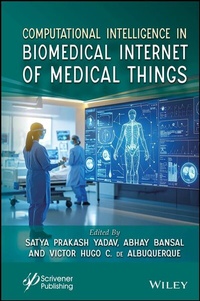
Computational Intelligence in Biomedical Internet of Medical Things
Description

Through comprehensive insights and real-world case studies, this book features in-depth knowledge of key concepts relating to optimizing biomedical IoMT systems.
Biomedical Internet of Medical Things is a technological paradigm encompassing a range of technologies that enable machines to mimic human intelligence. Machine and deep learning algorithms facilitate self-learning for the discovery of hidden patterns, associations, and risks from voluminous datasets. Computer vision and natural language processing are prominent applications of AI, allowing machines to see and understand the world in ways previously only possible for humans. In healthcare, generative techniques can analyze large and complex datasets from wearable sensors, identifying patterns and trends that can aid in detecting, diagnosing, and monitoring chronic diseases. This book comprehensively consolidates the latest technologies, groundbreaking research, and practical applications of computational intelligence in biomedical IoMT, with a strong emphasis on optimizing healthcare information systems.
Readers will find the volume:
- Explores the transformative role of computational intelligence in the Internet of Medical Things (IoMT), demonstrating how intelligent systems enhance healthcare efficiency, accuracy, and patient-centric solutions at various scales;
- Examines key computational intelligence techniques and algorithms used in modern biomedical IoMT applications, emphasizing their impact on real-time diagnostics, personalized treatment, and remote patient monitoring;
- Highlights the evolution of AI-driven paradigms in biomedical IoMT, showcasing their role in predictive analytics, automated decision-making, and adaptive healthcare systems;
- Investigates the integration of trust management and advanced cybersecurity frameworks in intelligent healthcare networks.
Audience
Academics, research scholars, and industry professionals in the fields of mathematics, computer science, information technology, and health science.
More details
Other editions
Additional editions
Persons
Satya Prakash Yadav, PhD is an Associate Professor in the Department of Computer Science and Engineering, Madan Mohan Malaviya University of Technology, Gorakhpur, U.P., India with more than 17 years of experience. He has published four books, two patents, and many research articles in international journals and conferences. His research focuses on image processing, information retrieval, and feature extraction and programming.
Abhay Bansal, PhD is a Professor and the Dean of the School of Computer Science Engineering and Technology and the Dean of International Affairs and Corporate Outreach, Bennett University, Greater Noida , UP, India with more than 29 years of research and teaching experience. He has published more than 130 papers in various international journals and conferences of repute. His research interests include data science, data analytics, cloud computing, and data structure.
Victor Hugo C. de Albuquerque, PhD is a Professor and Senior Researcher in the Department of Teleinformatics Engineering, Federal University of Ceará, Brazil. He is a full member of the Brazilian Society of Biomedical Engineering and serves as an editor for several international journals and conferences. He has experience in biomedical science and engineering, mainly in the fields of applied computing, intelligent systems, and visualization and interaction.
Content
Preface xix
Part I: Foundations and Frameworks 1
1 Introduction to Computational Biomedical Intelligence 3
G. Padma Priya, Anima Nanda, Nimisha Ghosh, E. Sakthivel, Devendra Parmar and Rakesh Kumar Yadav
1.1 Introduction 4
1.2 Emergence of Computational Biomedical Intelligence 6
1.3 Applications Driving Innovation in Healthcare 8
1.4 Bridging Biomedical Complexity with Advanced Computing 9
1.5 Prospects and Challenges 10
1.6 Conclusion 13
2 Fundamentals of Biomedical Data and Social Determinants 17
Girija Shankar Sahoo, D. Alex Anand, Manoranjan Parhi, Abdul Khadar A., Subbulakshmi Ganesan and Swapnil M. Parikh
2.1 Introduction 18
2.2 Methodology 19
2.3 Models of Machine Learning and Deep Learning are Employed to Predict Cardiovascular Diseases 22
2.4 Results 24
2.5 Conclusion 30
3 The Impact of Biomedical Intelligence on Public Health 35
Smitha Madhavan, Malathi H., Anjali R. Kumbar, Bethanney Janney J., Debahuti Mishra and Ritesh Kumar
3.1 Introduction 36
3.2 Related Works 38
3.3 Proposed Methods 39
3.4 Challenges the Biomedical Intelligence in Public Healthcare 41
3.5 Impact of Public Health on Disease Prediction Using Machine Learning 42
3.6 Impact of Public Health in Disease Prediction Using Deep Learning 42
3.7 Result and Discussion 42
3.8 Discussion 51
3.9 Conclusion 51
4 Healthcare Data Integration and Management 55
Swaroop Mohanty, Piyali Roy Chowdhury, Renuka Jyothi S., Satya Ranjan Das and Dhananjay Kumar Yadav
4.1 Introduction 56
4.2 Methodology 57
4.3 Results 60
4.4 Conclusion 65
5 Ethics and Legal Issues in Computational Biomedical Intelligence 69
Mohitkumar Jagdishchandra Rathod, Neha Arora, Sindu Divakaran, Ankita Agarwal, Suhas Ballal and Chinmaya Kumar Mohapatra
5.1 Introduction 70
5.2 Description of Biomedical Technological Growth and Development 73
5.3 Ethical Considerations in Computational Biomedical Intelligence 76
5.4 Legal Considerations in Computational Biomedical Intelligence 83
5.5 Result 85
5.6 Discussion 87
5.7 Conclusion 87
Part II: Advanced Analytical Techniques 93
6 Bioinstrumentation and Medical Devices 95
Roopashree R., Utpalkumar B. Patel, Krishnakumar Samikan, Joe Arun Raja, Preeti Naval and Aneesh Wunnava
6.1 Introduction 96
6.2 Computational Intelligence Techniques in the Internet of Medical Things 98
6.3 Conclusion 108
7 Biomedical Signal Processing for Community Health 111
Sheuli Sen, Santanu Kumar Sahoo, Rekha M.M., Jemmy Christy H., Sumitra Menaria and Pooja Shukla
7.1 Introduction 112
7.2 Literature Reviews 114
7.3 Methodology 115
7.4 Results 121
7.5 Discussion 124
7.6 Conclusion 124
8 Medical Image Processing and Analysis 127
Pallavi. M., Sarbeswar Hota, Ankita Gandhi, Anbarasi Jebaselvi G. D., G. Padma Priya and Divyanshi Rajvanshi
8.1 Introduction 128
8.2 Related Work 129
8.3 Methodology 131
8.4 Result 137
8.5 Discussion 140
8.6 Conclusion 141
9 Genomic and Proteomic Data Analysis for Population Health 143
Roja Lakshmi Karri, Anand Prakash, Suman Sau, Subbulakshmi Ganesan, Jayshree Nellore and Shweta Singh
9.1 Introduction 144
9.2 Methodology 145
9.3 Human Genome Project 146
9.4 Information Synthesis and Integration 152
9.5 Conclusion 157
10 Telemedicine and Remote Monitoring 161
Sheuli Sen, Girija Shankar Sahoo, Anjali R. Kumbhar, Sibun Parida, Aranganathan A. and Malathi H.
10.1 Introduction 162
10.2 Related Works 163
10.3 Methodology 165
10.4 Experimental Results 167
10.5 Discussion 172
10.6 Conclusion 173
11 Machine Learning and Artificial Intelligence in Biomedical Applications 177
Deepti Pandey, Indraah Kolandaisamy, Visvesvaran C., Renuka Jyothi S., Suraya Mubeen and Prabhat Kumar Sahu
11.1 Introduction 178
11.2 Levels of Artificial Intelligence Applications Across Biomedical Subfields 179
11.3 Artificial Intelligence-Based Medical Imaging 180
11.4 Different Diagnosis Using Machine Learning and Artificial Intelligence 183
11.5 Performance Evaluation of Machine Learning and Deep Learning Methods in Biomedical Application 185
11.6 Transformative Impact of Artificial Intelligence in Healthcare 191
11.7 Conclusion 192
12 The Internet of Medical Things in Chronic Disease Management 197
Ravindra Pandey, Shaktijeet Mohapatra, Suhas Ballal, Ritesh Kumar, Raesa Razeen and Bavanilatha M.
12.1 Introduction 198
12.2 Related Works 199
12.3 Methodology 201
12.4 Results 206
12.5 Discussion 210
12.6 Conclusion 210
13 Wearable Technologies in Internet of Medical Things Biomedical Intelligence 213
Ramesh B. Darla, Biswaranjan Swain, Roopashree R., Amreen Khanum D., Trapty Agarwal and Barani Selvaraj
13.1 Introduction 214
13.2 Related Articles 215
13.3 Methodology 217
13.4 Result and Discussion 221
13.5 Conclusion 225
Part III: Systems and Applications 229
14 Health Informatics and Community Decision Support Systems 231
Sheuli Sen, S. Jayashree, Sudhanshu Shekhar Bisoyi, Rekha M.M., Raesa Razeen and Ankita Agarwal
14.1 Introduction 232
14.2 Methodology 234
14.3 Patient-Centered Care through Healthcare Informatics 234
14.4 Clinical Decision Support Systems Framework 235
14.5 Telemedicine Framework 237
14.6 Telehealth Framework 238
14.7 Conclusion 244
15 Healthcare Data Acquisition and Management 251
G. Padma Priya, Indumathi S.M., Rahul Priyadarshi, Brijesh Vala, Preeti Naval and Kumari K.
15.1 Introduction 252
15.2 Healthcare Data Framework 253
15.3 Assessment of Healthcare Data 261
16 Telemedicine and Remote Health Monitoring for Underserved Communities 267
Sheuli Sen, Subbulakshmi Ganesan, Rohini Chavan, Deepak Dasaratha Rao, Binayak Pand and Ayesha Taranum
16.1 Introduction 268
16.2 Accessing Community Needs and Building Awareness 270
16.3 Establishing Infrastructure and Ensuring Accessibility 271
16.4 Implementing Remote Health Monitoring and Device Distribution 273
16.5 Facilitating Telemedicine and Providing Ongoing Support 275
16.6 Evaluating Effectiveness and Continuing Support 277
16.7 Result 278
16.8 Conclusion 280
17 Personalized Medicine and Computational Approaches 285
Dheeraj Kumar Singh, Sampath A. K., Balasankar Karavadi, Malathi H., Sarita Mahapatra and Pooja Shukla
17.1 Introduction 286
17.2 Biomedical Internet of Medical Things 288
17.3 Computational Approaches in Personalized Medicine 289
17.4 Bioinformatics and Multi-Omics in Personalized Medicine 292
17.5 Diagnosis and Treatment in Personalized Medicine 294
17.6 Major Disease in Personalized Medicine 296
17.7 Computational Approaches and Accuracy Outcomes in Personalized Medicine Studies 298
17.8 Discussions 300
17.9 Summary and Future Directions 301
18 Internet of Medical Things and Social Health 305
Divyanshi Rajvanshi, Sumitra Menaria, Rajan Thangamani, Roselin Jenifer D., Renuka Jyothi S. and Alakananda Tripathy
18.1 Introduction 306
18.2 The Internet-of-Medical-Things Architecture 308
18.3 Methodology 309
18.4 Healthcare Monitoring Using Artificial Intelligence 312
18.5 Result 312
18.6 Discussion 320
18.7 Conclusion 320
Part IV: Innovations and Future Directions 325
19 Bioinformatics Algorithms and Tools 327
Suhas Ballal, Pooja Shukla, Hetal Bhaidasna, Riyazulla Rahman J., Y. Swarna Latha and Abhilash Pati
19.1 Introduction 328
19.2 Methodology 330
19.3 Bioinformatics' Goals 330
19.4 Biological Sequence Examination 331
19.5 Basic Local Alignment Search Tool 333
19.6 Comprehensive Genome-to-Proteome Examines 334
19.7 Gene Expression and Functional Examination 338
19.8 Challenges and Future Directions 339
19.9 Conclusion 340
20 Biomedical Data Acquisition and Management 345
Praveen Priyaranjan Nayak, Roopashree R., Deeksha Choudhary, Jay Gandhi, Asif Mohamed H. B. and Poonguzhali S.
20.1 Introduction 346
20.2 Literature Review 347
20.3 Internet of Medical Things Technologies and Their Role in Biomedical Data Acquisition 349
20.4 The Internet of Medical Things Data Acquisition 349
20.5 Biomedical Data Management 355
20.6 Assessment of Security 359
20.7 Conclusion 361
21 Biomedical Data Integration and Fusion 365
Smita Rath, Emalda Roslin S., Rekha M.M., Awakash Mishra, Gaurav Kumar Ameta and Megha D. Bengalur
21.1 Introduction 366
21.2 Literature Reviews 367
21.3 Methodology 369
21.4 Results 376
21.5 Discussion 380
21.6 Conclusion 381
22 Biomedical Robotics and Assistive Technologies 383
Prasad P. S., Rourab Paul, Joany R. M., G. Padma Priya, Sweta Jethava and Ankita Thakur
22.1 Introduction 384
22.2 Surgical Robotics 386
22.3 Rehabilitation Robotics 389
22.4 Assistive Robotics 392
22.5 Wearable Assistive Robotics 393
22.6 Result 394
22.7 Discussion 397
22.8 Conclusion 397
23 Predictive Modeling in Healthcare 401
Trapty Agarwal, Lambodar Jena, Tabrej Mulla, Megalan Leo L. and Subbulakshmi Ganesan
23.1 Introduction 402
23.2 Methodology 404
23.3 Result 410
23.4 Discussion 413
23.5 Conclusion 414
24 Blockchain for Secure and Equitable Health Data Management 417
Ravindra Pandey, Arun Khatri, Amrutanshu Panigrahi, Malathi H., Intekhab Alam and Akshatha Y.
24.1 Introduction 418
24.2 Methodology 420
24.3 Blockchain 420
24.4 Assessment of Healthcare Management 432
24.5 Conclusion 434
25 Quantum Computing in Biomedical Intelligence 439
Indraah Kolandaisamy, Renuka Jyothi S., Muthiah M.A., Bharat Jyoti Ranjan Sahoo, Sharath Kumar A.J. and Deeksha Choudhary
25.1 Introduction 440
25.2 Quantum Computing 441
25.3 Difference Between Classical and Quantum Computing 443
25.4 Quantum Computing in Machine Learning 444
25.5 Quantum Computing in Healthcare 444
25.6 Methodology 445
25.7 Diagnosing Disease Using Quantum Computing 446
25.8 Impact of Quantum Computing on Drug Discovery 448
25.9 Result 448
25.10 Discussion 452
25.11 Conclusion 452
References 453
Index 457
1
Introduction to Computational Biomedical Intelligence
G. Padma Priya1, Anima Nanda2*, Nimisha Ghosh3, E. Sakthivel4, Devendra Parmar5 and Rakesh Kumar Yadav6
1Department of Chemistry and Biochemistry, Jain (Deemed-to-be University), Bangalore, Karnataka, India
2Department of Biomedical, Sathyabama Institute of Science and Technology, Chennai, Tamil Nadu, India
3Centre for Internet of Things, Siksha 'O' Anusandhan (Deemed to be University), Bhubaneswar, Odisha, India
4Department of Computer Science and Engineering, Presidency University, Bangalore, Karnataka, India
5Computer Science and Engineering, Parul Institute of Technology, Parul University, Vadodara, Gujarat, India
6Department of Computer Science, Maharishi School of Engineering & Technology, Maharishi University of Information Technology, Uttar Pradesh, India
Abstract
Computational biomedical intelligence (CBI) is an interdisciplinary field that integrates artificial intelligence (AI), machine learning (ML), and computational tools to solve complex problems in healthcare, from disorder prognosis to personalized medicinal drugs. However, the scope of this study is limited to data availability, AI approach interpretability, and regulatory limitations in healthcare applications. The objective of this article is to discover the function of CBI in advancing precision medicine, improving early detection, and improving healthcare decision-making through AI-driven insights. This study examines various components, which include AI applications in disease diagnosis, personalized medicinal drugs, drug discovery, and scientific imaging. It also explores demanding situations, including data privacy, model transparency, and healthcare. The advantages of medical practitioners and researchers lie in offering complete information on how CBI can transform healthcare, optimize patient outcomes, and inform future study directions.
Keywords: Computational biomedical intelligence, AI, machine learning, precision medicine
1.1 Introduction
The field of computational biomedical intelligence (CBI) is at the intersection of computer technology, artificial intelligence (AI), and biomedical sciences. It leverages computational tools, algorithms, and data evaluation strategies to address complex challenges in healthcare, biology, and medicine. The Internet of Medical Things (IoMT) is an aspect of the Internet-of-Things (IoT) technique that includes interconnected equipment for medicine for healthcare surveillance. The IoMT components, sometimes referred to as IoT for healthcare, integrate technology, interface detectors, and machine learning (ML)-based AI to allow individuals to have intervention-free monitoring of healthcare. The IoMT software connects patients to physicians' medical equipment, enabling remote data collection, processing, and transmission via a secure connection. The IoMT technology helps to cut unnecessary hospitalizations and associated medical costs by allowing remote monitoring of health metrics. The IoMT medical technology category includes portable, in-home individual health surveillance devices, as well as medical or point-of-care (POC) devices based on clinical systems [1]. The IoMT portable technology can also detect accidental tumbles in elderly persons. Injuries in the elderly are unavoidable, but conditions should be observed and managed to minimize long-term harm. The IoMT technologies that enable remote surveillance of indicators of health assist in lowering unnecessary hospital stays and associated medical costs [2].
Artificial intelligence and technological advances are transforming several industries, including healthcare. This is largely due to the potential benefits of AI technology for patients. Advancements in technology and financing have led to the widespread use of machinery in healthcare, including next-generation sequencing, computerized data collection and storage, diagnosis, and recommendations [3]. Advanced medical technology has extended to major start-ups globally, improving patient safety and longevity. Initially, advances in the health industry were driven by software and accessibility, which enabled digitization of formerly paper-based operations [4].
The term AI describes computer techniques that simulate human cognitive functions, for instance, deep learning (DL), cognition, involvement, flexibility, and perception. Certain systems can perform activities that often need the judgment and intelligence of individuals. These approaches are interdisciplinary and relevant to many domains, such as medical care and health [5]. Artificial intelligence has a big impact on the healthcare industry, with implementations spanning several phases. Artificial intelligence has a significant impact on pharmaceutical product development, including medication discovery and management. The AI technologies are utilized in discovering drugs, including screening and design [6]. Computational intelligence (CI) is an emerging topic at the forefront of bioinformatics and biomedical systems. To address the most difficult difficulties in disease knowledge and healthcare, cutting-edge CI combines biological disciplines. Bioinformatics has made significant advances in predicting the study of genetics, protein structures, and deciphering complex cell networks [7]. Computational biomedical intelligence is shown in Figure 1.1.
Figure 1.1 Computational biomedical intelligence.
(Source: Own elaboration).
Data analysis, mathematical modeling, and simulations are included in using computational tools in biology, biotechnology, biomedical research, medical care, and medical procedures. These tools enable and benefit insight into complicated structures of biology and understanding the structural underpinnings of illness. The combination of biological science, bioinformatics, and computing methods is aimed at improving the understanding of biological processes and increasing the accuracy in healthcare decision-making [8]. The functions of ML in the biological materials' domain concentrate on the effects, problems, and future possibilities. It facilitates the creation of innovative systems for delivering drugs, biological frameworks, and surgical instruments; biological materials are essential to medicine. A thorough understanding of nanoparticles' characteristics is necessary due to the complex connection they have with biological tissues, functions, and interconnections.
Machine learning offers a way to advance this knowledge, as well as to develop and optimize the [9]. Nanoscience in healthcare provides important advances in diagnostic and therapeutic imaging, biosensing, tailored drug delivery structures, and so on. Artificial intelligence has the potential to expand applications in biomedical engineering by analyzing and interpreting biological information, accelerating drug development, and identifying selected tiny molecules or distinctive substances with predictive behavior [10].
1.2 Emergence of Computational Biomedical Intelligence
The rapid development of biomedical information, coupled with the advancements in computational power has necessitated the development of sophisticated tools for information evaluation. Computational biomedical intelligence emerged as a reaction to this demand, integrating AI, ML, and computational biology to cope with complicated biomedical challenges. Advanced technology, such as modifying genes, AI, and huge amounts of data, have introduced new ethical hazards to medical research, and the capacity to safeguard patients has become more insufficient [11]. The epidemic acted as an accelerator, and the broad adoption of remote medicine was accelerated to its highest point. As a result, the role of telemedicine in modern healthcare has increased, irrevocably transforming the landscape of medical practice. Telecommuting characterized using digital communication, as well as technology to deliver distant medical treatments, has been established for several decades [12].
Biosensor development is receiving a lot of interest in bioscience and healthcare because of its extensive usage in therapeutic sessions, healthcare, and food preparation. Biosensors are used for illness detection, diagnosis, therapy, patient health observations, and human health control [13]. The emergence of CBI is shown in Figure 1.2.
The area of medical services has entered the big data era due to significant advancements in medical technology and biomedical data expansion. In this environment, computerized medicine became a brand-new area. The multidisciplinary discipline of computing healthcare blends biology, arithmetic technology, and the domain of medicine to analyze large amounts of biological data with computers [14]. The IoMT consists of biological instruments and systems that interface with healthcare infrastructures to handle data [15]. The rising cost of medical care may impede corporate growth. Chronic problems are also becoming more prevalent, which is exacerbated by the global population's aging in diverse parts of the world. Indeed, there is a greater likelihood that the current population is more prone to chronic illnesses.
As a result, healthcare accessibility will inevitably become costly for most people. The IoMT has improved biopharmaceutical and healthcare processes while also allowing virtual patient treatment [16]. Machine learning and other strong computational technologies with great...
