

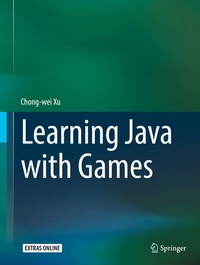
Learning Java with Games
Description

This innovative approach to teaching Java language and programming uses game design development as the method to applying concepts.
Instead of teaching game design using Java, projects are designed to teach Java in a problem-solving approach that is both a fun and effective. Learning Java with Games introduces the concepts of Java and coding; then uses a project to emphasize those ideas. It does not treat the object-oriented and procedure and loop parts of Java as two separate entities to be covered separately, but interweaves the two concepts so the students get a better picture of what Java is.
After studying a rich set of projects, the book turns to build up a "Three-layer Structure for Games" as an architecture template and a guiding line for designing and developing video games. The proposed three-layer architecture not only merges essential Java object-oriented features but also addresses loosely coupled software architecture.
More details
Other editions
Additional editions
Person
Content
2 Basics of Java programming: a project PrintXmasCard
3 Java operators: a game GuessInt in text
4 UML and its usage: a game WheelFortune in text
5 GUI programming with graphical drawing: a project PaintXmasCard
6 Software components and event handling: projects CalculatorApp and ImageSlider
8 Event driven with an update-paint chain: a game Blackjack
9 Key control: a game Sudoku
10 Mouse control: a game Agnes
11 Animation programming: a digital clock and an analog clock
12 Merge visualization, event-driven, and animation: a game WheelVideo
13 Animated sprites and collisions: a game Pong
14 Multiple screens: an extension of the game Pong
15 A three-layer software structure for games: a game PongStruTwo
16 Usage of the framework: projects SymBall and Tornado
17 Image sprite and UML state machine: a game Breakout
18 Sound effect and composite class: enriching the game Breakout
19 Dynamically changed sprite's structure: a game Worm
20 Chess-like game: a game Othello
21 An introduction of artificial intelligence: extensions of the game Othello
22 Visualizing array sorting algorithms
23 Animating conversions between binary and decimal
24 Animating binary arithmetic computations
Appendix A: References
Appendix B: The three-layer software structure for games
