

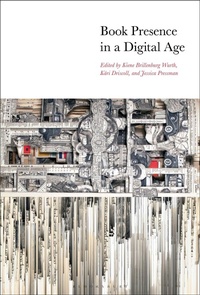
Book Presence in a Digital Age
1st Edition
Published on 28. June 2018
280 pages
978-1-5013-2119-1 (ISBN)
Description

Contrary to the apocalyptic pronouncements of paper media's imminent demise in the digital age, there has been a veritable surge of creative reimaginings of books as bearers of the literary. From typographic experiments (Mark Z. Danielewski's House of Leaves, Steven Hall's The Raw Shark Texts) to accordion books (Anne Carson's Nox), from cut ups (Jonathan Safran Foer's Tree of Codes) to collages (Graham Rawle's Woman's World), from erasures (Mary Ruefle's A Little White Shadow) to mixups (Simon Morris's The Interpretations of Dreams), print literature has gone through anything but a slow, inevitable death. In fact, it has re-invented itself materially.
Starting from this idea of media plurality, Book Presence in a Digital Age explores the resilience of print literatures, book art, and zines in the late age of print from a contemporary perspective, while incorporating longer-term views on media archeology and media change. Even as it focuses on the materiality of books and literary writing in the present, Book Presence also takes into consideration earlier 20th-century "moments" of media transition, developing the concepts of presence and materiality as analytical tools to perform literary criticism in a digital age. Bringing together leading scholars, artists, and publishers, Book Presence in a Digital Age offers a variety of perspectives on the past, present, and future of the book as medium, the complex relationship of materiality to virtuality, and of the analog to the digital.
Starting from this idea of media plurality, Book Presence in a Digital Age explores the resilience of print literatures, book art, and zines in the late age of print from a contemporary perspective, while incorporating longer-term views on media archeology and media change. Even as it focuses on the materiality of books and literary writing in the present, Book Presence also takes into consideration earlier 20th-century "moments" of media transition, developing the concepts of presence and materiality as analytical tools to perform literary criticism in a digital age. Bringing together leading scholars, artists, and publishers, Book Presence in a Digital Age offers a variety of perspectives on the past, present, and future of the book as medium, the complex relationship of materiality to virtuality, and of the analog to the digital.
Reviews / Votes
Book Presence in a Digital Age is that rare volume that reads as both the culmination and anticipation of a field. It reflexively brings together some of the most compelling critics and artists thinking about 'the book' as medium and cultural artifact - and the individual conversations, explorations, and interventions that result would have alone made for a worthy volume. But the cumulative effect is much more than this, for collectively they articulate the questions that will inform scholarship and artistic practice for some years to come. * Rita Raley, Associate Professor of English, University of California, Santa Barbara, USA * Operating in the force field between literary theory, comparative media studies, and new materialism, Book Presence in a Digital Age brims over with fresh, insightful, and nuanced explorations of the shifting contours of bookishness in the information age. By means of richly variegated points of entry, it demonstrates how print artifacts, far from hovering at the margins of the digital media ecology, have emerged as one of the defining laboratories for the elaboration of contemporary cultural forms. * Jeffrey Schnapp, Faculty Director of metaLAB, Harvard University, USA *More details
Edition
1. Auflage
Language
English
Place of publication
New York
United States
Publishing group
Bloomsbury Publishing PLC (Digital)
Target group
Professional and scholarly
Illustrations
10 color illus
ISBN-13
978-1-5013-2119-1 (9781501321191)
Copyright in bibliographic data and cover images is held by Nielsen Book Services Limited or by the publishers or by their respective licensors: all rights reserved.
Schweitzer Classification
Other editions
Additional editions
Kiene Brillenburg Wurth | Kari Driscoll | Jessica Pressman
Book Presence in a Digital Age
Book
12/2019
Bloomsbury Academic USA
€62.15
Shipment within 15-20 days
Persons
Kiene Brillenburg Wurth is Professor of Literature and Comparative Media at the University of Utrecht, the Netherlands, and project leader of the VIDI project "Back to the Book" funded by the Dutch Research Council. She is the author of Musically Sublime: Infinity, Indeterminacy, Irresolvability (2009) and the editor of Between Page and Screen: Remaking Literature Through Cinema and Cyberspace (2012).
Kari Driscoll is Assistant Professor of Comparative Literature at the University of Utrecht, the Netherlands.
Jessica Pressman is Associate Professor of English and Comparative Literature at San Diego State University, USA. She is the author of Digital Modernism: Making It New in New Media (2014), co-author (with Mark C. Marino and Jeremy Douglass) of Reading Project: A Collaborative Analysis of William Poundstone's Project for Tachistoscope {Bottomless Pit} (2015), and co-editor (with N. Katherine Hayles) of Comparative Textual Media: Transforming the Humanities in a Postprint Era (2013).
Kari Driscoll is Assistant Professor of Comparative Literature at the University of Utrecht, the Netherlands.
Jessica Pressman is Associate Professor of English and Comparative Literature at San Diego State University, USA. She is the author of Digital Modernism: Making It New in New Media (2014), co-author (with Mark C. Marino and Jeremy Douglass) of Reading Project: A Collaborative Analysis of William Poundstone's Project for Tachistoscope {Bottomless Pit} (2015), and co-editor (with N. Katherine Hayles) of Comparative Textual Media: Transforming the Humanities in a Postprint Era (2013).
Content
List of Plates
List of Figures
Notes on Contributors
1. Book Presence: An Introductory Exploration
Kiene Brillenburg Wurth (Utrecht University, the Netherlands)
I: Theory and Overview
2. Pagina Abscondita: Reading the the Book's Wake
John T. Hamilton (Harvard University, USA)
3. From Codex to Codecs
Garrett Stewart (University of Iowa, USA)
4. Bookwork and Bookishness: An Interview with Brian Dettmer and Doug Beube
Jessica Pressman (San Diego State University, USA)
Section II: Media Changes and Materiality
5. Infrathin Platforms: Print on Demand as Auto-Factography
Hannes Bajohr (Berlin's Center for Literary and Cultural Research, Germany)
6. Genre and Materiality: Autobiography and Zines
Anna Poletti (Utrecht University, the Netherlands)
7. Doing Things with Literature in the Digital Age: Italo Calvino's If on a Winter's Night a Traveller and the Material Turn in Literary Studies
Liedeke Plate (Radboud University Nijmegen, the Netherlands)
8. 'Book for Loan': S as Paradox on Media Change
Emma De Vries and Yra van Dijk (Leiden University, the Netherlands)
9. Book Presence and Feline Absence: A Conversation with Mark Z. Danielewski
Kari Driscoll (Utrecht University, the Netherlands) and Inge van de Ven (Tilburg University, the Netherlands)
Section III: Conceptual Possibilities of the Book
10. Learn to Read Differently
Simon Morris (Leeds Beckett University, UK)
11. Emoji Dick and the Eponymous Whale
Lisa Gitelman (New York University, USA)
12. The Demediation of Alphabetic Writing in Memory Palace and Fugitive Sparrows
Kiene Brillenburg Wurth (Utrecht University, the Netherlands)
13. Revisiting the Book-as-World: World-Making and Book Materiality in Only Revolutions and The Atlas
Inge van de Ven (Tilburg University, the Netherlands)
14. Books as Archives: An Interview with Ernst van Alphen
Kiene Brillenburg Wurth (Utrecht University, the Netherlands)
Index
List of Figures
Notes on Contributors
1. Book Presence: An Introductory Exploration
Kiene Brillenburg Wurth (Utrecht University, the Netherlands)
I: Theory and Overview
2. Pagina Abscondita: Reading the the Book's Wake
John T. Hamilton (Harvard University, USA)
3. From Codex to Codecs
Garrett Stewart (University of Iowa, USA)
4. Bookwork and Bookishness: An Interview with Brian Dettmer and Doug Beube
Jessica Pressman (San Diego State University, USA)
Section II: Media Changes and Materiality
5. Infrathin Platforms: Print on Demand as Auto-Factography
Hannes Bajohr (Berlin's Center for Literary and Cultural Research, Germany)
6. Genre and Materiality: Autobiography and Zines
Anna Poletti (Utrecht University, the Netherlands)
7. Doing Things with Literature in the Digital Age: Italo Calvino's If on a Winter's Night a Traveller and the Material Turn in Literary Studies
Liedeke Plate (Radboud University Nijmegen, the Netherlands)
8. 'Book for Loan': S as Paradox on Media Change
Emma De Vries and Yra van Dijk (Leiden University, the Netherlands)
9. Book Presence and Feline Absence: A Conversation with Mark Z. Danielewski
Kari Driscoll (Utrecht University, the Netherlands) and Inge van de Ven (Tilburg University, the Netherlands)
Section III: Conceptual Possibilities of the Book
10. Learn to Read Differently
Simon Morris (Leeds Beckett University, UK)
11. Emoji Dick and the Eponymous Whale
Lisa Gitelman (New York University, USA)
12. The Demediation of Alphabetic Writing in Memory Palace and Fugitive Sparrows
Kiene Brillenburg Wurth (Utrecht University, the Netherlands)
13. Revisiting the Book-as-World: World-Making and Book Materiality in Only Revolutions and The Atlas
Inge van de Ven (Tilburg University, the Netherlands)
14. Books as Archives: An Interview with Ernst van Alphen
Kiene Brillenburg Wurth (Utrecht University, the Netherlands)
Index
