

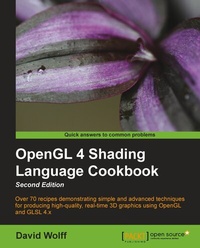
OpenGL 4 Shading Language Cookbook, Second Edition
Acquiring the skills of OpenGL Shading Language is so much easier with this cookbook. You'll be creating graphics rather than learning theory, gaining a high level of capability in modern 3D programming along the way.
2nd Edition
Published on 3. June 2024
394 pages
978-1-78216-703-7 (ISBN)
Description

Acquiring the skills of OpenGL Shading Language is so much easier with this cookbook. You ll be creating graphics rather than learning theory, gaining a high level of capability in modern 3D programming along the way.Key Features - Discover simple and advanced techniques for leveraging modern OpenGL and GLSL
- Learn how to use the newest features of GLSL including compute shaders, geometry, and tessellation shaders
- Get to grips with a wide range of techniques for implementing shadows using shadow maps, shadow volumes, and more
- Clear, easy-to-follow examples with detailed explanations and full, cross-platform source code available from GitHub
Book DescriptionOpenGL Shading Language (GLSL) is a programming language used for customizing parts of the OpenGL graphics pipeline that were formerly fixed-function, and are executed directly on the GPU. It provides programmers with unprecedented flexibility for implementing effects and optimizations utilizing the power of modern GPUs. With Version 4, the language has been further refined to provide programmers with greater power and flexibility, with new stages such as tessellation and compute. OpenGL 4 Shading Language Cookbook provides easy-to-follow examples that first walk you through the theory and background behind each technique, and then go on to provide and explain the GLSL and OpenGL code needed to implement it. Beginner level through to advanced techniques are presented including topics such as texturing, screen-space techniques, lighting, shading, tessellation shaders, geometry shaders, compute shaders, and shadows. OpenGL Shading Language 4 Cookbook is a practical guide that takes you from the fundamentals of programming with modern GLSL and OpenGL, through to advanced techniques. The recipes build upon each other and take you quickly from novice to advanced level code. You'll see essential lighting and shading techniques; examples that demonstrate how to make use of textures for a wide variety of effects and as part of other techniques; examples of screen-space techniques including HDR rendering, bloom, and blur; shadowing techniques; tessellation, geometry, and compute shaders; how to use noise effectively; and animation with particle systems. OpenGL Shading Language 4 Cookbook provides examples of modern shading techniques that can be used as a starting point for programmers to expand upon to produce modern, interactive, 3D computer graphics applications.What you will learn - Compile, debug, and communicate with shader programs
- Use new features of GLSL 4 such as subroutines, sampler objects, and uniform blocks
- Implement core lighting and shading techniques such as diffuse and specular shading, per-fragment shading, and spotlights
- Use textures for a variety of effects including cube maps for reflection or refraction
- Implement screen-space techniques such as HDR, bloom, blur filters, order-independent transparency, and deferred shading
- Utilize noise in shaders
- Use shaders for animation
- Make use of compute shaders for physics, animation, and general computing
- Learn how to use new OpenGL features such as shader storage buffer objects, and image load/store
Who this book is forThis book is for OpenGL programmers looking to use the modern features of GLSL 4 to create real-time, three-dimensional graphics. Familiarity with OpenGL programming, along with the typical 3D coordinate systems, projections, and transformations is assumed. It can also be useful for experienced GLSL programmers who are looking to implement the techniques that are presented here.
- Learn how to use the newest features of GLSL including compute shaders, geometry, and tessellation shaders
- Get to grips with a wide range of techniques for implementing shadows using shadow maps, shadow volumes, and more
- Clear, easy-to-follow examples with detailed explanations and full, cross-platform source code available from GitHub
Book DescriptionOpenGL Shading Language (GLSL) is a programming language used for customizing parts of the OpenGL graphics pipeline that were formerly fixed-function, and are executed directly on the GPU. It provides programmers with unprecedented flexibility for implementing effects and optimizations utilizing the power of modern GPUs. With Version 4, the language has been further refined to provide programmers with greater power and flexibility, with new stages such as tessellation and compute. OpenGL 4 Shading Language Cookbook provides easy-to-follow examples that first walk you through the theory and background behind each technique, and then go on to provide and explain the GLSL and OpenGL code needed to implement it. Beginner level through to advanced techniques are presented including topics such as texturing, screen-space techniques, lighting, shading, tessellation shaders, geometry shaders, compute shaders, and shadows. OpenGL Shading Language 4 Cookbook is a practical guide that takes you from the fundamentals of programming with modern GLSL and OpenGL, through to advanced techniques. The recipes build upon each other and take you quickly from novice to advanced level code. You'll see essential lighting and shading techniques; examples that demonstrate how to make use of textures for a wide variety of effects and as part of other techniques; examples of screen-space techniques including HDR rendering, bloom, and blur; shadowing techniques; tessellation, geometry, and compute shaders; how to use noise effectively; and animation with particle systems. OpenGL Shading Language 4 Cookbook provides examples of modern shading techniques that can be used as a starting point for programmers to expand upon to produce modern, interactive, 3D computer graphics applications.What you will learn - Compile, debug, and communicate with shader programs
- Use new features of GLSL 4 such as subroutines, sampler objects, and uniform blocks
- Implement core lighting and shading techniques such as diffuse and specular shading, per-fragment shading, and spotlights
- Use textures for a variety of effects including cube maps for reflection or refraction
- Implement screen-space techniques such as HDR, bloom, blur filters, order-independent transparency, and deferred shading
- Utilize noise in shaders
- Use shaders for animation
- Make use of compute shaders for physics, animation, and general computing
- Learn how to use new OpenGL features such as shader storage buffer objects, and image load/store
Who this book is forThis book is for OpenGL programmers looking to use the modern features of GLSL 4 to create real-time, three-dimensional graphics. Familiarity with OpenGL programming, along with the typical 3D coordinate systems, projections, and transformations is assumed. It can also be useful for experienced GLSL programmers who are looking to implement the techniques that are presented here.
All prices
More details
Other editions
Additional editions
David Wolff
OpenGL 4 Shading Language Cookbook
Acquiring the skills of OpenGL Shading Language is so much easier with this cookbook. You'll be creating graphics rather than learning theory, gaining a high level of capability in modern 3D programming along the way.
Book
12/2013
2nd Edition
Packt Publishing
€69.80
Shipment within 3-4 weeks
Persons
Wolff David :
David Wolff is a professor in the computer science department at Pacific Lutheran University (PLU). He received a PhD in Physics and an MS in computer science from Oregon State University. He has been teaching computer graphics to undergraduates at PLU for over 17 years, using OpenGL.
David Wolff is a professor in the computer science department at Pacific Lutheran University (PLU). He received a PhD in Physics and an MS in computer science from Oregon State University. He has been teaching computer graphics to undergraduates at PLU for over 17 years, using OpenGL.
Content
Table of Contents - Getting Started with GLSL 4.0
- The Basics of GLSL Shaders
- Lighting, Shading, and Optimizations
- Using Textures
- Image Processing, Screen Space Techniques, and Alternate Rendering Techniques
- Using Geometry and Tessellation Shaders
- Shadows
- Using Noise in Shaders
- Animation and Particles
- Compute Shaders
- The Basics of GLSL Shaders
- Lighting, Shading, and Optimizations
- Using Textures
- Image Processing, Screen Space Techniques, and Alternate Rendering Techniques
- Using Geometry and Tessellation Shaders
- Shadows
- Using Noise in Shaders
- Animation and Particles
- Compute Shaders

