

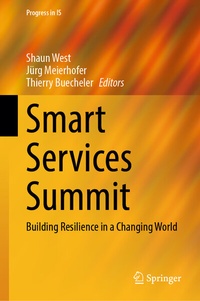
Smart Services Summit
Description

This book presents up-to-date descriptions of Smart Services Innovations in industry, supported by new scientific approaches. It summarizes the outcomes of the fifth Smart Services Summit, held in Zurich in October 2023, which primarily focused on the ability of Smart Service Systems to support resilience and build sustainability.
As the evolution of Smart Services accelerates, new technologies can be leveraged to create new value propositions and business models that deliver tangible sustainability outcomes. This book addresses social, economic, and environmental aspects of sustainability in connection with new technologies and includes papers on how these technologies can help achieve resilience and sustainability. In this context, topics such as sustainability and resilience in supply chains, X-as-a-Service, large language models for service automation, and location-based systems are discussed.
Given its scope, the book represents an indispensable guide for practitioners and advanced students alike.
More details
Other editions
Additional editions
Persons
Shaun West lectures in Smart Service Innovation at Lucerne University of Applied Sciences and Arts (Switzerland). In this role, he works closely with industry to better understand the application and development of Smart Services in industrial settings. He collaborates with several universities, including Stanford, Aston Business School, Florence, and Bergamo. He is also coordinating a Swiss 1MUSD project on the use of Smart Twins in complex industrial applications. Having previously worked for GE Energy Services (Italy), as VP Business Development at Sulzer (Switzerland), and for RWE (UK), Shaun holds an M.B.A. from HEC (Paris) and a Ph.D. from Imperial College London.
Jürg Meierhofer holds a Ph.D. from ETH Zurich and an Executive M.B.A. from the University of Fribourg (Switzerland). He is the director of studies for Smart Service Engineering at Zurich University of Applied Sciences (ZHAW) and the head of the Smart Services Group at the data innovation alliance. The optimization and design of Smart Services are hallmarks of his activities in various industries. He is currently the director of studies for executive education in the field of Smart Service Engineering and Industry 4.0 at ZHAW.
Thierry Buecheler is the head of the Business Value & Strategy team at Oracle EMEA, where he spearheads strategic initiatives and delivers exceptional management consulting services. He has extensive experience at the interface of business and IT in several sectors and industries: Before joining Oracle, he was an engagement manager at McKinsey & Company in Europe, North America, and Africa and a visiting researcher at NEC Tokyo, Japan. Before that, he worked for two Swiss banks in the IT and strategy departments. He holds a Ph.D. in Computer Science/Artificial Intelligence from the University of Zurich and an M.Sc. in Computer Science from ETH Zurich, Switzerland.
Content
- Intro
- Foreword
- Preface
- About the Summit
- Contents
- Editors and Contributors
- Smart Services and Resilience
- Using Synthetic Data for Improving Robustness and Resilience in ML-Based Smart Services
- 1 Introduction
- 2 Synthetic Data
- 3 An Architecture for Robustness in Smart Services
- 4 Experiments
- 5 Conclusion
- References
- Sustainable Smart Services for Financial Institutions: Evaluation of ESG Service Creation Framework Applicability for Practitioners
- 1 Introduction
- 2 ESG Service Creation Framework
- 3 Methodology
- 4 Results of the Interviews
- 5 Insights and Reflections
- 6 Demonstration: ESG Readiness Assessment for SMEs
- 7 Conclusion and Outlook
- References
- Quantitative Models for Sustainable Smart Services in the Building Industry
- 1 Introduction
- 2 Methodology
- 3 Literature
- 3.1 Potential of Smart Services
- 3.2 Smart Building
- 3.3 B2B Platforms
- 3.4 Quantification of Economic and Environmental Value
- 4 Results
- 4.1 User Analysis
- 4.2 Quantitative Assessment of the Economic and Environmental Service Value Creation
- 4.3 Calculation Example
- 4.4 Environmental Dimension
- 5 Discussion
- 6 Conclusion, Limitations and Future Research
- References
- Interrelation Between Resilience and Sustainability in Smart Service Systems
- 1 Introduction
- 2 Literature Review
- 2.1 Measuring Sustainability in Manufacturing Systems
- 2.2 Measuring Resilience in Manufacturing Systems
- 2.3 Relationship Between Resilience and Sustainability
- 2.4 Case Studies of Smart Services
- 3 Research Design
- 3.1 Research Methods
- 4 Discussions
- 4.1 Assessment of Case Study Companies Based on Sustainability Aspects and Resilience Factors
- 4.2 Analysis and Recommendations of the Case Study Companies
- 4.3 Relationship Between Sustainability and Resilience
- 5 Conclusion, Limitations and Scope for Future Research
- 5.1 Conclusion
- 5.2 Limitations
- 5.3 Scope for Future Research
- References
- Building Supply Chain Resilience Using Artificial Intelligence in Risk Management Systems
- 1 Introduction
- 2 Literature Review
- 2.1 Risk Definition
- 2.2 Supply Chain Risk Management (SCRM)
- 2.3 Bow Tie Risk Framework
- 2.4 Introduction to Artificial Intelligence in SCRM
- 3 Research Methodology
- 4 Results
- 4.1 Gaps in Bow-Tie Risk Framework
- 4.2 Need for Artificial Intelligence Based on Risk Type
- 4.3 Relevance of AI in the Risk Management Systems
- 5 Discussions
- 5.1 Building Risk Management System Using Enhanced Bow-Tie Risk Framework
- 5.2 Guidance to Businesses
- 6 Conclusions, Limitations, and Future Research
- 6.1 Conclusions
- 6.2 Limitations
- 6.3 Future Research
- References
- Discovering Dynamic Resiliency in Organizations
- 1 Introduction and Motivation
- 2 State of Art and Next Steps
- 2.1 Resiliency in Organizations as a Multi-disciplinary Concept
- 2.2 Nudges from Contingency Theories for a 'System View'
- 3 Re-interpreting Resilience: A Personal and Contextual View of 'Resiliency'
- 3.1 The Contribute of Systems Thinking
- 4 Resiliency in Organizations
- 4.1 Is It De Facto Dynamic?!
- 4.2 The Role of Structural Pre-conditions and Systems Determinants
- 5 Findings, Implications and First Conclusions
- References
- Resilient and Value Creating Wine Ecosystem: An NFT-Driven Agricultural Digital Twin Case Study with #NFGrapevine
- 1 Introduction
- 1.1 Research Questions
- 2 Background
- 2.1 Web3
- 2.2 Internet of Things
- 2.3 Digital Twin
- 3 Methodology
- 3.1 Analysis of Current State
- 4 Results
- 4.1 The #NFG Ecosystem
- 4.2 Data to Value Stream
- 4.3 Recommended Actions
- 5 Discussion
- 6 Conclusion, Limitations, and Future Research
- 6.1 Academic Implications
- 6.2 Managerial Considerations
- References
- Contribution Model Ecosystem for Resiliency and Sustainability
- 1 Introduction
- 2 Literature Review
- 2.1 Contribution Model Framework and Ecosystem
- 2.2 Contribution Model Ecosystem
- 3 Methodology
- 4 Results
- 4.1 Case Study 1: Sustainable Building Practices
- 4.2 Case Study 2: Sustainable Food Supply Chain
- 4.3 Case Study 3: Long-Life Electrical Assets
- 4.4 Case Study 4: Sustainable Urban Mobility
- 5 Discussion
- 5.1 Contribution Model to Support Sustainability
- 5.2 Managerial Implications
- 5.3 Theoretical Implications
- 6 Conclusions, Limitations, and Future Research
- References
- Innovative Business Models and Systems
- Towards a Taxonomy of Large Language Model Based Business Model Transformations
- 1 Introduction
- 2 Theoretical Background
- 2.1 Business Model Transformation
- 2.2 The Economic Value of Large Language Models
- 3 Research Methodology
- 4 Results
- 4.1 New Customer Benefits
- 4.2 New Sales and Communication Channels
- 4.3 Increased Business Process Automation
- 4.4 Improved Use of Information Resource
- 4.5 Business Model Viability
- 5 Discussion
- 5.1 Contribution to Theory
- 5.2 Contribution to Practice
- 6 Conclusion
- References
- Four Scenarios for Future of Outcome-Based Contracts
- 1 Introduction
- 2 Uncertainty in OBC Futures
- 3 Methodology
- 4 Four Scenarios for Future of OBCs
- 5 Discussion
- 6 Conclusions, Limitations, and Future Research
- Appendix 1: Participants of the Disaggregate Delphi
- Appendix 2: Futures Table for Industrial Equipment OBCs in 2033
- References
- The Role of Strategic and Learning Orientation in Creating Competitive Advantage Through Digital Service Innovation
- 1 Introduction
- 2 Theoretical Background
- 2.1 Strategic and Learning Orientation to Drive Innovation Capabilities
- 2.2 Digital Service Innovation to Drive Manufacturer Performance
- 3 Conceptual Framework Development and Results
- 3.1 Cultural Antecedents of Digital Service Innovation
- 3.2 Consequences of Digital Service Innovation
- 4 Contributions and Research Opportunities
- 4.1 Theoretical Contributions
- 4.2 Managerial Contributions
- 4.3 Research Opportunities
- References
- Reflections for Innovation Management from the Design of a Service Platform Offer in Rail Freight
- 1 Introduction
- 2 Literature Review
- 3 Methodology
- 4 Results
- 4.1 Initial Innovation Process
- 4.2 Actual Innovation Process
- 5 Discussion
- 5.1 Key Lessons from the Case
- 5.2 Development Process
- 5.3 Managerial Relevance
- 5.4 Academic Implications
- 6 Conclusions and Future Research
- References
- Monetization Roadmap for Digital Services in Product-Service Systems: Insights and Challenges from a Case Study
- 1 Introduction
- 2 Literature Review
- 2.1 Advanced Services in PSS
- 2.2 Revenue Models in PSS
- 3 Methodology
- 4 Results and Discussion
- 4.1 Service Scoping
- 4.2 Testing
- 4.3 Service and Product Distinction
- 4.4 Individuality in the Service Offers
- 4.5 Monetization Roadmap
- 4.6 Academic Implications
- 5 Conclusion
- References
- Digital Twins and System Integration
- How Teams Use Tangible Prototypes to Move from Future Speculation to Decisions When Developing Resilient Product-Service Systems
- 1 Introduction
- 2 Theoretical Background
- 3 Research Methodology
- 4 Results
- 4.1 Rapid Embodiment of Complex Scenarios
- 4.2 Bounding Complexity into Simple Objects
- 4.3 Rapid Iteration and Concept Exchange
- 4.4 Defining Boundaries of Opportunity and Invention Space
- 5 Discussion and Implications
- 6 Conclusions
- References
- Moving Towards Smart Visualization for Smart City Services: A Systematic Literature Review in Earthquake Engineering
- 1 Introduction
- 1.1 Motivation
- 1.2 Approach
- 2 Research Methodology
- 3 Results
- 4 Discussion
- 5 Conclusion
- References
- The Smart Factory as an Operational Asset-Use of Visual Twins to Improve Factory Operational Performance
- 1 Introduction
- 2 Literature Review
- 2.1 Operational Improvement
- 2.2 The Digital Twin
- 2.3 Augmented Reality and Gamification for Better Decision-Making
- 3 Methodology
- 4 Results
- 4.1 Inventory Reduction in Engineered-To-Order Production
- 4.2 Factory Footprint Optimization for Manufacture-To-Order Production
- 5 Discussion
- 5.1 Academic Implications
- 5.2 Managerial Implications
- 6 Conclusion
- References
- Enhancing Energy Flexibility via Product-Service Systems: An Analysis of Dishwasher Usage with Renewable Integration at HSB Living Lab+
- 1 Introduction
- 2 Literature Review
- 3 Methodology
- 3.1 Overall Methodology
- 3.2 HSB Living Lab+ Case Study
- 3.3 Three Scenarios of PSS
- 3.4 PSS Sustainability Multi Criteria Assessment
- 4 Results
- 4.1 Scenario 1: Product as Usual (PAU)
- 4.2 Scenario 2: PSS 1-Product with Screen-Based Interface
- 4.3 Scenario 3: PSS 2-Product with QR Code-Based Web Interface
- 4.4 PSS Sustainability Assessment
- 5 Discussion
- 6 Conclusion
- References
- Leveraging User-Centricity for OEMs Through Product, Software, and Service Development
- 1 Introduction
- 2 Services in the Realm of OEMs of Complex Hardware
- 3 Relevant Questions for Product and Software Development from a Digital Servitization Perspective
- 4 Interdependencies Between Product, Service, and Software
- 5 Service Design in Digital Servitization
- 6 Conclusion
- References
- Extended Abstracts and Posters
- Automatic Transcription of the Basic MTM-2 Motions in Virtual Reality
- 1 Introduction
- 2 Methodology
- 3 Findings
- 4 Conclusion, Limitations, and Future Research
- References
- Critical Evaluation of Full Droneload (FDL) and Less-Than Droneload (LDL) in Drone-Based Last Mile Delivery
- 1 Introduction and Background
- 2 Parcel, LTL, FTL
- 3 Parcel, LDL, FDL
- 4 Conclusion
- References
- Strengthening Customer Loyalty and Enhancing Resilience via Self-Service
- 1 Introduction
- 2 Theoretical Background
- 3 Research Methodology
- 4 Findings
- 5 Conclusions, Limitations, and Future Research
- References
- An Intelligent Personal Digital Assistant for Financial Inclusion-Exploratory Research on the Design of the Ecosystem
- 1 Introduction
- 1.1 Service System Engineering
- 1.2 Behavioural Change
- 1.3 Ecosystems and Nudging
- 2 Methodology
- 3 Findings
- 4 Conclusions, Future Research and Limitations
