

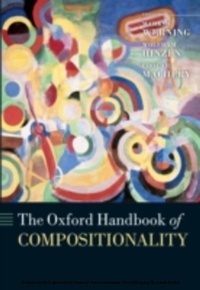
The Oxford Handbook of Compositionality
1st Edition
Published on 9. February 2012
765 pages
978-0-19-163329-4 (ISBN)
Description

In this book leading scholars from every relevant field report on all aspects of compositionality, the notion that the meaning of an expression can be derived from its parts. Understanding how compositionality works is a central element of syntactic and semantic analysis and a challenge for models of cognition. It is a key concept in linguistics and philosophy and in the cognitive sciences more generally, and is without question one of the most exciting fields in the study of language and mind. The authors of this book report critically on lines of research in different disciplines, revealing the connections between them and highlighting current problems and opportunities.
The force and justification of compositionality have long been contentious. First proposed by Frege as the notion that the meaning of an expression is generally determined by the meaning and syntax of its components, it has since been deployed as a constraint on the relation between theories of syntax and semantics, as a means of analysis, and more recently as underlying the structures of representational systems, such as computer programs and neural architectures. The Oxford Handbook of Compositionality explores these and many other dimensions of this challenging field. It will appeal to researchers and advanced students in linguistics and philosophy and to everyone concerned with the study of language and cognition including those working in neuroscience, computational science, and bio-informatics.
More details
Other editions
Additional editions
Markus Werning | Wolfram Hinzen | Edouard Machery
The Oxford Handbook of Compositionality
Book
02/2012
1st Edition
Oxford University Press
€213.80
Shipment within 15-20 days
Persons
Markus Werning is Professor of Philosophy of Language and Cognition at the Ruhr University of Bochum. He is author of the book The Compositional Brain: Neuronal Foundations of Conceptual Representation (Mentis, 2010).
Wolfram Hinzen is Professor of Philosophy of Language at the University of Durham. His books include Mind Design and Minimal Syntax and An Essay on Names and Truth (OUP, 2006, 2007).
Edouard Machery is Associate Professor in the History and Philosophy of Science Department at the University of Pittsburgh. His book Doing without Concepts was published by OUP in 2009.
Content
- Introduction
- Part I: History and Overview
- 1: Theo Janssen: Compositionality: Its Historic Context
- 2: Marcus Kracht: Compositionality in Montague Grammar
- 3: Zoltan Szabo: The Case for Compositionality
- 4: Ede Zimmermann: Compositionality Problems and How to Solve Them
- Part II: Compositionality in Language
- 5: Sebastian Löbner: Sub-Compositionality
- 6: Pauline Jacobson: Direct Compositionality
- 7: Jeff Pelletier: Holism and Compositionality
- 8: Francois Recanati: Compositionality, Flexibility, and Context-dependence
- 9: Dag Westerstahl: Compositionality in Kaplan Style Semantics
- 10: Paul Pietroski: Semantic Monadicity with Conceptual Polyadicity
- Part III: Compositionality in Formal Semantics
- 11: Wilfrid Hodges: Formalising the Relationship Between Meaning and Syntax
- 12: Tim Fernando: Compositionality in Discourse From a Logical Perspective
- 13: Gabriel Sandu: Compositionality and the Context Principle
- Part IV: Lexical Decomposition
- 14: Dieter Wunderlich: Lexical Decomposition in Grammar
- 15: Wolfram Hinzen: Syntax in the Atom
- 16: Heidi Harley: Lexical Decomposition in Modern Syntactic Theory
- 17: James Pustejovsky: Co-compositionality
- Part V: The Compositionality of Mind
- 18: Lila Gleitman,Andrew Connolly, and Sharon L. Armstrong: Can Prototype Representations Support Composition and Decomposition?
- 19: James Hampton and Martin Jönsson: Typicality and Compositionality: The Logic of Combining Vague Concepts
- 20: Edward Wisniewski and Jing Wu: Emergency!!! Challenges to a Compositional Understanding of Noun-noun Combinations
- 21: Edouard Machery and Lisa Lederer: Simple Heuristics for Concept Combination
- 22: Jesse Prinz: Regaining Composure: A Defense of Prototype Compositionality
- Part VI: Evolutionary and Communicative Success of Compositional Structures
- 23: Gerhard Schurz: Prototypes and their Composition from an Evolutionary Point of View
- 24: Kenny Smith and Simon Kirby: Compositionality and Linguistic Evolution
- 25: Michael Arbib: Compositionality and Holophrasis: From Action and Perception Through Protolanguage to Language
- 26: Peter Pagin: Communication and the Complexity of Semantics
- Part VII: Neural Models fo Compositional Representation
- 27: Terry Horgan: Connectionism, Dynamical Cognition, and Non-Classical Compositional Representation
- 28: Martina Penke: The Dual-Mechanism Debate
- 29: Terrence Stewart and Chris Eliasmith: Compositionality and Biologically Plausible Models
- 30: Andreas K. Engel and Alexander Maye: Neural Assemblies, the Binding Problem, and Neural Synchrony
- 31: Markus Werning: Non-symbolic Compositional Representation and Its neuronal Foundation: Towards an Emulative Semantics
- 32: Giosue Baggio, Michiel van Lambalgen, and Peter Hagoort: The Processing Consequences of Compositionality
- Appendix
- References
- Index
