

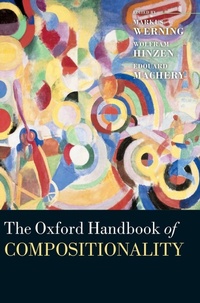
The Oxford Handbook of Compositionality
1st Edition
Published on 9. February 2012
Book
Hardback
766 pages
978-0-19-954107-2 (ISBN)
Description
In this book leading scholars from every relevant field report on all aspects of compositionality, the notion that the meaning of an expression can be derived from its parts. Understanding how compositionality works is a central element of syntactic and semantic analysis and a challenge for models of cognition. It is a key concept in linguistics and philosophy and in the cognitive sciences more generally, and is without question one of the most exciting fields in the study of language and mind. The authors of this book report critically on lines of research in different disciplines, revealing the connections between them and highlighting current problems and opportunities.
The force and justification of compositionality have long been contentious. First proposed by Frege as the notion that the meaning of an expression is generally determined by the meaning and syntax of its components, it has since been deployed as a constraint on the relation between theories of syntax and semantics, as a means of analysis, and more recently as underlying the structures of representational systems, such as computer programs and neural architectures. The Oxford Handbook of Compositionality explores these and many other dimensions of this challenging field. It will appeal to researchers and advanced students in linguistics and philosophy and to everyone concerned with the study of language and cognition including those working in neuroscience, computational science, and bio-informatics.
The force and justification of compositionality have long been contentious. First proposed by Frege as the notion that the meaning of an expression is generally determined by the meaning and syntax of its components, it has since been deployed as a constraint on the relation between theories of syntax and semantics, as a means of analysis, and more recently as underlying the structures of representational systems, such as computer programs and neural architectures. The Oxford Handbook of Compositionality explores these and many other dimensions of this challenging field. It will appeal to researchers and advanced students in linguistics and philosophy and to everyone concerned with the study of language and cognition including those working in neuroscience, computational science, and bio-informatics.
Reviews / Votes
The editors should be commended for also having the vision to create a forward-looking volume that highlights both current debates in the field as well as speculative theoretical questions that will likely shape and direct future research endeavors in the years to come. The editors did an excellent job of bringing together academics with various, diverse specializations to contribute to a volume with such a broad scope of coverage...this volume and its contents will undoubtedly have a high impact in various fields of language science for years to come. * Linguist List *More details
Series
Language
English
Place of publication
Oxford
United Kingdom
Target group
College/higher education
Researchers and advanced students in linguistics and philosophy; everyone concerned with the study of language and cognition, including those working in neuroscience, computational science, and bio-informatics.
Dimensions
Height: 250 mm
Width: 175 mm
Thickness: 45 mm
Weight
1477 gr
ISBN-13
978-0-19-954107-2 (9780199541072)
Copyright in bibliographic data and cover images is held by Nielsen Book Services Limited or by the publishers or by their respective licensors: all rights reserved.
Schweitzer Classification
Other editions
Additional editions
Markus Werning | Wolfram Hinzen | Edouard Machery
The Oxford Handbook of Compositionality
E-Book
02/2012
1st Edition
OUP eBook
€82.99
Available for download
Markus Werning | Wolfram Hinzen | Edouard Machery
The Oxford Handbook of Compositionality
E-Book
02/2012
1st Edition
OUP eBook
€82.99
Available for download
Persons
Markus Werning is Professor of Philosophy of Language and Cognition at the Ruhr University of Bochum. He is author of the book The Compositional Brain: Neuronal Foundations of Conceptual Representation (Mentis, 2010).
Wolfram Hinzen is Professor of Philosophy of Language at the University of Durham. His books include Mind Design and Minimal Syntax and An Essay on Names and Truth (OUP, 2006, 2007).
Edouard Machery is Associate Professor in the History and Philosophy of Science Department at the University of Pittsburgh. His book Doing without Concepts was published by OUP in 2009.
Wolfram Hinzen is Professor of Philosophy of Language at the University of Durham. His books include Mind Design and Minimal Syntax and An Essay on Names and Truth (OUP, 2006, 2007).
Edouard Machery is Associate Professor in the History and Philosophy of Science Department at the University of Pittsburgh. His book Doing without Concepts was published by OUP in 2009.
Content
PART I: HISTORY AND OVERVIEW; PART II: COMPOSITIONALITY IN LANGUAGE; PART III: COMPOSITIONALITY IN FORMAL SEMANTICS; PART IV: LEXICAL DECOMPOSITION; PART V: THE COMPOSITIONALITY OF MIND; PART VI: EVOLUTIONARY AND COMMUNICATIVE SUCCESS OF COMPOSITIONAL STRUCTURES; PART VII: NEURAL MODELS FO COMPOSITIONAL REPRESENTATION