

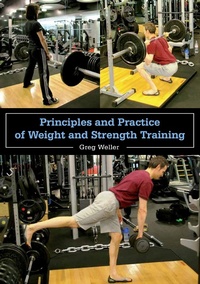
Principles and Practice of Weight and Strength Training
Published on 30. June 2013
160 pages
978-1-84797-629-1 (ISBN)
Description

The practical application of exercise theory by strength and conditioning coaches the world over has helped develop exercise research knowledge into effective training methods. Principles and Practice of Weight and Strength Training will cover how to properly prepare yourself for your chosen sport or activity by increasing strength.It examines the following: Common postural problems and how to improve posture; Techniques for self-myofascial release; A wide range of mobility and stability exercises, shown through step-by-step colour photography; More advanced weight and core exercises for the improving athlete; Implementing effective training programmes. Principles and Practice of Weight and Strength Training will help people make sure they train effectively, reduce injuries, improve their performance and enjoyment, and not waste time and effort on poor practice.'I owe Greg Weller my career. He is by far the best strength and conditioning coach I have ever had the pleasure of working with, in or outside of professional rugby.' Dan Smith, Professional Rugby Player, Doncaster Knights, Bath Rugby, England U21s. A practical guide to how to properly prepare yourself for your chosen sport by increasing strength, aimed at athletes and those supplementing their training in specific sports. Superbly illustrated with 230 step-by-step colour photographs. Greg Weller has been involved in sport and the fitness industry for over twenty years.
More details
Other editions
Additional editions
Book
06/2013
The Crowood Press Ltd
€36.08
Shipment within 15-20 days
Content
- Intro
- Principles and Practice of weight and strength Training
- Acknowledgements
- CONTENTS
- INTRODUCTION
- CHAPTER 1 POSTURE
- Healthy Posture
- Common Postural Dysfunctions
- Rounded Shoulders
- Anterior Pelvic Tilt
- Foot Pronation or Eversion
- Pelvic and Spinal Awareness
- Quadruped Spine Mobilizer
- Bird Dog
- CHAPTER 2 TRAINING PREPARATION/WARM-UP PHASE
- An Effective Warm-Up
- A Note on Static Stretching
- The Four Stages of the Warm-Up
- Stage One: SMR (Self Myofascial Release)
- Stage Two: Mobility and Stability
- Stage Three: Pre-Activation
- Stage Four: Specific Activation
- CHAPTER 3 STRENGTH TRAINING
- Why You Need to be Strong
- Benefits of Strength Training
- Adaptations to Strength Training
- Neural Adaptations
- Morphological Adaptations
- Types of Strength
- Isometric Strength
- Eccentric Strength
- Concentric Strength
- Maximum Strength
- Relative Strength
- Starting Strength
- Explosive Strength
- Plyometric or Reactive Strength
- Strength Endurance
- Strength-Speed and Speed-Strength
- Strength is a Skill
- Do Not Train to Failure
- Train on Your Feet
- Keep Training Sessions Under an Hour
- Fuzzy Training (Grey Areas)
- How Strong Do You Need To Be?
- CHAPTER 4 THE TORSO OR 'CORE TRAINING'
- Maintaining Posture and Stability
- Abdominal Bracing
- Exercises for the Core
- Floor Exercises
- Stability Ball Exercises
- Roll-Outs
- Kneeling Stability Ball Roll-Outs
- Cable Exercises
- CHAPTER 5 DOUBLE-LEG MOVEMENTS
- Body-Weight Squats
- Reverse Pattern Squats
- Goblet Squats
- Back Squats with a Bar
- A Note on Abdominal Bracing
- Common Errors and Correction
- Squat Depth
- Too Much Weight on the Toes
- Lateral Weight Shift
- Knees Collapsing In
- Rounding the Back
- Front Squats with a Bar
- Overhead Squats
- Dead Lifts
- Olympic Bar Dead Lift
- Sumo Dead Lift
- Stiff-Leg Dead Lift
- Developing Strength in the Posterior Chain
- Pull-Through
- Hip Thrusts
- CHAPTER 6 SINGLE-LEG MOVEMENTS
- Split Squats
- Basic Technique
- Errors and Correction
- Rear Foot Elevated Split Squats (RFESS)
- Step-Ups
- Basic Technique
- Lateral Step-Ups
- Lunges
- Reverse Lunge Technique
- Errors and Correction
- Forward Lunge Technique
- Walking Lunges
- Lateral Lunges
- Single-Leg Stiff-Leg Dead Lift
- Single-Leg Squat
- Basic Technique
- Single-Leg Squat Variation
- Errors and Correction
- CHAPTER 7 VERTICAL AND HORIZONTAL PULLING
- Vertical Pulling
- Neutral-Grip Pull-Ups
- Supinated-Grip Pull-Ups or Chins
- Pronated-Grip Pull-Ups
- Developing the Strength
- Weighted Pull-Ups
- Errors and Correction
- Horizontal Pulling
- Inverted Rows
- Barbell/Dumbbell Rows
- Standing Cable Rows
- Bench Dumbbell Rows
- Single-Arm Rows
- CHAPTER 8 VERTICAL AND HORIZONTAL PUSHING
- Vertical Pushing
- Standing Barbell Press
- Errors and Correction
- Standing Dumbbell Press
- Single-Arm Press
- Horizontal Pushing
- Press-Ups
- Press-Up Progressions
- Suspension-System Press-Ups
- One-Arm Press-Ups
- Dumbbell Chest Press
- CHAPTER 9 PLANNING TRAINING
- At The Beginning
- Preparation
- A Simple Programme
- A More Advanced Programme
- Techniques
- Clusters
- Wave Loading
- BIBLIOGRAPHY
- INDEX
