

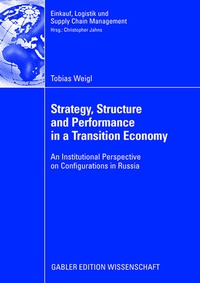
Strategy, Structure and Performance in a Transition Economy
An Institutional Perspective on Configurations in Russia
1st Edition
Published on 26. August 2008
XXII, 385 pages
978-3-8350-5562-9 (ISBN)
Description

st Since the beginning of the 21 century, three key business trends have been identified with a pronounced influence on future microeconomic and macroeconomic developments across the globe: Firstly, with the advent of the network economy, int- organizational relations and structures are increasingly becoming the object of analysis. Successful companies have extended the concept of an appropriate organizational structure beyond internal relationships to those spanning across the entire business network by taking the country specific institutional context into consideration. Secondly, with slowing growth in the developed markets and abundant growth opportunities in the developing economies, companies are turning to these markets for new business expansion. Finally, during the last number of years, so called 'emerging giants', which are strong local players from developing economies, have started to globalize and to expand into the developed markets. Among other reasons, these firms have edged themselves into the limelight by maintaining the right fit between their strategy type and inter-organizational structures in their home markets.
More details
Series
Language
English
Place of publication
Wiesbaden
Germany
Publishing group
Betriebswirtschaftlicher Verlag Gabler
Target group
Professional and scholarly
Illustrations
XXII, 385 p.
File size
8,47 MB
ISBN-13
978-3-8350-5562-9 (9783835055629)
DOI
10.1007/978-3-8350-5562-9
Schweitzer Classification
Other editions
Additional editions
Tobias Weigl
Strategy, Structure and Performance in a Transition Economy
An Institutional Perspective on Configurations in Russia
Book
02/2008
1st Edition
Springer Gabler
€53.49
Shipment within 10-15 days
Persons
Dr. Tobias Weigl promovierte bei Prof. Dr. Christopher Jahns am Supply Management Institute der European Business School (ebs) in Oestrich-Winkel. Er ist als Business Development Manager Emerging Markets bei DHL tätig.
Content
Basics on Strategy, Structure and Environment.- Russia as a Major Transition Economy.- Theoretical Framework and Hypotheses.- Empirical data.- Empirical analysis of the theoretical model.- Conclusion.
5 Empirical Data (S. 177-178)
This chapter introduces the empirical data used in this dissertation. First, the data gathering process is described in Chapter 5.1. Following this, an overview of the sample is provided in Chapter 5.2. Then, a descriptive analysis of the status quo and trends of Russia's business environment is performed in Chapter 5.3. Here, possible insights on the future development of Russia are provided with particular focus on its business environment. Finally, the operationalization of the constructs is discussed in Chapter 5.4.
5.1 Data Gathering
To complement the extensive literature review, several interviews with experts are conducted in order to gain a better overall understanding of the topic, both from a theoretical as well as from a practical perspective. The interviews are conducted with a group of seven management directors and management professors. The interviews are based on a relatively open scheme, but cover a few pre-defined topics.54 Naturally, these interviews are not sufficient to make substantive, quantitative assessments, or to draw conclusions about the population (e.g. Dillmann, 2002). Thus, they are not suited for validating the theoretical model. However, they serve to determine important dimensions, which later require more in-depth investigation. For this purpose, a standardized55 questionnaire has been used in order to generate an extensive database in line with the goals of this dissertation.
The standardized questionnaire, in English and Russian, includes classification questions (seven point metric scale). The Russian version has been translated back into English by an independent source to ensure comparability of the two versions. The questionnaire contains six sections:
(1) General questions about the firm: In the first section, the respondents are asked to provide general information about themselves, such as name and job title, and about the firm, such as revenue and number of employees.
(2) Institutional context: The respondents are asked to evaluate the institutional context in Russia. The focus is on six areas (see Chapter 2.3.3): A) political system, b) social system, c) openness, d) product markets, e) labor market, and f) capital market.
(3) Business environment: The respondents are also asked to evaluate their firm's specific business environment. This part provides a better understanding about the status quo and trends in the Russian business environment. It covers five dimensions: A) market demand, b) market opportunities, c) technology development, d) suppliers' and buyers' behavior, and e) development of local sourcing.
(4) Strategy: The respondents are asked to evaluate their firm's specific strategic orientation. Referring to the Miles and Snow framework explained in Chapter 2.1.3.3, four strategy types are included: A) prospector, b) analyzer, c) defender, and d) reactor. The firms are classified based on the proximity of each firm's business strategy attributes to the ideal profiles for the four strategy types. This approach is recommended by several authors (e.g. Segev, 1987, Namiki, 1989, Smith et al., 1989, Conant et al., 1990, Thomas et al., 1991, Desarbo et al., 2005) and explained in more detail in Chapter 6.1.
This chapter introduces the empirical data used in this dissertation. First, the data gathering process is described in Chapter 5.1. Following this, an overview of the sample is provided in Chapter 5.2. Then, a descriptive analysis of the status quo and trends of Russia's business environment is performed in Chapter 5.3. Here, possible insights on the future development of Russia are provided with particular focus on its business environment. Finally, the operationalization of the constructs is discussed in Chapter 5.4.
5.1 Data Gathering
To complement the extensive literature review, several interviews with experts are conducted in order to gain a better overall understanding of the topic, both from a theoretical as well as from a practical perspective. The interviews are conducted with a group of seven management directors and management professors. The interviews are based on a relatively open scheme, but cover a few pre-defined topics.54 Naturally, these interviews are not sufficient to make substantive, quantitative assessments, or to draw conclusions about the population (e.g. Dillmann, 2002). Thus, they are not suited for validating the theoretical model. However, they serve to determine important dimensions, which later require more in-depth investigation. For this purpose, a standardized55 questionnaire has been used in order to generate an extensive database in line with the goals of this dissertation.
The standardized questionnaire, in English and Russian, includes classification questions (seven point metric scale). The Russian version has been translated back into English by an independent source to ensure comparability of the two versions. The questionnaire contains six sections:
(1) General questions about the firm: In the first section, the respondents are asked to provide general information about themselves, such as name and job title, and about the firm, such as revenue and number of employees.
(2) Institutional context: The respondents are asked to evaluate the institutional context in Russia. The focus is on six areas (see Chapter 2.3.3): A) political system, b) social system, c) openness, d) product markets, e) labor market, and f) capital market.
(3) Business environment: The respondents are also asked to evaluate their firm's specific business environment. This part provides a better understanding about the status quo and trends in the Russian business environment. It covers five dimensions: A) market demand, b) market opportunities, c) technology development, d) suppliers' and buyers' behavior, and e) development of local sourcing.
(4) Strategy: The respondents are asked to evaluate their firm's specific strategic orientation. Referring to the Miles and Snow framework explained in Chapter 2.1.3.3, four strategy types are included: A) prospector, b) analyzer, c) defender, and d) reactor. The firms are classified based on the proximity of each firm's business strategy attributes to the ideal profiles for the four strategy types. This approach is recommended by several authors (e.g. Segev, 1987, Namiki, 1989, Smith et al., 1989, Conant et al., 1990, Thomas et al., 1991, Desarbo et al., 2005) and explained in more detail in Chapter 6.1.
