

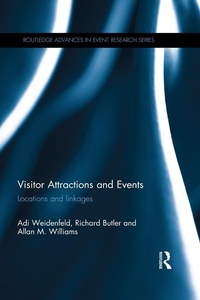
Visitor Attractions and Events
Locations and linkages
Published on 28. April 2016
274 pages
978-1-317-58025-6 (ISBN)
Description

Both visitor attractions and events play pivotal roles in the appeal of tourism destination regions to visitors by virtue of being the main motivator of tourist trips and determining consumers' choices. However, more recently visitor attractions have become more multifaceted, have proliferated and fragmented in terms of form, location, scale and style, and their role is undergoing major changes in a post-modern world as a result of consumer demands and competitive innovations.
Visitor Attractions and Events for the first time theoretically and empirically explores the relations between events and attractions to offer new thinking of the role of space and place in shaping development, management practices and strategies in the sector as well as future implications. The book reveals how location is pivotal in the development, planning, and management of visitor attractions and events. Whereas the location of natural attractions is relatively fixed in space and their locations cannot be predetermined or relocated, human-made or contrived attractions are more influenced by the planning process in the context of the locational decision-making process. Competition and cooperation between visitor attractions and the aspects which shape these relations, including complementarities, compatibility, knowledge spill overs and diffusion of innovations, product similarities and spatial proximity remain largely ignored in the visitor attraction sector and thus are major elements in the focus of this book. Comparative examples ranging from small to major attractions in a wide variety of locations are included.
This significant volume will appeal widely to all those interested in the visitor sector, such as tourism, events, leisure studies, destination management and sociology.
Visitor Attractions and Events for the first time theoretically and empirically explores the relations between events and attractions to offer new thinking of the role of space and place in shaping development, management practices and strategies in the sector as well as future implications. The book reveals how location is pivotal in the development, planning, and management of visitor attractions and events. Whereas the location of natural attractions is relatively fixed in space and their locations cannot be predetermined or relocated, human-made or contrived attractions are more influenced by the planning process in the context of the locational decision-making process. Competition and cooperation between visitor attractions and the aspects which shape these relations, including complementarities, compatibility, knowledge spill overs and diffusion of innovations, product similarities and spatial proximity remain largely ignored in the visitor attraction sector and thus are major elements in the focus of this book. Comparative examples ranging from small to major attractions in a wide variety of locations are included.
This significant volume will appeal widely to all those interested in the visitor sector, such as tourism, events, leisure studies, destination management and sociology.
More details
Series
Language
English
Place of publication
London
United Kingdom
Publishing group
Taylor & Francis Ltd
Target group
College/higher education
Illustrations
21 s/w Abbildungen, 9 s/w Tabellen, 21 s/w Zeichnungen
9 Tables, black and white; 21 Line drawings, black and white; 21 Illustrations, black and white
File size
1,87 MB
ISBN-13
978-1-317-58025-6 (9781317580256)
Copyright in bibliographic data and cover images is held by Nielsen Book Services Limited or by the publishers or by their respective licensors: all rights reserved.
Schweitzer Classification
Other editions
Additional editions
Adi Weidenfeld | Richard Butler | Allan M. Williams
Visitor Attractions and Events
Locations and linkages
Book
12/2021
1st Edition
Routledge
€65.50
Shipment within 10-20 days

Adi Weidenfeld | Richard Butler | Allan M. Williams
Visitor Attractions and Events
Locations and linkages
Book
05/2016
1st Edition
Routledge
€231.90
Shipment within 10-20 days
Persons
Adi Weidenfeld is a senior lecturer in tourism management at the Business School, Middlesex University, London, UK, and a visiting researcher at Hanken School of Economics in Vaasa, Finland. Adi has worked on his two-year Marie Curie Intra-European postdoctoral Fellowship at Hanken School of Economics, Finland and completed his PhD in Geography at the University of Exeter, UK, after graduating a Masters in European Property and Development Planning at University College London, UK. His main interests include visitor attraction management, tourism development planning and policies, tourism clusters, knowledge transfer and innovation in tourism and tourism cross border region.
Richard Butler is an Emeritus Professor of Tourism, Strathclyde Business School, University of Strathclyde, Glasgow, UK, and Visiting Professor, Tourism Academy, NHTV University, Breda, Holland. He has degrees in Geography from the University of Nottingham (B.A.) and the University of Glasgow (PhD), and has been engaged in tourism research from 1964. He taught at the University of Western Ontario, Canada, from 1967 to 1997, and then joined the University of Surrey, UK, where he was Deputy Head of Research in the School of Management Studies for the Service Sector. He then took a part time position as Professor of Tourism at the University of Strathclyde in 2005. He has also taught and conducted research at James Cook University in Australia, CISET in Venice, Klaipeda College in Lithuania and Hong Kong Polytechnic University. His main research interests are in the development process of tourist destinations, island studies and the impacts of tourism, the latter particularly in the context of sustainability and resilience.
Allan M. Williams is a Professor of Tourism and Mobility Studies, School of Hospitality and Tourism Management, University of Surrey, UK. Allan Williams studied economics and geography as an undergraduate, before completing his PhD at the London School of Economics, UK. Subsequently he has worked at the Universities of Durham, Exeter, London Metropolitan and Surrey. His research focuses on the relationship between mobility and economic development, encompassing both tourism and migration. Recent books include Tourism and Innovation (with Michael Hall), Wiley-Blackwell Companion to Tourism (edited with Lew and Hall) and Migration Risk and Uncertainty (with Vladimir Bal?z). He is co-editor of Tourism Geographies, and a fellow of the Academy of Social Science.
Richard Butler is an Emeritus Professor of Tourism, Strathclyde Business School, University of Strathclyde, Glasgow, UK, and Visiting Professor, Tourism Academy, NHTV University, Breda, Holland. He has degrees in Geography from the University of Nottingham (B.A.) and the University of Glasgow (PhD), and has been engaged in tourism research from 1964. He taught at the University of Western Ontario, Canada, from 1967 to 1997, and then joined the University of Surrey, UK, where he was Deputy Head of Research in the School of Management Studies for the Service Sector. He then took a part time position as Professor of Tourism at the University of Strathclyde in 2005. He has also taught and conducted research at James Cook University in Australia, CISET in Venice, Klaipeda College in Lithuania and Hong Kong Polytechnic University. His main research interests are in the development process of tourist destinations, island studies and the impacts of tourism, the latter particularly in the context of sustainability and resilience.
Allan M. Williams is a Professor of Tourism and Mobility Studies, School of Hospitality and Tourism Management, University of Surrey, UK. Allan Williams studied economics and geography as an undergraduate, before completing his PhD at the London School of Economics, UK. Subsequently he has worked at the Universities of Durham, Exeter, London Metropolitan and Surrey. His research focuses on the relationship between mobility and economic development, encompassing both tourism and migration. Recent books include Tourism and Innovation (with Michael Hall), Wiley-Blackwell Companion to Tourism (edited with Lew and Hall) and Migration Risk and Uncertainty (with Vladimir Bal?z). He is co-editor of Tourism Geographies, and a fellow of the Academy of Social Science.
Content
Section I : Introduction: The visitor attraction and event sectors
1. Introduction: The visitor attraction and event sectors
2. Events, visitor attractions, and the event attraction continuum
(Adi Weidenfeld and Anna Leask)
3. Spatial Clustering and Agglomeration of Visitor Attractions
4. The Visitor Attraction Life Cycle: Changing relationships between attractions in tourism destinations
Section II: Economic and management aspects of the visitor attraction sector
5. The appeal, attractiveness and compatibility of visitor attractions
6. Cooperation in the visitor attraction sector
7. Competition in the visitor attraction sector
8. Knowledge Transfer in the visitor attraction sector
9. Innovation in the visitor attraction sector
Section III: Implications and trends in the visitor attraction sector
10. The impacts of visitor attractions and events
11. Visitor Attractions as Icons and Flagships
12. Visitor attraction marketing and tourism destination branding - Implications for marketing practices
(Peter Bjoerk and Adi Weidenfeld)
13. Visitor attractions, recent and future trends: a practitioner perspective
(Ken Robinson CBE)
14. Conclusions
1. Introduction: The visitor attraction and event sectors
2. Events, visitor attractions, and the event attraction continuum
(Adi Weidenfeld and Anna Leask)
3. Spatial Clustering and Agglomeration of Visitor Attractions
4. The Visitor Attraction Life Cycle: Changing relationships between attractions in tourism destinations
Section II: Economic and management aspects of the visitor attraction sector
5. The appeal, attractiveness and compatibility of visitor attractions
6. Cooperation in the visitor attraction sector
7. Competition in the visitor attraction sector
8. Knowledge Transfer in the visitor attraction sector
9. Innovation in the visitor attraction sector
Section III: Implications and trends in the visitor attraction sector
10. The impacts of visitor attractions and events
11. Visitor Attractions as Icons and Flagships
12. Visitor attraction marketing and tourism destination branding - Implications for marketing practices
(Peter Bjoerk and Adi Weidenfeld)
13. Visitor attractions, recent and future trends: a practitioner perspective
(Ken Robinson CBE)
14. Conclusions
