

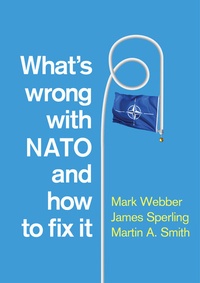
What's Wrong with NATO and How to Fix it
Description

NATO, the most successful alliance in history, is beset by unresolved tensions and divergent interests that are undermining its cohesion, credibility and capability.
In this new book, Mark Webber, James Sperling and Martin Smith explore four key post-Cold War developments that threaten NATO's survival: an overextended geostrategic reach and an unwieldly security policy portfolio; a failure to address capability short-falls and meet defence spending benchmarks; US weariness and European wariness that call NATO into question; and intra-alliance discord over Russia's place in the European security order and how to deal with Moscow's destabilization of Georgia and Ukraine. The authors propose in response a range of policy options that could reinvigorate NATO, but conclude with a note of caution. Alliances come and go and most are cast into the dustbin of history. If NATO is to avoid this fate, it must not only address the major problems that trouble it, but also get to grips with future challenges to alliance cohesion and credibility, from Brexit to the emerging contest with China.
Mark Webber is Professor of International Politics at the University of Birmingham.
James Sperling is Professor Emeritus of Political Science at the University of Akron.
Martin A. Smith is Senior Lecturer in Defence and International Affairs at the Royal Military Academy Sandhurst (RMAS).
More details
Other editions
Additional editions
Persons
Mark Webber is Professor of International Politics at the University of Birmingham.
James Sperling is Professor Emeritus of Political Science at the University of Akron.
Martin A. Smith is Senior Lecturer in Defence and International Affairs at the Royal Military Academy Sandhurst (RMAS).
Content
Introduction: What Is Wrong with NATO?
Part I Problems
Chapter 1. Doing Too Much: The Problem of Task Proliferation
Chapter 2. Weary or Wary? The Problem of American Leadership in NATO
Chapter 3. Fiscal Constraints, Military Capabilities and Burden-Sharing
Chapter 4. NATO and Russia: Cold War Redux
Part II Treatments
Chapter 5. Task Discretion: Doing Less, Better
Chapter 6. American Leadership or European Autonomy?
Chapter 7. Cash, Capabilities and NATO Effectiveness
Chapter 8. Mending NATO-Russia Relations
Conclusion: Improvement, Repair and NATO's Future
Notes
Introduction: What Is Wrong with NATO?
There would appear to be much wrong with the North Atlantic Treaty Organization. To its detractors, NATO (or 'the Alliance') has been written off as 'irrelevant'.1 During the 2016 presidential campaign, Donald Trump called it 'obsolete'.2 French President Emanuel Macron has suggested NATO is 'experiencing [.] brain death'.3 Hence, so the argument runs, if NATO did not exist, no one in Europe or North America would any longer want to create it.4 In this book, we outline the problems that beset the Alliance, but also put forward ways of addressing them. To declare our position up front: NATO, we argue, is salvageable and worth keeping. This book is structured around identifying what its problems are and then showing how they can be treated. Before doing so, however, it is worth outlining some of the broader issues which condition NATO's state of affairs.
NATO's Predicament
Does NATO still have a credible sense of purpose rooted in the realities of contemporary international politics? During the Cold War, when NATO faced off against the Soviet Union and its Warsaw Pact allies, this was a question hardly worth asking. The enemy was obvious, as was the means of countering it - through the combined military efforts of the US and its European allies. The end of the Cold War and the dissolution of the Soviet Union in 1991 thus raised the question of what, if anything, NATO had left to do. It was a view common in the early 1990s that NATO was ill suited to a world without a powerful adversary.5 And despite an intervening quartercentury of adaptation and deployment - in the Balkans, Libya, Afghanistan and NATO's eastern flank facing Russia - that argument persists. NATO plays only a marginal role in countering three of the major threats affecting European security: the war in Syria, jihadist-inspired terrorism and migration flows from the Sahel and the wider Middle East. That NATO is positioned against these threats in such an unimpressive fashion owes much to its own crisis of conviction. Over the last three decades, NATO has compensated for the absence of a common agreed enemy of the Cold War type by acting reactively, dealing with crises as they arise according to the dictates of geography (as in the Balkans), American leadership (as in Afghanistan) or geopolitical 'muscle memory' (as in its response to Russia).6 Behaving in this way demonstrates a certain strategic and institutional flexibility but belies an underlying divergence of priorities among allies as well as the absence of any overarching sense of commitment to a common cause.7
NATO's sense of drift is also evident in its own internal political dynamics. Strains between the US and its Canadian and European allies have been part and parcel of NATO's history. During the Cold War, the US took a dim view of Europeans' reluctance to spend sufficiently on defence. For their part, some European governments (most notably in France and West Germany) suspected that the American commitment to the defence of Europe was lukewarm. Division, however, has worsened since the Cold War's end. This is a theme we take up in later chapters. In brief, each US president has witnessed a different but escalating set of problems in the transatlantic relationship. For President Bill Clinton it was centred on the Balkans. For his successor, George W. Bush, it was over the Iraq war of 2003. The administration of Barack Obama, meanwhile, complained openly about the unwillingness of certain allies to spend adequately on defence. Unease in Washington was mirrored by disquiet in Europe - at US unilateralism and the shift of America's strategic priorities away from Europe. NATO was caught up in these currents. Its internal divisions over Iraq were described as the Alliance's 'near-death experience'.8 Secretary of Defence Robert Gates warned in 2011 that NATO had 'a dim, if not dismal future'.9
Mutual suspicion reached its zenith with the election of Donald Trump in 2016. Trump went on to criticize NATO in a manner unparalleled among previous American presidents. Paradoxically, the level of material support for European defence actually increased in the Trump years. But words matter, and Trump's broadsides against NATO as well as individual allies (he openly criticized France and Canada and reserved a particular animus for Germany) generated deep anxieties that the US could one day abandon its NATO commitments.10 NATO scepticism has not been limited to the US. We have already noted the comments of the French President. In 2016, Turkish Foreign Minister Mevlüt Çavusoglu suggested his country would 'think of exit' from NATO owing to a perceived lack of solidarity for coupthreatened President Erdogan.11 The Prime Minister of Iceland, Katrín Jakobsdóttir, has said her country 'shouldn't be [a] member of NATO'.12
Beneath these voices of transatlantic dissent lurks a deeper problem: the withering away of political community. NATO throughout the Cold War claimed to be the upholder of liberal democratic values. Such a position was, admittedly, compromised by the Alliance's undemocratic minority: the Salazar dictatorship in Portugal and the occasional military rulers of Greece and Turkey. But in juxtaposition to Soviet communism, the claim had some mileage. Despite the end of the Cold War, such arguments continued to be made, providing (as we will see in Chapter 1) justification for NATO's military interventions as well as the policy of membership enlargement. But NATO's value-based orientation now seems less and less convincing. NATO's newest members, Montenegro and North Macedonia, were admitted despite distinctly patchy records of democratic compliance. NATO's military mission in Afghanistan has long been detached from an initial hope that it would incubate political and social reform in the country. And a number of NATO allies - Turkey, Hungary, Poland, Italy and the US under Trump - have succumbed to strains of national chauvinism in their foreign policies that are profoundly damaging to the Alliance's bonds of solidarity. Brexit, although a withdrawal from the European Union (EU), has been seen, similarly, as undermining trust and goodwill among the UK and its NATO allies. Such political currents are, according to New York Times columnist Roger Cohen, 'the greatest [ever] challenge to the Atlantic alliance and the civilization it has sustained'.13
No, NATO Is Not Finished
In view of these deep-seated problems, one might simply conclude that NATO is beyond repair. Why bother attempting to fix it if by doing so an 'institutional dinosaur' is kept on life support? Far better to give NATO a 'dignified retirement', dividing its functions between Europe and America, with states in the former seeking alternative Europe-wide solutions to their common defence thereby leaving the US and Canada to pursue their security interests unencumbered by European responsibilities.14 This is a view we reject. NATO certainly has its problems, but to do away with the organization would worsen and not improve the security position of its members. Reforming NATO, rather, is the more realistic and preferred course of action. Occasionally, political leaders have intimated at withdrawal from the Alliance, but none of NATO's members has advocated its dissolution. Any argument for doing so is unpersuasive. The alternative case presented in this book, for a reformed NATO, is framed by five starting assumptions.
NATO is not in terminal decline
Declinist views have characterized much commentary and scholarship on NATO. But time after time, such views have proven wrong. During the Cold War, the Suez Crisis of 1956, French withdrawal from NATO's integrated military commands in the 1960s and differences in the early 1980s between the Reagan administration and some European governments over how to deal with the Soviets were all seen as evidence of internal corrosion. However, as Wallace Thies has convincingly argued, the Alliance's 'self-healing tendencies' of democratic membership, internal democratic decision-making and institutional complexity ensured the accommodation of its members' interests, and with it ongoing resolve in facing down the Soviet bloc.15
Declinist positions resurfaced at the Cold War's end only to be confounded by NATO's repurposing in the 1990s. By 1995, one analyst was able to write that 'European security was once again dominated by the NATO alliance and US leadership, perhaps to a greater extent than even in the last years of the Cold War.'16 The prompt for that verdict was the Alliance's decisive aerial intervention in Bosnia. Operation Deliberate Force, launched in August 1995, served as the catalyst for the Dayton Peace Accords, which finally brought a semblance of political stability to the troubled Balkan region. It also marked NATO's entry into peacekeeping (60,000 NATO personnel would go on to be deployed to Bosnia, the largest military deployment in Europe since World War II). NATO undertook a further air operation four years later. Operation Allied Force pushed the Serb leader Slobodan Milosevic to a peace deal over Kosovo and paved the way for the entry of...
