

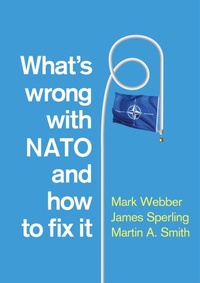
What's Wrong with NATO and How to Fix it
Published on 11. March 2021
Book
Paperback/Softback
304 pages
978-0-7456-8262-4 (ISBN)
Description
NATO, the most successful alliance in history, is beset by unresolved tensions and divergent interests that are undermining its cohesion, credibility and capability.
In this new book, Martin Smith, James Sperling and Mark Webber explore four key post-Cold War developments that threaten NATO's survival: an overextended geostrategic reach and an unwieldly security policy portfolio; a failure to address capability short-falls and meet defense spending benchmarks; US weariness and European wariness that call NATO into question; and intra-alliance discord over Russia's place in the European security order and how to deal with Moscow's destabilisation of Georgia and Ukraine. The authors propose in response a range of policy options that could reinvigorate NATO, but conclude with a note of caution. Alliances come and go and most are cast into the dustbin of history. If NATO is to avoid this fate it must not only address the major problems that trouble it, but also get to grips with future challenges to alliance cohesion and credibility, from Brexit to the emerging contest with China.
In this new book, Martin Smith, James Sperling and Mark Webber explore four key post-Cold War developments that threaten NATO's survival: an overextended geostrategic reach and an unwieldly security policy portfolio; a failure to address capability short-falls and meet defense spending benchmarks; US weariness and European wariness that call NATO into question; and intra-alliance discord over Russia's place in the European security order and how to deal with Moscow's destabilisation of Georgia and Ukraine. The authors propose in response a range of policy options that could reinvigorate NATO, but conclude with a note of caution. Alliances come and go and most are cast into the dustbin of history. If NATO is to avoid this fate it must not only address the major problems that trouble it, but also get to grips with future challenges to alliance cohesion and credibility, from Brexit to the emerging contest with China.
Reviews / Votes
"Like the precision-guided weapons and delivery systems they would argue European allies have too few of, the authors of this insightful, accessible book home in on what ails NATO with pinpoint precision. The recommended fixes are far-reaching in their capacity to ameliorate these problems and to ensure that NATO will be around to celebrate its 80th birthday. Thoroughly researched, clearly written, and persuasively argued, this book is a necessity for those thinking about how the alliance can best navigate the 2020s and beyond."John R. Deni, US Army War College
"Books wrongly predicting NATO's demise have been coming off the printing press for almost as long as the alliance has been in existence. This has made many observers blase about academic writings on NATO's future. What is Wrong with NATO and How to Fix It is much more valuable than the usual overviews of NATO's multiple challenges. Written by three renowned scholars, the book offers many realistic and well-considered reforms aimed at making the alliance fit for the 21st century. This makes it compulsory reading for the alliance's current leadership and anyone concerned about the fate of the transatlantic security relationship in our disorderly and increasingly confrontational world."
Jamie Shea, University of Exeter and former NATO Deputy Assistant Secretary General
"The only book to offer a systematic and up to date treatment of NATO with a problem-solving attitude. Theoretically informed and policy orientated, it's an excellent source for teaching NATO to novices."
Lorenzo Cladi, University of Plymouth
"If you're looking for a concise text that deftly identifies the present challenges facing NATO and then goes just beyond pointing out the problems, but actually offers workable solutions to address these ills, then this is the text for you. What's Wrong with NATO and How to Fix It is a well-paced, yet comprehensive read that will be of interest to scholars and policy-makers alike."
Michael John Williams, Syracuse University
More details
Other editions
Additional editions
Mark Webber | James Sperling | Martin A. Smith
What's Wrong with NATO and How to Fix it
Book
03/2021
1st Edition
Polity Press
€65.00
Shipment within 15-20 days
Mark Webber | James Sperling | Martin A. Smith
What's Wrong with NATO and How to Fix it
E-Book
03/2021
1st Edition
Wiley
€18.99
Available for download
Persons
Mark Webber is Professor of International Politics at the University of Birmingham.
James Sperling is Professor Emeritus of Political Science at the University of Akron.
Martin A. Smith is Senior Lecturer in Defence and International Affairs at the Royal Military Academy Sandhurst (RMAS).
James Sperling is Professor Emeritus of Political Science at the University of Akron.
Martin A. Smith is Senior Lecturer in Defence and International Affairs at the Royal Military Academy Sandhurst (RMAS).
Content
Introduction: What Is Wrong with NATO?
Part I Problems
Chapter 1. Doing Too Much: The Problem of Task Proliferation
Chapter 2. Weary or Wary? The Problem of American Leadership in NATO
Chapter 3. Fiscal Constraints, Military Capabilities and Burden-Sharing
Chapter 4. NATO and Russia: Cold War Redux
Part II Treatments
Chapter 5. Task Discretion: Doing Less, Better
Chapter 6. American Leadership or European Autonomy?
Chapter 7. Cash, Capabilities and NATO Effectiveness
Chapter 8. Mending NATO-Russia Relations
Conclusion: Improvement, Repair and NATO's Future
Notes
Part I Problems
Chapter 1. Doing Too Much: The Problem of Task Proliferation
Chapter 2. Weary or Wary? The Problem of American Leadership in NATO
Chapter 3. Fiscal Constraints, Military Capabilities and Burden-Sharing
Chapter 4. NATO and Russia: Cold War Redux
Part II Treatments
Chapter 5. Task Discretion: Doing Less, Better
Chapter 6. American Leadership or European Autonomy?
Chapter 7. Cash, Capabilities and NATO Effectiveness
Chapter 8. Mending NATO-Russia Relations
Conclusion: Improvement, Repair and NATO's Future
Notes