

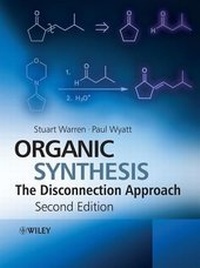
Organic Synthesis
Description

Reviews / Votes
?The authors have succeeded admirably in the updating of a classicin the pedagogy of organic chemistry.? ( Journal of MedicinalChemistry , August 2009) ?This book is suitable for advanced undergraduate students,researchers and professional chemists. Both the writing and thediagrams are simple and clear.? ( Reviews, May 2009)More details
Other editions
Additional editions
Persons
Dr Stuart Warren, Department of Chemistry, University of Cambridge, UK
Dr Warren is the author of the bestselling textbooks Organic Synthesis: The Disconnection Approach (Wiley), Organic Synthesis: Strategy and Control (Wiley) and Organic Chemistry (OUP).
Dr Paul Wyatt, School of Chemistry, University of Bristol, UK
Dr Wyatt is Director of Undergraduate Studies for the School of Chemistry at Bristol University and also Director of BRISTOL ChemLabS - a HEFCE Centre for Excellence in Teaching & Learning. He is co-author, with Warren, of Organic Synthesis: Strategy and Control.
Content
Preface ix
General References xi
1. The Disconnection Approach 1
2. Basic Principles: Synthons and Reagents Synthesis of Aromatic Compounds 7
3. Strategy I: The Order of Events 17
4. One-Group C-X Disconnections 23
5. Strategy II: Chemoselectivity 29
6. Two-Group C-X Disconnections 35
7. Strategy III: Reversal of Polarity, Cyclisations, Summary of Strategy 45
8. Amine Synthesis 53
9. Strategy IV: Protecting Groups 61
10. One Group C-C Disconnections I: Alcohols 69
11. General Strategy A: Choosing a Disconnection 77
12. Strategy V: Stereoselectivity A 83
13. One Group C-C Disconnections II: Carbonyl Compounds 93
14. Strategy VI: Regioselectivity 101
15. Alkene Synthesis 107
16. Strategy VII: Use of Acetylenes (Alkynes) 115
17. Two-Group C-C Disconnections I: Diels-Alder Reactions 121
18. Strategy VIII: Introduction to Carbonyl Condensations 129
19. Two-Group C-C Disconnections II: 1,3-Difunctionalised Compounds 133
20. Strategy IX: Control in Carbonyl Condensations 139
21. Two-Group C-C Disconnections III: 1,5-Difunctionalised Compounds Conjugate (Michael) Addition and Robinson Annelation 151
22. Strategy X: Aliphatic Nitro Compounds in Synthesis 161
23. Two-Group Disconnections IV: 1,2-Difunctionalised Compounds 167
24. Strategy XI: Radical Reactions in Synthesis 177
25. Two-Group Disconnections V: 1,4-Difunctionalised Compounds 185
26. Strategy XII: Reconnection 193
27. Two-Group C-C Disconnections VI: 1,6-diCarbonyl Compounds 199
28. General Strategy B: Strategy of Carbonyl Disconnections 207
29. Strategy XIII: Introduction to Ring Synthesis: Saturated Heterocycles 217
30. Three-Membered Rings 229
31. Strategy XIV: Rearrangements in Synthesis 237
32. Four-Membered Rings: Photochemistry in Synthesis 245
33. Strategy XV: The Use of Ketenes in Synthesis 251
34. Five-Membered Rings 255
35. Strategy XVI: Pericyclic Reactions in Synthesis: Special Methods for Five-Membered Rings 261
36. Six-Membered Rings 269
37. General Strategy C: Strategy of Ring Synthesis 279
38. Strategy XVII: Stereoselectivity B 289
39. Aromatic Heterocycles 301
40. General Strategy D: Advanced Strategy 313
Index 325
