

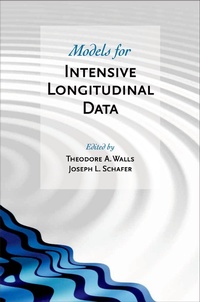
Models for Intensive Longitudinal Data
1st Edition
Published on 19. January 2006
311 pages
978-0-19-803866-5 (ISBN)
Description

Rapid technological advances in devices used for data collection have led to the emergence of a new class of longitudinal data: intensive longitudinal data (ILD). Behavioral scientific studies now frequently utilize handheld computers, beepers, web interfaces, and other technological tools for collecting many more data points over time than previously possible. Other protocols, such as those used in fMRI and monitoring of public safety, also produce ILD, hence the statistical models in this volume are applicable to a range of data. The volume features state-of-the-art statistical modeling strategies developed by leading statisticians and methodologists working on ILD in conjunction with behavioral scientists. Chapters present applications from across the behavioral and health sciences, including coverage of substantive topics such as stress, smoking cessation, alcohol use, traffic patterns, educational performance and intimacy.
Models for Intensive Longitudinal Data (MILD) is designed for those who want to learn about advanced statistical models for intensive longitudinal data and for those with an interest in selecting and applying a given model. The chapters highlight issues of general concern in modeling these kinds of data, such as a focus on regulatory systems, issues of curve registration, variable frequency and spacing of measurements, complex multivariate patterns of change, and multiple independent series. The extraordinary breadth of coverage makes this an indispensable reference for principal investigators designing new studies that will introduce ILD, applied statisticians working on related models, and methodologists, graduate students, and applied analysts working in a range of fields. A companion Web site at www.oup.com/us/MILD contains program examples and documentation.
More details
Other editions
Additional editions
Theodore A. Walls | Joseph L. Schafer
Models for Intensive Longitudinal Data
Book
02/2006
Oxford University Press Inc
€125.10
Shipment within 15-20 days
Persons
Theodore A. Walls, Ph.D., is Professor of Psychology at the University of Rhode Island. As a research scientist at The Methodology Center at The Pennsylvania State University, Dr. Walls developed methods for the analysis of intensive longitudinal data and convened the international study group whose work led to the publication of this volume. His current work is focused on the development of models reflecting dynamic intraindividual processes.
Joseph L. Schafer, Ph.D., is Associate Professor of Statistics and an Investigator at The Methodology Center at The Pennsylvania State University. Dr. Schafer has developed techniques for analyzing incomplete data and incorporating missing-data uncertainty into statistical inference. His areas of research also include latent-class and latent transition analysis, nonsampling errors in surveys and censuses, strategies for statistical computing and software development, and statistical methods for casual inference.
Content
- Intro
- Contents
- Contributors
- Introduction: Intensive Longitudinal Data
- 1 Multilevel Models for Intensive Longitudinal Data
- 1.1 Behavioral Scientific Motivations for Collecting Intensive Longitudinal Data
- 1.2 Overview of Multilevel Models
- 1.3 Applying Multilevel Modeling to Intensive Longitudinal Data
- 1.4 Application: Control and Choice in Indian Schoolchildren
- 1.5 Summary
- 2 Marginal Modeling of Intensive Longitudinal Data by Generalized Estimating Equations
- 2.1 What Is GEE Regression?
- 2.2 Practical Considerations in the Application of GEE
- 2.3 Application: Reanalysis of the Control and Choice Data Using GEE
- 3 A Local Linear Estimation Procedure for Functional Multilevel Modeling
- 3.1 The Model
- 3.2 Practical Considerations
- 3.3 Application: Smoking Cessation Study
- 3.4 Discussion
- 4 Application of Item Response Theory Models for Intensive Longitudinal Data
- 4.1 IRT Model
- 4.2 Estimation
- 4.3 Application: Adolescent Smoking Study
- 4.4 Discussion
- 5 Fitting Curves with Periodic and Nonperiodic Trends and Their Interactions with Intensive Longitudinal Data
- 5.1 Periodic and Nonperiodic Trends
- 5.2 The Model
- 5.3 Application: Personality Data
- 5.4 Discussion
- 6 Multilevel Autoregressive Modeling of Interindividual Differences in the Stability of a Process
- 6.1 Defining Stability as Regularity in a Time Series
- 6.2 Multilevel Models
- 6.3 A Multilevel AR(1) Model
- 6.4 Application: Daily Alcohol Use
- 6.5 Estimating This Model in SAS PROC MIXED
- 6.6 Predicting the Individual AR(1) Coefficients
- 6.7 Discussion
- 7 The State-Space Approach to Modeling Dynamic Processes
- 7.1 Gaussian State-Space Models
- 7.2 Some Special Cases of State-Space Models
- 7.3 Parameter Estimation
- 7.4 Application 1: Connectivity Analysis with fMRI Data
- 7.5 Application 2: Testing the Induced Demand Hypothesis from Matched Traffic Profiles
- 7.6 Conclusions
- 8 The Control of Behavioral Input/Output Systems
- 8.1 A Typical Input/Output System
- 8.2 Modeling System Dynamics
- 8.3 Controller Strategies to Meet an Output Target
- 8.4 Fitting Dynamic Models to Intensive Longitudinal Data
- 9 Dynamical Systems Modeling: An Application to the Regulation of Intimacy and Disclosure in Marriage
- 9.1 Self-Regulation and Intrinsic Dynamics
- 9.2 Coupled Regulation and Coupled Dynamics
- 9.3 Time-Delay Embedding
- 9.4 Accounting for Individual Differences in Dynamics
- 9.5 Application: Daily Intimacy and Disclosure in Married Couples
- 9.6 Discussion
- 10 Point Process Models for Event History Data: Applications in Behavioral Science
- 10.1 Ecological Momentary Assessment of Smoking
- 10.2 Point Process Models
- 10.3 Application: An EMA Study of Smoking Data
- 10.4 Discussion of Results
- 10.5 Multivariate Point Patterns
- 11 Emerging Technologies and Next-Generation Intensive Longitudinal Data Collection
- 11.1 Intensive Data Collection Systems
- 11.2 Statistical Issues for Intensive Longitudinal Measurement
- 11.3 Summary
- Index
- A
- B
- C
- D
- E
- F
- G
- H
- I
- K
- L
- M
- N
- O
- P
- Q
- R
- S
- T
- V
- W
