

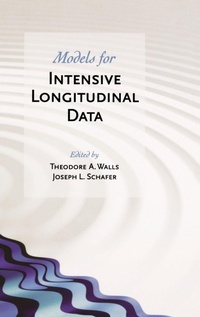
Models for Intensive Longitudinal Data
Published on 23. February 2006
Book
Hardback
320 pages
978-0-19-517344-4 (ISBN)
Description
A new class of longitudinal data has emerged with the use of technological devices for scientific data collection. This class of data is called intensive longitudinal data (ILD). This volume features state-of-the-art applied statistical modelling strategies developed by leading statisticians and methodologists working in conjunction with behavioural scientists.
Reviews / Votes
"The topics covered and the multidisciplinary authors make it appealing to a very wide range of researchers in statistics and the social and behavioral sciences."-- Technometrics"Walls and Schafer have compiled a most interesting and practical volume on methods of analysis of what they call Intensive Longitudinal Data--data from more than just three or four observation waves. This book is interesting because it shows that new and unusual hypotheses can be addressed to complex data, and practical because the methods discussed and proposed are applicable and programs will run on regular PCs. The topics addressed and the
multidisciplinary authors make this volume appealing to a very wide readership in biostatistics and the social and behavioral sciences. This is a groundbreaking book for the emerging field of statistical modeling of
intensive longitudinal data!"--Alexander von Eye, Professor of Psychology, Michigan State University
"From Palm Pilots to wearable computers to GPS monitors, modern technology is allowing today's empirical researchers to generate vast quantities of longitudinal data quickly and easily. But how should these data be analyzed? Models for Intensive Longitudinal Data provides a wonderful overview of the wide array of new analytic options...a hitchhiker's guide to an exciting new galaxy in longitudinal data analysis."--Judith D. Singer, James Bryant
Conant Professor of Education, Harvard Graduate School of Education.
"Intensive longitudinal data is a fascinating and burgeoning field of statistical endeavor. MILD is a spicy introduction to a colorful subject."--Robert E. Weiss, Professor of Biostatistics, UCLA School of Public Health
"Clearly, the doors to an exciting line of research and application have been opened. The editors did an excellent job, making sure the number of errors is minimal, the level of exposition is comparable over the chapters, and chapters cross-reference each other where meaningful. It is not very often that researchers detect a niche and go successfully about establishing and filling it. Walls and Schafer have accomplished this task."--Alexander von Eye,
Structural Equation Modeling: A Multidisciplinary Journal
"Although this volume will be of greatest value to quantitatively oriented researchers in psychology and other areas of social science, I also recommend it to the statisticians and anyone else interested in the collection and analysis of ILD.--Journal of the American Statistical Association
"I recommend it highly and hazard the opinion that sociologists, demographers, and related social scientists will develop their own companions to this volume in future years."--American Journal of Sociology
"[Models for Intensive Longitudinal Data] addresses most of the researchers in the behavioral and related sciences, such as psychology, sociology, education, economics, management, and medical sciences. The book also addresses methodologists and statisticians, who are professionally dealing with longitudinal analysis, to enhance their knowledge of the type of model covered and the technical problems involved in their formulation. In addition, the book
offers applied researchers new ideas about the use of longitudinal analysis in solving their problems."--Psychometrika
"The topics covered and the multidisciplinary authors make it appealing to a very wide range of researchers in statistics and the social and behavioral sciences."-- Technometrics
"Walls and Schafer have compiled a most interesting and practical volume on methods of analysis of what they call intensive longitudinal data--data from more than just three or four observation waves. The book is interesting because it shows that new and unusual hypotheses can be addressed to complex data, and practical because the methods discussed and proposed are applicable and programs will run on regular PCs. The topics addressed and the
multidisciplinary authors make this volume appealing to a very wide readership in biostatistics and the social and behavioral sciences. This is a groundbreaking book for the emerging field of statistical modeling of
intensive longitudinal data!"--Alexander von Eye, Professor of Psychology, Michigan State University
"From Palm Pilots to wearable computers to GPS monitors, modern technology is allowing today's empirical researchers to generate vast quantities of longitudinal data quickly and easily. But how should these data be analyzed? Models for Intensive Longitudinal Data provides a wonderful overview of the wide array of new analytic options...a hitchhiker's guide to an exciting new galaxy in longitudinal data analysis."--Judith D. Singer, James Bryant
Conant Professor of Education, Harvard Graduate School of Education.
"Intensive longitudinal data is a fascinating and burgeoning field of statistical endeavor. MILD is a spicy introduction to a colorful subject."--Robert E. Weiss, Professor of Biostatistics, UCLA School of Public Health
"Clearly, the doors to an exciting line of research and application have been opened. The editors did an excellent job, making sure the number of errors is minimal, the level of exposition is comparable over the chapters, and chapters cross-reference each other where meaningful. It is not very often that researchers detect a niche and go successfully about establishing and filling it. Walls and Schafer have accomplished this task."--Alexander von Eye,
Structural Equation Modeling: A Multidisciplinary Journal
"I recommend it highly and hazard the opinion that sociologists, demographers, and related social scientists will develop their own companions to this volume in future years."--American Journal of Sociology
"[Models for Intensive Longitudinal Data] addresses most of the researchers in the behavioral and related sciences, such as psychology, sociology, education, economics, management, and medical sciences. The book also addresses methodologists and statisticians, who are professionally dealing with longitudinal analysis, to enhance their knowledge of the type of model covered and the technical problems involved in their formulation. In addition, the book
offers applied researchers new ideas about the use of longitudinal analysis in solving their problems."--Psychometrika
More details
Language
English
Place of publication
New York
United States
Target group
Professional and scholarly
Applied statisticians, methodologists in social and behaviour sciences, data analysts, graduate students in methodology & statistics courses.
Illustrations
Numerous tables and line drawings
Dimensions
Height: 240 mm
Width: 161 mm
Thickness: 23 mm
Weight
705 gr
ISBN-13
978-0-19-517344-4 (9780195173444)
Copyright in bibliographic data and cover images is held by Nielsen Book Services Limited or by the publishers or by their respective licensors: all rights reserved.
Schweitzer Classification
Other editions
Additional editions
Theodore A. Walls | Joseph L. Schafer
Models for Intensive Longitudinal Data
E-Book
01/2006
1st Edition
OUP eBook
€65.99
Available for download
Theodore A. Walls | Joseph L. Schafer
Models for Intensive Longitudinal Data
E-Book
01/2006
1st Edition
OUP eBook
€65.99
Available for download
Persons
Theodore A. Walls, Ph.D., is Professor of Psychology at the University of Rhode Island. As a research scientist at The Methodology Center at The Pennsylvania State University, Dr. Walls developed methods for the analysis of intensive longitudinal data and convened the international study group whose work led to the publication of this volume. His current work is focused on the development of models reflecting dynamic intraindividual processes.
Joseph L. Schafer, Ph.D., is Associate Professor of Statistics and an Investigator at The Methodology Center at The Pennsylvania State University. Dr. Schafer has developed techniques for analyzing incomplete data and incorporating missing-data uncertainty into statistical inference. His areas of research also include latent-class and latent transition analysis, nonsampling errors in surveys and censuses, strategies for statistical computing and software development, and
statistical methods for casual inference.
Joseph L. Schafer, Ph.D., is Associate Professor of Statistics and an Investigator at The Methodology Center at The Pennsylvania State University. Dr. Schafer has developed techniques for analyzing incomplete data and incorporating missing-data uncertainty into statistical inference. His areas of research also include latent-class and latent transition analysis, nonsampling errors in surveys and censuses, strategies for statistical computing and software development, and
statistical methods for casual inference.
Content
Introduction: Intensive Longitudinal DataTheodore A. Walls and Joseph L. Schafer:
1: Theodore A. Walls, Hyekyung Jung, and Joseph E. Schwartz: Multilevel Models for Intensive Longitudinal Data
2: Joseph L. Schafer: Marginal Modeling of Intensive Longitudinal Data by Generalized Estimating Equations
3: Runze Li, Tammy L. Root, and Saul Shiffman: A Local Linear Estimation Procedure for Functional Multilevel Modeling
4: Donald Hedeker, Robin J. Mermelstein, and Brian R. Flay: Application of Item Response Theory Models for Intensive Longitudinal Data
5: Carlotta Ching Ting Fok and James O. Ramsay: Periodic Trends, Non-periodic Trends, and their Interactions in Longitudinal or Functional Data
6: Michael J. Rovine and Theodore A. Walls: Multilevel Autoregressive Modeling of Interindividual Differences in the Regularity of a Process
7: Moon-Ho Ringo Ho, Robert Shumway, and Hernando Ombao: The State-Space Approach to Modeling Dynamic Processes
8: James O. Ramsay: The Control of Behavioral Input/Output Systems
9: Steven M. Boker and Jean-Phillippe Laurenceau: Dynamical Systems Modeling: An Application to the Regulation of Intimacy and Disclosure in Marriage
10: Stephen L. Rathbun, Saul Shiffman, and Chad J. Gwaltney: Point Process Models for Event History Data: Applications ion the Behavioral Science
11: Sarah M. Nusser, Stephen S. Intille, and Ranjan Maitra: Emerging Technologies and Next Generation Intensive Longitudinal Data Collection
1: Theodore A. Walls, Hyekyung Jung, and Joseph E. Schwartz: Multilevel Models for Intensive Longitudinal Data
2: Joseph L. Schafer: Marginal Modeling of Intensive Longitudinal Data by Generalized Estimating Equations
3: Runze Li, Tammy L. Root, and Saul Shiffman: A Local Linear Estimation Procedure for Functional Multilevel Modeling
4: Donald Hedeker, Robin J. Mermelstein, and Brian R. Flay: Application of Item Response Theory Models for Intensive Longitudinal Data
5: Carlotta Ching Ting Fok and James O. Ramsay: Periodic Trends, Non-periodic Trends, and their Interactions in Longitudinal or Functional Data
6: Michael J. Rovine and Theodore A. Walls: Multilevel Autoregressive Modeling of Interindividual Differences in the Regularity of a Process
7: Moon-Ho Ringo Ho, Robert Shumway, and Hernando Ombao: The State-Space Approach to Modeling Dynamic Processes
8: James O. Ramsay: The Control of Behavioral Input/Output Systems
9: Steven M. Boker and Jean-Phillippe Laurenceau: Dynamical Systems Modeling: An Application to the Regulation of Intimacy and Disclosure in Marriage
10: Stephen L. Rathbun, Saul Shiffman, and Chad J. Gwaltney: Point Process Models for Event History Data: Applications ion the Behavioral Science
11: Sarah M. Nusser, Stephen S. Intille, and Ranjan Maitra: Emerging Technologies and Next Generation Intensive Longitudinal Data Collection