

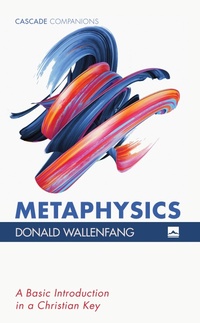
Metaphysics
A Basic Introduction in a Christian Key
Published on 18. September 2019
154 pages
978-1-5326-4352-1 (ISBN)
Description

What is metaphysics? Metaphysics: A Basic Introduction in a Christian Key gives a simplified answer to this daunting question. Born under the shadow of the Parthenon by Aristotle and his contemporaries, metaphysics eventually enjoyed its heyday in the medieval era and is finding a resurgence today in modernity. This book explores the perennial question of being and its uptake in the world of Christian theology. Donald Wallenfang leads the reader through five navigable chapters that feature the most basic themes of metaphysics: the question of being, first principles, causality, cosmology, and morality. The abstract tendencies of metaphysics are brought down to earth with reference to the gospel of Jesus and the relevance of metaphysics for daily living. Altogether, the reader will be inspired to think toward the whole by asking questions that penetrate beneath the surface of things. Beauty, truth, and goodness will be unveiled to the degree that we accompany Jesus the metaphysician along his itinerary of being given.
More details
Other editions
Additional editions
Book
09/2019
Wipf & Stock Publishers
€21.10
Shipment within 3-4 weeks
Book
09/2019
Wipf & Stock Publishers
€38.60
Shipment within 3-4 weeks
Person
Donald Wallenfang, Emmanuel Mary of the Cross, is a Secular Discalced Carmelite and professor of theology and philosophy at Sacred Heart Major Seminary in Detroit. He is the author of Metaphysics: A Basic Introduction in a Christian Key (Cascade, 2019); Phenomenology: A Basic Introduction in the Light of Jesus Christ (Cacade, 2019); Dialectical Anatomy of the Eucharist: An Étude in Phenomenology (Cascade, 2017); Human and Divine Being: A Study on the Theological Anthropology of Edith Stein (Cascade, 2017); and coeditor (with John C. Cavadini) of Evangelization as Interreligious Dialogue (Pickwick, 2019) and Pope Francis and the Event of Encounter (Pickwick, 2018).
Content
- Intro
- Title Page
- Introduction
- Chapter 1: BEING
- I. Being Itself (ipsum esse) and Beings (entia)
- A. Ontological Difference
- B. Unity and Diversity
- C. The Universal and the Particular
- D. First Contemplation
- II. Form and Matter
- A. Hylomorphism
- B. Spiritual Being
- C. Contemplating Spirit
- III. Substance
- A. Substance and Accidents
- B. Substance in the Concrete
- C. Substance in the Abstract
- D. Essence and Existence
- E. Christology
- IV. I Am
- Questions
- Chapter 2: FIRST PRINCIPLES
- I. First Principles of Being
- A. The Good
- B. That Than Which Nothing Greater Can Be Thought
- II. Laws of Logic
- A. The Principle of Noncontradiction
- B. The Principle of the Excluded Middle
- C. The Principle of Identity and Difference
- III. "In the beginning was the Logos" (John 1:1)
- Questions
- Chapter 3: CAUSALITY
- I. Act and Potency
- II. Aristotle's Four Causes
- A. Material Cause
- B. Efficient Cause
- C. Formal Cause
- D. Final Cause
- E. Thomas Aquinas's Five Ways to Verify Divinity
- III. "Whoever believes in the Son has eternal life" (John 3:36a)
- Questions
- Chapter 4: COSMOLOGY
- I. Law and Order
- II. Hierarchy of Being
- III. The Transcendentals
- IV. Eschatology
- V. "The redeemer of man, Jesus Christ, is the center of the universe and of history" (John Paul II, Redemptor Hominis, 1)
- Questions
- Chapter 5: MORALITY
- I. Do Good and Avoid Evil
- II. Moral Law
- A. Eternal Law
- B. Natural Law
- C. Human/Civil Law
- D. Divine Law
- III. Conscience
- IV. A More Excellent Way
- V. Morality Incomplete
- Questions
