

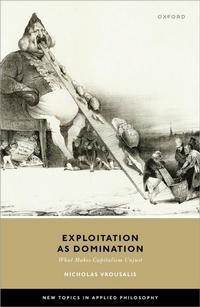
Exploitation as Domination
What Makes Capitalism Unjust
Published on 17. November 2022
224 pages
978-0-19-269353-2 (ISBN)
Description

This is an open access title available under the terms of a CC BY-NC-ND 4.0 International license. It is offered as a free PDF download from OUP and selected open access locations.
Exploitation is a globally pervasive phenomenon. Slavery, serfdom, and the patriarchy are part of its lineage. Temporary and sex workers, commercial surrogacy, precarious labour contracts, sweatshops, and markets in blood, vaccines or human organs, are some contemporary manifestations of exploitation. What makes these exploitative transactions unjust? And is capitalism inherently exploitative? This book offers answers to these two questions. Nicholas Vrousalis argues that exploitation is a form of domination, self-enrichment through the domination of others. On the domination view, exploitation complaints are not, fundamentally, about harm, coercion or unfairness. Rather, they are about who serves whom and why. Exploitation, in a word, is a dividend of servitude: the dividend the powerful extract from the servitude of the vulnerable. Vrousalis claims that this servitude is inherent to capitalist relations between consenting adults whereby capital is monetary control over the labour capacity of others. It follows that capitalism, the mode of production where capital predominates, is an inherently unjust social structure.
More details
Other editions
Additional editions
Book
11/2022
Oxford University Press
€101.50
Shipment within 15-20 days
Person
Nicholas Vrousalis is an Associate Professor in Practical Philosophy at Erasmus University, Rotterdam. He read economics and Trinity Hall, Cambridge, and obtained his doctorate in political philosophy from the University of Oxford. In 2015 Vrousalis published his first book, The Political Philosophy of G. A. Cohen, with Bloomsbury. His research interests include distributive ethics, democratic theory, and the history of political thought, with an emphasis on Kant, Hegel, and Marx.
Content
- Cover
- Exploitation as Domination: What Makes Capitalism Unjust
- Copyright
- Dedication
- Contents
- List of Figure and Tables
- Preface
- Introduction
- Main Arguments of the Book
- Summary of the Book
- How to Read this Book
- PART I BACKGROUND
- 1: Theories of Exploitation
- 1.1 Introduction
- 1.2 The Generic Account
- 1.3 Conceptual Speciation
- 1.4 Teleological Theories
- 1.4.1 Exploitation as harm
- 1.4.2 Exploitation as failure of reciprocity
- 1.5 Respect Theories
- 1.5.1 Exploitation as forced nonreciprocation
- 1.5.2 Exploitation as a rights violation
- 1.5.3 Exploitation as distributive injustice
- 1.5.3.1 Just price
- 1.5.3.2 Just distribution
- 1.6 Freedom Theories
- 1.6.1 Exploitation as vulnerability instrumentalization
- 1.6.2 Exploitation as domination
- 1.6.3 Wertheimer's domination view
- Conclusion
- Looking ahead
- Further reading
- PART II THEORY
- 2: Domination at Work
- 2.1 The Non-Servitude Proviso
- 2.1.1 Introducing the Non-Servitude Proviso
- 2.1.2 Freedom and mode of production
- 2.2 Justifying the Proviso
- 2.3 Reproducible Exploitation
- 2.3.1 Collective ownership (I)
- 2.3.2 Capitalist ownership (II)
- 2.4 Implications for Capitalism
- 2.4.1 Capitalist ownership (III)
- 2.4.2 How capital violates the Proviso
- 2.4.3 Domination without exploitation
- 2.5 The Role of Money
- 2.6 Forms of Domination
- 2.6.1 Point-of-production domination
- 2.6.2 Property-relations domination
- 2.6.3 A third form of domination
- 2.7 Domination, Alienation, Reification
- 2.8 The Presence and Relevance of ExploitationUnder Capitalism
- Conclusion
- Appendix: Productivity growth
- 3: How Exploiters Dominate
- 3.1 Metrics of Exploitation
- 3.1.1 Unequal exchange of labour
- 3.1.2 Roemer on unequal exchange
- 3.1.3 Why surplus labour is indispensable
- 3.2 Vulnerability and Domination
- 3.2.1 The place of vulnerability
- 3.2.2 The priority of domination
- 3.3 Masters, Billionaires, Offers, Kidneys, Surrogacy
- 3.3.1 Master and servant
- 3.3.2 Exploiting billionaires
- 3.3.3 Lucrative offers
- 3.3.4 Kidneys and surrogacy
- 3.4 Against the Vulnerability View
- 3.5 Against the Fairness View
- 3.5.1 The lenience objection
- 3.5.2 The trivialization objection
- Conclusion
- Appendix: Rich and poor
- 4: Structural Domination in the Market
- 4.1 The Structure of Structural Domination
- 4.1.1 Structural power relations in general
- 4.1.2 Structural domination in general
- 4.2 Structuration = Regulation
- 4.3 Defining the Regulation Function
- 4.4 How Capitalists Dominate
- 4.5 Capitalism Entails the State
- 4.6 Capital's Agentlessness
- 4.7 Modes of Capitalist Exploitation
- 4.7.1 The vertical case
- 4.7.2 The horizontal case
- 4.8 The Cage's Girth
- 4.8.1 Across time
- 4.8.2 Across space
- Conclusion
- PART III APPLICATIONS
- 5: Capitalist Exploitation: ItsForms, Origin, and Fate
- 5.1 The Problem of Subsumed Labour
- 5.2 Definitions
- 5.2.1 Capitalist relations of production
- 5.2.2 The capitalist mode of production
- 5.2.3 Exploitation and subsumption
- 5.3 Capital Without Wage-Labour
- 5.3.1 An invalid inference
- 5.3.2 Usurers, merchants, and surplus value
- 5.4 Capital Before Wage-Labour
- 5.4.1 Skillman on subsumption
- 5.4.2 Banaji on subsumption
- 5.4.3 Brenner and Wood on subsumption
- 5.5 Capital After Wage-Labour
- 5.6 The Case Against Market Socialism
- 5.6.1 Against self-exploitation
- 5.6.2 The real case against market socialism
- 5.6.3 How abstract subsumption is distinctive
- 5.7 How Capitalists Dominate
- Conclusion
- Appendix: Exploitation across heterogenuous firms
- 6: Exploitation and International Relations
- 6.1 Domination in International Relations
- 6.2 Colonial and Liberal Imperialism
- 6.2.1 Colonial imperialism
- 6.2.2 Liberal imperialism
- 6.3 Globalization and International Exploitation
- 6.3.1 States and classes
- 6.3.2 How imperialists exploit
- 6.3.2.1 Free trade
- 6.3.2.2 Capital exports
- 6.4 Resistance and Working-Class Internationalism
- 6.4.1 The right to resist
- 6.4.2 Against national self-determination
- 6.4.3 The burdens of working-class internationalism
- Conclusion
- Appendix: Who exploits whom?
- PART IV ALTERNATIVES
- 7: The Emancipated Economy
- 7.1 Against Unconditional Basic Income
- 7.2 Ambiguities of Property-Owning Democracy
- 7.2.1 Roemer's POD
- 7.2.2 Why POD is not enough
- 7.3 Trepidations of Workplace Democracy
- 7.3.1 The general case for WD
- 7.3.2 The labour epistocracy
- 7.3.3 Why WD is not enough
- 7.4 'Liberal Socialism:' The Hybrid Model
- 7.5 The Black Box of the State
- 7.5.1 Worker control, bottom-up
- 7.5.2 Dilemmas of socialization
- Conclusion
- References
- Index
