

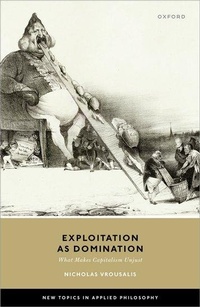
Exploitation as Domination
What Makes Capitalism Unjust
Published on 30. November 2022
Book
Hardback
212 pages
978-0-19-286769-8 (ISBN)
Description
This is an open access title available under the terms of a CC BY-NC-ND 4.0 International license. It is offered as a free PDF download from OUP and selected open access locations.
Exploitation is a globally pervasive phenomenon. Slavery, serfdom, and the patriarchy are part of its lineage. Temporary and sex workers, commercial surrogacy, precarious labour contracts, sweatshops, and markets in blood, vaccines or human organs, are some contemporary manifestations of exploitation. What makes these exploitative transactions unjust? And is capitalism inherently exploitative? This book offers answers to these two questions. Nicholas Vrousalis argues that exploitation is a form of domination, self-enrichment through the domination of others. On the domination view, exploitation complaints are not, fundamentally, about harm, coercion or unfairness. Rather, they are about who serves whom and why. Exploitation, in a word, is a dividend of servitude: the dividend the powerful extract from the servitude of the vulnerable. Vrousalis claims that this servitude is inherent to capitalist relations between consenting adults whereby capital is monetary control over the labour capacity of others. It follows that capitalism, the mode of production where capital predominates, is an inherently unjust social structure.
Exploitation is a globally pervasive phenomenon. Slavery, serfdom, and the patriarchy are part of its lineage. Temporary and sex workers, commercial surrogacy, precarious labour contracts, sweatshops, and markets in blood, vaccines or human organs, are some contemporary manifestations of exploitation. What makes these exploitative transactions unjust? And is capitalism inherently exploitative? This book offers answers to these two questions. Nicholas Vrousalis argues that exploitation is a form of domination, self-enrichment through the domination of others. On the domination view, exploitation complaints are not, fundamentally, about harm, coercion or unfairness. Rather, they are about who serves whom and why. Exploitation, in a word, is a dividend of servitude: the dividend the powerful extract from the servitude of the vulnerable. Vrousalis claims that this servitude is inherent to capitalist relations between consenting adults whereby capital is monetary control over the labour capacity of others. It follows that capitalism, the mode of production where capital predominates, is an inherently unjust social structure.
Reviews / Votes
It is to the great credit of this book, and its author, that they focus attention on such questions, and provide a clear rationale for their pursuit. * Callum Zavos MacRae, The Philosophy Department, The Graduate Center, NY, United States * In Exploitation as Domination, Nicholas Vrousalis brings philosophical discussions of exploitation full circle back to capitalism. * Lillian Cicerchia, University of Amsterdam * The book makes a powerful case for the major conceptual connections that it proposes, and it will most likely serve in the years to come as both an instructive example of the rigor and breadth with which novel research in the philosophy of socialism can be conducted. * Callum Zavos MacRae, Res Publica * Vrousalis' book brings us to the brink of [...] a revived critique of political economy, rather than a new theory of distributive justice. * Lillian Cicerchia, Economics & Philosophy * It is to the great credit of this book, and its author, that they focus attention on such questions, and provide a clear rationale for their pursuit. * Callum Zavos MacRae, Res Publica * This book explores the conceptual interrelationships between human "exploitation" and "domination." ...This book is extremely well written and well organized. * Choice * the best and most comprehensive alternative conception of exploitation currently on offer. * Lucas Stanczyk, Erasmus Journal for Philosophy and Economics * A decade ago, purely distributive approaches [to exploitation] were dominant. The challenges Vrousalis has raised for these accounts have had a major impact. It is now largely taken for granted... that exploitation requires something more than maldistribution. Exploitation as Domination makes that point abundantly clear. * Roberto Veneziani, Analysis * Nicholas Vrousalis's central claims about exploitation in Exploitation as Domination are clear and intuitively compelling: exploitation is self-enrichment through the domination of others, and it is inherent to capitalism. * Benjamin Ferguson, Ethics *More details
Series
Language
English
Place of publication
Oxford
United Kingdom
Target group
College/higher education
Product notice
sewn/stitched
Cloth over boards
Dimensions
Height: 238 mm
Width: 163 mm
Thickness: 20 mm
Weight
275 gr
ISBN-13
978-0-19-286769-8 (9780192867698)
Copyright in bibliographic data and cover images is held by Nielsen Book Services Limited or by the publishers or by their respective licensors: all rights reserved.
Schweitzer Classification
Other editions
Additional editions
E-Book
11/2022
OUP eBook
€69.99
Available for download
E-Book
10/2022
1st Edition
OUP eBook
€48.99
Available for download
Person
Nicholas Vrousalis is an Associate Professor in Practical Philosophy at Erasmus University, Rotterdam. He read economics and Trinity Hall, Cambridge, and obtained his doctorate in political philosophy from the University of Oxford. In 2015 Vrousalis published his first book, The Political Philosophy of G. A. Cohen, with Bloomsbury. His research interests include distributive ethics, democratic theory, and the history of political thought, with an emphasis on Kant, Hegel, and Marx.
Content
Table of Contents
List of Figures and Tables
Introduction
Background
1: Theories of Exploitation
Theory
2: Domination at Work
3: How Exploiters Dominate
4: Structural Domination in the Market
Applications
5: Capitalist Exploitation: Its Forms, Origin, and Fate
6: Exploitation and International Relations
Alternatives
7: The Emancipated Economy
References
List of Figures and Tables
Introduction
Background
1: Theories of Exploitation
Theory
2: Domination at Work
3: How Exploiters Dominate
4: Structural Domination in the Market
Applications
5: Capitalist Exploitation: Its Forms, Origin, and Fate
6: Exploitation and International Relations
Alternatives
7: The Emancipated Economy
References