

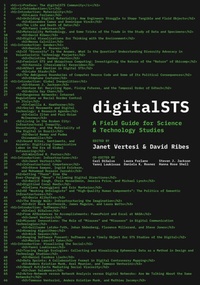
digitalSTS
A Field Guide for Science & Technology Studies
1st Edition
Published on 7. May 2019
568 pages
978-0-691-19060-0 (ISBN)
Description

No detailed description available for "digitalSTS".
All prices
More details
Language
English
Place of publication
Princeton
United States
Publishing group
De Gruyter
Target group
Professional and scholarly
Edition type
Digital original
Product notice
Reflowable
Illustrations
75 b/w illus. 1 table. 4 maps.
75 b/w illus. 1 table. 4 maps.
File size
18,53 MB
ISBN-13
978-0-691-19060-0 (9780691190600)
Schweitzer Classification
Other editions
Additional editions
Book
05/2019
Princeton University Press
€42.50
Article not available at the moment
Book
05/2019
Princeton University Press
€155.50
Shipment within 10-20 days
Persons
Janet Vertesi is assistant professor of sociology at Princeton University and the author of Seeing Like a Rover: How Robots, Teams, and Images Craft Knowledge of Mars. David Ribes is associate professor in the Department of Human Centered Design and Engineering and director of the Data Ecologies Lab at the University of Washington.
Content
- Cover
- Contents
- Preface: The digitalSTS Community
- Introduction
- Introduction / Materiality
- Unfolding Digital Materiality: How Engineers Struggle to Shape Tangible and Fluid Objects
- The Life and Death of Data
- Materiality Methodology, and Some Tricks of the Trade in the Study of Data and Specimens
- Digital Visualizations for Thinking with the Environment
- Introduction / Gender
- If "Diversity" Is the Answer, What Is the Question? Understanding Diversity Advocacy in Voluntaristic Technology Projects
- Feminist STS and Ubiquitous Computing: Investigating the Nature of the "Nature" of Ubicomp
- Affect and Emotion in digitalSTS
- The Ambiguous Boundaries of Computer Source Code and Some of Its Political Consequences
- Introduction / Global Inequalities
- Venture Ed: Recycling Hype, Fixing Futures, and the Temporal Order of Edtech
- Dangerous Networks: Internet Regulations as Racial Border Control in Italy
- Social Movements and Digital Technology: A Research Agenda
- Living in the Broken City: Infrastructural Inequity, Uncertainty, and the Materiality of the Digital in Brazil
- Sound Bites, Sentiments, and Accents: Digitizing Communicative Labor in the Era of Global Outsourcing
- Introduction / Infrastructure
- Infrastructural Competence
- Getting "There" from the Ever-Changing "Here": Following Digital Directions
- Digitized Coral Reefs
- Of "Working Ontologists" and "High-Quality Human Components": The Politics of Semantic Infrastructures
- The Energy Walk: Infrastructuring the Imagination
- Introduction / Software
- From Affordances to Accomplishments: PowerPoint and Excel at NASA
- Misuser Innovations: The Role of "Misuses" and "Misusers" in Digital Communication Technologies
- Knowing Algorithms
- Keeping Software Present: Software as a Timely Object for STS Studies of the Digital
- Introduction / Visualizing the Social
- Tracing Design Ecologies: Collecting and Visualizing Ephemeral Data as a Method in Design and Technology Studies
- Data Sprints: A Collaborative Format in Digital Controversy Mapping
- Smart Artifacts Mediating Social Viscosity
- Actor-Network versus Network Analysis versus Digital Networks: Are We Talking about the Same Networks?
- Acknowledgments
- Contributors
- Index

