

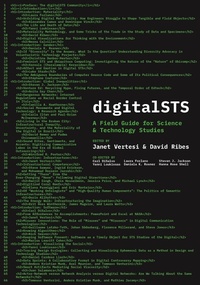
digitalSTS
A Field Guide for Science & Technology Studies
Will be published approx. on 7. May 2019
Book
Paperback/Softback
568 pages
978-0-691-18708-2 (ISBN)
Description
New perspectives on digital scholarship that speak to today's computational realities
Scholars across the humanities, social sciences, and information sciences are grappling with how best to study virtual environments, use computational tools in their research, and engage audiences with their results. Classic work in science and technology studies (STS) has played a central role in how these fields analyze digital technologies, but many of its key examples do not speak to today's computational realities. This groundbreaking collection brings together a world-class group of contributors to refresh the canon for contemporary digital scholarship.
In twenty-five pioneering and incisive essays, this unique digital field guide offers innovative new approaches to digital scholarship, the design of digital tools and objects, and the deployment of critically grounded technologies for analysis and discovery. Contributors cover a broad range of topics, including software development, hackathons, digitized objects, diversity in the tech sector, and distributed scientific collaborations. They discuss methodological considerations of social networks and data analysis, design projects that can translate STS concepts into durable scientific work, and much more.
Featuring a concise introduction by Janet Vertesi and David Ribes and accompanied by an interactive microsite, this book provides new perspectives on digital scholarship that will shape the agenda for tomorrow's generation of STS researchers and practitioners.
Scholars across the humanities, social sciences, and information sciences are grappling with how best to study virtual environments, use computational tools in their research, and engage audiences with their results. Classic work in science and technology studies (STS) has played a central role in how these fields analyze digital technologies, but many of its key examples do not speak to today's computational realities. This groundbreaking collection brings together a world-class group of contributors to refresh the canon for contemporary digital scholarship.
In twenty-five pioneering and incisive essays, this unique digital field guide offers innovative new approaches to digital scholarship, the design of digital tools and objects, and the deployment of critically grounded technologies for analysis and discovery. Contributors cover a broad range of topics, including software development, hackathons, digitized objects, diversity in the tech sector, and distributed scientific collaborations. They discuss methodological considerations of social networks and data analysis, design projects that can translate STS concepts into durable scientific work, and much more.
Featuring a concise introduction by Janet Vertesi and David Ribes and accompanied by an interactive microsite, this book provides new perspectives on digital scholarship that will shape the agenda for tomorrow's generation of STS researchers and practitioners.
Reviews / Votes
"Winner of the Olga Amsterdamska Award, European Association for the Study of Science and Technology"More details
Language
English
Place of publication
New Jersey
United States
Target group
College/higher education
Professional and scholarly
Product notice
Paperback (trade)
Illustrations
4 Maps
Dimensions
Height: 254 mm
Width: 180 mm
Thickness: 40 mm
Weight
1139 gr
ISBN-13
978-0-691-18708-2 (9780691187082)
Copyright in bibliographic data and cover images is held by Nielsen Book Services Limited or by the publishers or by their respective licensors: all rights reserved.
Schweitzer Classification
Other editions
Additional editions
E-Book
05/2019
1st Edition
Princeton University Press
from
€204.95
Available for download
Persons
Janet Vertesi is assistant professor of sociology at Princeton University and the author of Seeing Like a Rover: How Robots, Teams, and Images Craft Knowledge of Mars. David Ribes is associate professor in the Department of Human Centered Design and Engineering and director of the Data Ecologies Lab at the University of Washington.