

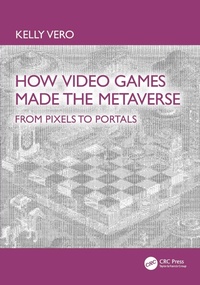
How Video Games Made the Metaverse
From Pixels to Portals
Published on 22. January 2026
168 pages
978-1-040-60803-6 (ISBN)
Description

This book offers an unflinching look at the creative and structural challenges of storytelling in interactive media. Drawing on over 30 years of industry experience, Kelly Vero explores the rich interplay between narrative, design and technology, making the case for why story, far from being a cosmetic layer, is foundational to player engagement, emotional investment and lasting value in games and virtual worlds.
The book unpacks how narrative design works across different genres and platforms: from AAA games and sandbox titles to immersive metaverses, offering a toolkit of questions and techniques to help creators build experiences that resonate. Vero brings the reader inside the design process, examining iterative workflows, empathy versus hypothesis testing, and the importance of building for diverse, evolving user bases. She draws from case studies including The Legend of Zelda, BTS Universe Story, Final Fantasy XIV and even RuneScape's infamous party hat, showing how stories are told not just through dialogue, but also through User Interface (UI), environment, mechanics and player choice.
Crucially, How Video Games Made the Metaverse: From Pixels to Portals is about building worlds that people want to live in. Whether you're a product lead, a writer or a designer, this book explores how to integrate content, interaction and community into a unified whole. It challenges creators to abandon ego-led development and instead embrace deep user understanding as the compass for creative direction.
By the end, readers will understand how to apply storytelling techniques not only to games and metaverses, but also to digital products more broadly, from loyalty programmes and education platforms to virtual retail and Artificial Intelligence (AI) companions. Vero's reflections on narrative, purpose and legacy offer a roadmap for creating digital experiences that matter, not just ones that entertain.
The book unpacks how narrative design works across different genres and platforms: from AAA games and sandbox titles to immersive metaverses, offering a toolkit of questions and techniques to help creators build experiences that resonate. Vero brings the reader inside the design process, examining iterative workflows, empathy versus hypothesis testing, and the importance of building for diverse, evolving user bases. She draws from case studies including The Legend of Zelda, BTS Universe Story, Final Fantasy XIV and even RuneScape's infamous party hat, showing how stories are told not just through dialogue, but also through User Interface (UI), environment, mechanics and player choice.
Crucially, How Video Games Made the Metaverse: From Pixels to Portals is about building worlds that people want to live in. Whether you're a product lead, a writer or a designer, this book explores how to integrate content, interaction and community into a unified whole. It challenges creators to abandon ego-led development and instead embrace deep user understanding as the compass for creative direction.
By the end, readers will understand how to apply storytelling techniques not only to games and metaverses, but also to digital products more broadly, from loyalty programmes and education platforms to virtual retail and Artificial Intelligence (AI) companions. Vero's reflections on narrative, purpose and legacy offer a roadmap for creating digital experiences that matter, not just ones that entertain.
More details
Language
English
Place of publication
London
United Kingdom
Publishing group
Taylor & Francis Ltd
Target group
Professional and scholarly
Product notice
Reflowable
Illustrations
26 Tables, black and white; 4 Line drawings, black and white; 4 Illustrations, black and white
File size
1,70 MB
ISBN-13
978-1-040-60803-6 (9781040608036)
Copyright in bibliographic data and cover images is held by Nielsen Book Services Limited or by the publishers or by their respective licensors: all rights reserved.
Schweitzer Classification
Other editions
Additional editions
Book
approx. 01/2026
1st Edition
CRC Press
€74.20
Not yet published

Book
approx. 01/2026
1st Edition
CRC Press
€178.70
Not yet published
Person
Kelly Vero is a game developer, futurist and technology pioneer with 30 years of experience in the interactive entertainment industry. She has worked with leading studios and brands worldwide, and is a frequent keynote speaker on the metaverse, narrative design and AI. Her previous book Breaking Through Bytes was published in 2025.
Content
1. Introduction to Technology, 2. Early Tech Stacks, 3. Game Engines and AI, 4. Avatars, Digital Twins and Plug-Ins Part I, 5. Avatars, Digital Twins and Plug-Ins Part II, 6. Introduction to Narrative and Design, 7. Design and Game Thinking, 8. Good Stories, 9. A Life in the Metaverse, 10. Introduction to User Experience, 11. Interoperability, 12. User Acquisition, 13. Communities and Influencers, Afterword
