

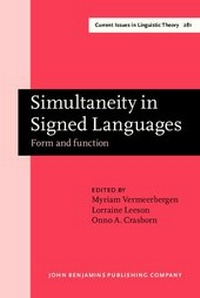
Simultaneity in Signed Languages
Form and function
1st Edition
Published on 21. February 2007
VIII, 360 pages
978-90-272-9295-7 (ISBN)
Description

Signed language users can draw on a range of articulators when expressing linguistic messages, including the hands, torso, eye gaze, and mouth. Sometimes these articulators work in tandem to produce one lexical item while in other instances they operate to convey different types of information simultaneously. Over the past fifteen years, there has been a growing interest in the issue of simultaneity in signed languages. However, this book is the first to offer a comprehensive treatment of this topic, presenting a collection of papers dealing with different aspects of simultaneity in a range of related and unrelated signed languages, in descriptive and cross-linguistic treatments which are set in different theoretical frameworks. This volume has relevance for those interested in sign linguistics, in teaching and learning signed languages, and is also highly recommended to anyone interested in the fundamental underpinnings of human language and the effects of signed versus spoken modality.
More details
Other editions
Additional editions
Myriam Vermeerbergen | Lorraine Leeson | Onno A. Crasborn
Simultaneity in Signed Languages
Form and function
Book
02/2007
John Benjamins Publishing Co
€132.50
Shipment within 10-15 days
Persons
Content
- Simultaneity in Signed Languages
- Editorial page
- Title page
- LCC data
- Dedication
- Contents
- Simultaneity in signed languages
- 1. Introduction
- 2. Simultaneous structures discussed in this book
- 3. What this book is not about
- 4. Simultaneity in spoken languages
- 4.1. Prosody
- 4.2. Nonverbal communication
- 5. Simultaneity in signed languages: An overview of work to date
- 5.1. Research focusing on simultaneous constructions in signed languages
- 5.2. Dominance reversals
- 5.3. The French tradition
- 5.4. Beyond the seminal works on simultaneity
- 6. Outline of the volume
- 7. Some notes on terminology and formatting
- 7.1. `Sign language' versus `signed language'
- 7.2. Referring to individual signed languages
- 7.3. The hands
- 7.4. Presentation of examples
- References
- Locative functions of simultaneous perspective constructions in German Sign Language narratives
- 1. Introduction
- 2. Previous research on simultaneous constructions
- 3. Signing perspective
- 3.1. Prototypical manifestations of signing perspective
- 3.2. Non-prototypical manifestations of signing perspective
- 4. Previous research on the simultaneous use of different perspectives
- 5. Signing perspective and discourse structure constraints
- 6. Locative functions of non-prototypically aligned simultaneous constructions
- 7. Simultaneous constructions in character perspective narratives
- 7.1. Full semantic specification through supplementation
- 7.2. Full semantic specification through disambiguation
- 8. Simultaneous constructions in observer and character perspective narratives
- 8.1. Mapping between perspectives for efficiency and explicitness of expression
- 8.2. Mapping between spaces to shift event component focus
- 9. Summary and discussion
- References
- Appendix: Description of stimulus film
- Conceptual blending and the windowing of attention in simultaneous constructions in Irish Sign Language
- 1. Introduction
- 2. The data
- 3. Simultaneous constructions in ISL
- 4. Windowing of attention
- 5. Mapping thought and language: Mental spaces
- 6. Conceptual blends in ISL
- 7. The role of the non-dominant hand in simultaneous constructions in ISL
- 8. Summary
- References
- A cognitive linguistic view of simultaneity in process signs in French Sign Language
- 1. Approach to simultaneity
- 2. The corpus
- 3. Structure of process signs
- 3.1. Signs which construct syntactic space
- 3.2. Applicative and cognitive grammar
- 3.3. Iconic references in morphology: the link between the hands and the head and torso
- 3.4. Network of the components of a verb sign
- 3.5. Anaphoric references
- 3.6. Cognitive-semantic interpretation and morpho-syntax in process signs
- 4. Syntactic simultaneity
- 4.1. Components of syntactic simultaneity
- 4.2. Function of syntactic simultaneity
- 5. Conclusion
- References
- Simultaneity in French Sign Language discourse
- 1. Introduction
- 1.1. The problem
- 1.2. Iconicity in signed languages
- 1.3. The data
- 1.4. Outline in three parts
- 2. Cuxac's model
- 2.1. Brief presentation of Cuxac's model of intent
- 2.2. Highly Iconic Structures and transfer operations
- 2.3. Transfers of person
- 2.4. Proforms, transfers and property markers, rather than classifiers
- 2.5. Cuxac's discussion of simultaneity
- 3. Simultaneity in Highly Iconic Structures (illustrative intent)
- 3.1. Simple transfers
- 3.2. In combined transfers: Double transfers
- 3.3. Synthesis
- 4. Simultaneity in frozen signs, pointing and mouthing (non-illustrative intent)
- 4.1. Two simultaneous frozen signs
- 4.2. An `unfrozen' sign
- 4.3. Simultaneity combining both intents
- 5. Conclusion
- Acknowledgments
- References
- Simultaneous constructions in Adamorobe Sign Language (Ghana)
- 1. Introduction
- 1.1. Simultaneous constructions in signed languages
- 1.2. Adamorobe
- 1.3. Languages in Adamorobe
- 2. Data
- 3. Simultaneous manual-oral combinations
- 3.1. Simultaneous combinations of a mouthing and a manual sign of size and shape
- 3.2. Simultaneous combinations of a colour mouthing and a manual sign
- 4. Bimanual simultaneous constructions
- 4.1. Data
- 4.2. Results
- 4.3. Ground incorporation
- 4.4. A manual sign with a whole body sign expressing simultaneous events
- 4.5. Discourse marking hold
- 4.6. Discussion
- 5. Conclusion
- References
- Mouthings and simultaneity in British Sign Language
- 1. Introduction
- 2. Data corpus: Collection and analysis
- 3. Data transcription
- 4. Results
- 4.1. Stretching of mouth patterns
- 4.2. Anticipations
- 4.3. Additional mouthings
- 4.4. Incomplete relation to the sign
- 4.5. Specific identification of a sign
- 4.6. Mouthings with simultaneous manual signs
- 4.7. Simultaneous production of phrases
- 4.8. Numerals and quantifiers
- 4.9. Constructed speaking
- 4.10. Expression of sounds
- 4.11. Other mouthings
- 5. Conclusion
- Acknowledgements
- References
- The non-dominant hand in a Swedish Sign Language discourse
- 1. Introduction
- 2. Material and method
- 3. The non-dominant hand
- 3.1. In lap
- 3.2. At chest
- 3.3. Mirror at chest
- 3.4. Mirroring
- 3.5. Doubling
- 3.6. Sign fragments
- 3.7. Buoys
- 4. Dominance reversals
- 5. Discussion
- 6. Summary
- References
- A crosslinguistic comparison of buoys
- 1. An introduction to buoys
- 2. List buoys
- 2.1. Sequentially built lists vs. single fixed-length lists
- 2.2. Lists as spatial representations
- 2.3. List buoy summary
- 3. THEME buoys in ASL, SSL, and NSL
- 4. Fragment buoys
- 5. The POINTER buoy
- 6. Conclusions
- References
- Point buoys
- 1. Introduction
- 2. POINT-G and POINT-B
- 3. Buoys representing points in space
- 3.1. Example one
- 3.2. Example two
- 3.3. Example three
- 4. Buoys representing points in time
- 4.1. Example four
- 4.2. Example five
- 4.3. Example six
- 4.4. Example seven
- 5. Use of signing space in relation to point buoys
- 6. Discussion
- References
- Appendix
- Transcription conventions
- Simultaneous use of the two hands in Jordanian Sign Language
- 1. Introduction
- 2. Jordanian Sign Language (LIU)
- 3. Data and methodology
- 4. Phonological restrictions on simultaneity
- 5. Simultaneity in classifier constructions in LIU
- 6. Do buoys exist in LIU?
- 6.1. Simultaneity involving determiners and pronouns
- 6.2. Numbers in simultaneous constructions
- 6.3. The use of perseverations
- 7. Functions of dominance reversal
- 8. The interaction of simultaneity and dominance reversal
- 9. Conclusion
- References
- Appendix
- Sign + gesture = speech + gesture?
- 1. Introduction: Definition of gesture and aim of this contribution
- 2. Gesture integrated and gesture having `moved out'
- 2.1. Gesture integrated
- 2.2. Gesture on the mouth
- 3. Sign + gesture, one hand for each?
- 3.1. `Enumeration'
- 3.2. Pointing signs and pointing gestures
- 3.3. Concurrent lexical items and gesture(s)
- 4. Discussion
- Acknowledgments
- References
- Appendix: Transcription conventions
- Acquisition of simultaneous constructions by deaf children of Hong Kong Sign Language
- 1. Introduction
- 2. Simultaneity in signed language
- 2.1. Simultaneity: A definition
- 2.2. Classifier constructions in Hong Kong Sign Language
- 3. Implications for signed language acquisition
- 3.1. Classifier predicates: Previous acquisition findings
- 3.2. The non-dominant hand in the acquisition of classifier constructions
- 3.3. Triggering experiences in language acquisition
- 3.4. Research questions
- 4. The present study
- 4.1. Subjects
- 4.2. Methodology
- 5. Results
- 5.1. Production of simultaneous constructions
- 5.2. Performance on classifiers
- 5.3. Morphological development of dominant and non-dominant hands in S2 constructions
- 5.4. The non-dominant hand in the acquisition process
- 6. Discussion
- 7. Conclusion
- Notation conventions
- References
- Simultaneity in atypical signers
- 1. Introduction
- 2. Modality differences inherent to the physical production mechanism
- 3. Brain, motor control, and language
- 4. Signed language and the brain
- 5. Simultaneity and specific neural pathologies
- 5.1. Left hemisphere damage
- 5.2. Right hemisphere damage
- 5.3. Parkinson's disease
- 5.4. Cerebellar damage
- 5.5. Progressive supranuclear palsy
- 6. Implications for the structure of signed language
- 7. Directions for future research and methodological development
- References
- Perspectives on linearity and simultaneity
- 1. Introduction
- 2. Linearity and simultaneity - an historical perspective
- 3. Contemporary approaches to simultaneity in signed languages
- 4. Simultaneity and linearity in grammar and semantics
- 5. Simultaneity and linearity in discourse
- 6. Future directions in research
- References
- Name index
- Language index
- Subject index
- The series CURRENT ISSUES IN LINGUISTIC THEORY
