

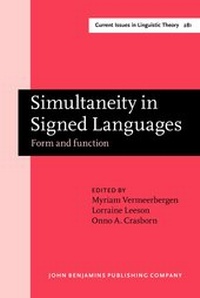
Simultaneity in Signed Languages
Form and function
Published on 21. February 2007
Book
Hardback
360 pages
978-90-272-4796-4 (ISBN)
Description
Signed language users can draw on a range of articulators when expressing linguistic messages, including the hands, torso, eye gaze, and mouth. Sometimes these articulators work in tandem to produce one lexical item while in other instances they operate to convey different types of information simultaneously. Over the past fifteen years, there has been a growing interest in the issue of simultaneity in signed languages. However, this book is the first to offer a comprehensive treatment of this topic, presenting a collection of papers dealing with different aspects of simultaneity in a range of related and unrelated signed languages, in descriptive and cross-linguistic treatments which are set in different theoretical frameworks. This volume has relevance for those interested in sign linguistics, in teaching and learning signed languages, and is also highly recommended to anyone interested in the fundamental underpinnings of human language and the effects of signed versus spoken modality.
More details
Series
Language
English
Place of publication
Amsterdam
Netherlands
Target group
Professional and scholarly
Illustrations
(incl. CD-Rom)
Dimensions
Height: 245 mm
Width: 164 mm
Weight
815 gr
ISBN-13
978-90-272-4796-4 (9789027247964)
Copyright in bibliographic data and cover images is held by Nielsen Book Services Limited or by the publishers or by their respective licensors: all rights reserved.
Schweitzer Classification
Other editions
Additional editions
Myriam Vermeerbergen | Lorraine Leeson | Onno A. Crasborn
Simultaneity in Signed Languages
Form and function
E-Book
02/2007
1st Edition
John Benjamins Publishing Company
€155.99
Available for download
Persons
Content
1. Simultaneity in Signed Languages.: A String of Sequentially Organised Issues (by Vermeerbergen, Myriam); 2. Locative Functions of Simultaneous Perspective Constructions in German Sign Language Narratives (by Perniss, Pamela M.); 3. Conceptual Blending and the Windowing of Attention in Simultaneous Constructions in Irish Sign Language (by Leeson, Lorraine); 4. A Cognitive Linguistic View of Simultaneity in Process Signs in French Sign Language (by Risler, Annie); 5. Simultaneity in French Sign Language Discourse (by Sallandre, Marie-Anne); 6. Simultaneous Constructions in Adamorobe Sign Language (Ghana) (by Nyst, Victoria); 7. Mouthings and Simultaneity in British Sign Language (by Sutton-Spence, Rachel); 8. The Non-Dominant Hand in a Swedish Sign Language Discourse (by Nilsson, Anna-Lena); 9. A Crosslinguistic Comparison of Buoys. Evidence from American, Norwegian, and Swedish Sign Language (by Liddell, Scott K.); 10. Point Buoys: The Weak Hand as a Point of Reference for Time and Space (by Vogt-Svendsen, Marit); 11. Simultaneous Use of the Two Hands in Jordanian Sign Language (by Hendriks, Bernadet); 12. Sign + Gesture = Speech + Gesture?: Comparing Aspects of Simultaneity in Flemish Sign Language to Instances of Concurrent Speech and Gesture (by Vermeerbergen, Myriam); 13. Acquisition of Simultaneous Constructions by Deaf Children of Hong Kong Sign Language (by Tang, Gladys); 14. Simultaneity in Atypical Signers: Implications for the Structure of Signed Language (by Tyrone, Martha E.); 15. Perspectives on Linearity and Simultaneity (by Woll, Bencie); 16. Index of Names; 17. Index of Languages; 18. Index of Terms