

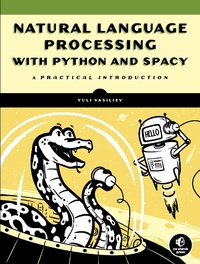
Natural Language Processing with Python and spaCy
A Practical Introduction
Published on 28. April 2020
216 pages
978-1-7185-0053-2 (ISBN)
Description

An introduction to natural language processing with Python using spaCy, a leading Python natural language processing library.
Natural Language Processing with Python and spaCy will show you how to create NLP applications like chatbots, text-condensing scripts, and order-processing tools quickly and easily. You'll learn how to leverage the spaCy library to extract meaning from text intelligently; how to determine the relationships between words in a sentence (syntactic dependency parsing); identify nouns, verbs, and other parts of speech (part-of-speech tagging); and sort proper nouns into categories like people, organizations, and locations (named entity recognizing). You'll even learn how to transform statements into questions to keep a conversation going.
You'll also learn how to:
• Work with word vectors to mathematically find words with similar meanings (Chapter 5)
• Identify patterns within data using spaCy's built-in displaCy visualizer (Chapter 7)
• Automatically extract keywords from user input and store them in a relational database (Chapter 9)
• Deploy a chatbot app to interact with users over the internet (Chapter 11)
"Try This" sections in each chapter encourage you to practice what you've learned by expanding the book's example scripts to handle a wider range of inputs, add error handling, and build professional-quality applications.
By the end of the book, you'll be creating your own NLP applications with Python and spaCy.
Natural Language Processing with Python and spaCy will show you how to create NLP applications like chatbots, text-condensing scripts, and order-processing tools quickly and easily. You'll learn how to leverage the spaCy library to extract meaning from text intelligently; how to determine the relationships between words in a sentence (syntactic dependency parsing); identify nouns, verbs, and other parts of speech (part-of-speech tagging); and sort proper nouns into categories like people, organizations, and locations (named entity recognizing). You'll even learn how to transform statements into questions to keep a conversation going.
You'll also learn how to:
• Work with word vectors to mathematically find words with similar meanings (Chapter 5)
• Identify patterns within data using spaCy's built-in displaCy visualizer (Chapter 7)
• Automatically extract keywords from user input and store them in a relational database (Chapter 9)
• Deploy a chatbot app to interact with users over the internet (Chapter 11)
"Try This" sections in each chapter encourage you to practice what you've learned by expanding the book's example scripts to handle a wider range of inputs, add error handling, and build professional-quality applications.
By the end of the book, you'll be creating your own NLP applications with Python and spaCy.
More details
Other editions
Additional editions
Book
05/2020
No Starch Press
€47.50
Shipment within 3-4 weeks
Person
Yuli Vasiliev is a programmer, freelance writer, and consultant who specializes in open source development, Oracle database technologies, and natural language processing.
Content
Introduction
Chapter 1: How Natural Language Processing Works
Chapter 2: The Text-Processing Pipeline
Chapter 3: Working with Container Objects and Customizing spaCy
Chapter 4: Extracting and Using Linguistic Features
Chapter 5: Working with Word Vectors
Chapter 6: Finding Patterns and Walking Dependency Trees
Chapter 7: Visualizations
Chapter 8: Intent Recognition
Chapter 9: Storing User Input in a Database
Chapter 10: Training Models
Chapter 11: Deploying Your Own Chatbot
Chapter 12: Implementing Web Data and Processing Images
Linguistic Primer
Chapter 1: How Natural Language Processing Works
Chapter 2: The Text-Processing Pipeline
Chapter 3: Working with Container Objects and Customizing spaCy
Chapter 4: Extracting and Using Linguistic Features
Chapter 5: Working with Word Vectors
Chapter 6: Finding Patterns and Walking Dependency Trees
Chapter 7: Visualizations
Chapter 8: Intent Recognition
Chapter 9: Storing User Input in a Database
Chapter 10: Training Models
Chapter 11: Deploying Your Own Chatbot
Chapter 12: Implementing Web Data and Processing Images
Linguistic Primer
