

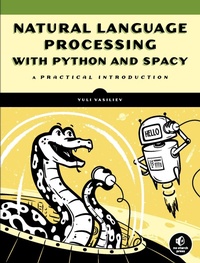
Natural Language Processing with Python and spaCy
A Practical Introduction
Published on 12. May 2020
Book
Paperback/Softback
216 pages
978-1-7185-0052-5 (ISBN)
Description
Smart Natural Language Processing with Python is an introduction to natural language processing (NLP). The book uses spaCy, a leading Python library for NLP, to guide readers through common NLP tasks related to generating and understanding human language with code. It addresses problems like understanding a user's intent, continuing a conversation with a human, and using syntactic dependencies. It also teaches you how to connect an NLP script to a messaging app, store user data in a database to fill in a form, and customise your own statistical models to improve text processing.
Reviews / Votes
"A good resource for those programmers who want to learn to bridge the gap and write applications that anyone can use just by talking or writing to their machines and have the machine reply back."-Jon Lazar, JustJon
More details
Language
English
Place of publication
San Francisco
United States
Dimensions
Height: 235 mm
Width: 181 mm
Thickness: 17 mm
Weight
435 gr
ISBN-13
978-1-7185-0052-5 (9781718500525)
Copyright in bibliographic data and cover images is held by Nielsen Book Services Limited or by the publishers or by their respective licensors: all rights reserved.
Schweitzer Classification
Other editions
Additional editions
E-Book
04/2020
No Starch Press
€34.99
Available for download
Person
Yuli Vasiliev is a programmer, freelance writer, and consultant who specializes in open source development, Oracle database technologies, and natural language processing.
Content
Introduction
Chapter 1: How Natural Language Processing Works
Chapter 2: The Text-Processing Pipeline
Chapter 3: Working with Container Objects and Customizing spaCy
Chapter 4: Extracting and Using Linguistic Features
Chapter 5: Working with Word Vectors
Chapter 6: Finding Patterns and Walking Dependency Trees
Chapter 7: Visualizations
Chapter 8: Intent Recognition
Chapter 9: Storing User Input in a Database
Chapter 10: Training Models
Chapter 11: Deploying Your Own Chatbot
Chapter 12: Implementing Web Data and Processing Images
Linguistic Primer
Chapter 1: How Natural Language Processing Works
Chapter 2: The Text-Processing Pipeline
Chapter 3: Working with Container Objects and Customizing spaCy
Chapter 4: Extracting and Using Linguistic Features
Chapter 5: Working with Word Vectors
Chapter 6: Finding Patterns and Walking Dependency Trees
Chapter 7: Visualizations
Chapter 8: Intent Recognition
Chapter 9: Storing User Input in a Database
Chapter 10: Training Models
Chapter 11: Deploying Your Own Chatbot
Chapter 12: Implementing Web Data and Processing Images
Linguistic Primer