

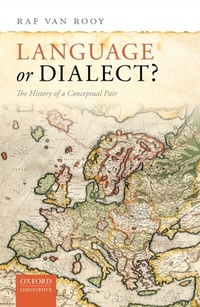
Language or Dialect?
The History of a Conceptual Pair
1st Edition
Published on 1. November 2020
288 pages
978-0-19-258448-9 (ISBN)
Description

This is an open access title available under the terms of a CC BY-NC-ND 4.0 International licence. It is free to read on the Oxford Academic platform and offered as a free PDF download from OUP and selected open access locations.
This book provides a historiographic study of the distinction between language and dialect, a puzzle which has long fascinated linguists and laypeople alike. It offers a comprehensive account of the intriguing and complex history of the language-dialect pair, and shows that its real origins can be found in sixteenth-century humanist scholarship. The book begins with a survey of the prehistory of the language/dialect distinction in antiquity and the Middle Ages. Raf Van Rooy then provides a detailed investigation of the emergence, establishment, and development of the conceptual pair during the early modern period, from the Renaissance to the Enlightenment, when linguistic diversity was first studied in depth. Finally, the much-debated and ambiguous fate of the language/dialect opposition in modern linguistics is explored: although a number of earlier ideas were adopted by later scholars, many linguists today question the notion of a seemingly arbitrary and subjective distinction between language and dialect.
More details
Other editions
Additional editions
Book
11/2020
Oxford University Press
€136.50
Shipment within 15-20 days
Person
Raf Van Rooy is affiliated with KU Leuven as a postdoctoral fellow of the Research Foundation - Flanders (FWO). He was educated at Leuven, Thessaloniki, Louvain-la-Neuve, and Ghent, and obtained his PhD in Linguistics in May 2017 from KU Leuven and the FWO. His research focuses on the early modern study of the Ancient Greek language and on the reception of key linguistic concepts of Greek origin. He has been awarded a number of grants and prizes for his research, which has been published in journals such as Language & Communication, Glotta, and Journal of Greek Linguistics.
Content
- Cover
- Language or Dialect?: The History of a Conceptual Pair
- Copyright
- Dedication
- Contents
- Acknowledgements
- List of Figures
- List of Tables
- Conventions
- 1: Introduction
- I: Prehistory, 500 BC-1500
- 2: A dive into the prehistory of the conceptual pair
- 2.1 The Greek dialects between anecdotes and definitions
- 2.2 Diálektos, a variety of interpretations
- 2.3 Philology as stimulus
- 2.4 The Latin West
- 2.5 Conclusion
- 3: The exception to the rule: Lingua and idioma in Roger Bacon's thought
- 3.1 Bacon at Babel
- 3.2 Another first for Bacon?
- 3.3 An outlook on different languages and their dialects: a central precondition
- 3.4 Thomas Aquinas: a like-minded exegete?
- 3.5 The Tower of Babel
- 3.6 Conclusion
- II: The Origin of the Conceptual Pair, 1500-50
- 4: From dogs and hounds to languages and dialects: The conceptual pair in Conrad Gessner's work
- 4.1 Exploring the linguistic world
- 4.2 Conrad Gessner, certified cataloguer and compiler
- 4.3 Ad fontes! Gessner reads Clement of Alexandria
- 4.4 The meanings of dialectus according to Gessner
- 4.5 Conclusion
- 5: Lingua and dialectus: From synonymy to contrast
- 5.1 Dialectus as a Latin word
- 5.2 The key symptom: contrasting lingua to dialectus
- 5.3 Developing the concept of common language
- 5.4 Updating dialectus definitions
- 5.5 The coining of a new phrase: 'to differ only in dialect'
- 5.6 An intricate conceptual web
- 5.7 Conclusion
- 6: Hellenism, standardization, and info-lust: The genesis of the conceptual pair in context
- 6.1 A major pivoting point: the rediscovery of the Greek dialects
- 6.2 From ancient Greece to Western Europe: standardizing the vernaculars
- 6.3 Knowledge revolution: information explosion and info-lust
- 6.4 The countability of language
- 6.5 A product of appropriation and subconscious adaptation
- 6.6 Conclusion
- III: Consolidation by Elaboration, 1550-1650
- 7: Space and nation: Greek definitions transformed
- 7.1 The spatial conception of dialect
- 7.2 Two topical topoi
- 7.3 Regional language variation: a universal phenomenon?
- 7.4 Nation or nations? The ethnic conception of the language/dialect distinction
- 7.5 Towards a political interpretation of 'nation'?
- 7.6 Space and nation: diagnostic criteria?
- 7.7 Conclusion
- 8: Aristotle's legacy: Substance, accidents, and mutual intelligibility
- 8.1 Extending the 'to differ only in dialect' phrase
- 8.2 Mithridates: polyglot or not?
- 8.3 A question of gradation: devising different levels of dialects
- 8.4 Mutual intelligibility: an early modern criterion
- 8.5 Johannes Goropius Becanus and immediate mutual intelligibility
- 8.6 The communicative reach of dialects versus languages
- 8.7 Conclusion
- 9: A subjective touch: Language beats dialect
- 9.1 Analogical norm or anomalous deviation?
- 9.2 From common to standard language
- 9.3 Superior or inferior?
- 9.4 Conclusion
- 10: The conceptual pair and language history: Language generates dialects
- 10.1 Language mothers and offshoot dialects
- 10.2 An early critic of the language-historical interpretation
- 10.3 A discursive strategy for historical classification
- 10.4 Conclusion
- 11: Consolidation by elaboration: Drawing the balance
- 11.1 The seven main interpretations: a synthesis
- 11.2 Emancipating the conceptual pair from the Greek heritage
- 11.3 Conclusion
- 12: The conceptual pair in transition: The case of Georg Stiernhielm
- 12.1 Georg Stiernhielm, a Swedish all-round scholar
- 12.2 The conceptual pair according to Stiernhielm
- 12.3 Conclusion
- IV: Systematization and Rationalization, 1650-1800
- 13: Putting the conceptual pair on the scholarly agenda: The orientalist Albert Schultens
- 13.1 Schultens's definitions of dialect
- 13.2 Language, dialect, and degenerate offshoot
- 13.3 Classes of linguistic variation
- 13.4 Schultens's legacy
- 13.5 Conclusion
- 14: Lexicostatistics avant la lettre: The historian Johann Christoph Gatterer and the conceptual pair
- 14.1 Gatterer's Vorrede
- 14.2 Characteristic words: Gatterer and basic vocabulary
- 14.3 Determining the degree of linguistic kinship: Gatterer's lexicostatistic framework
- 14.4 The historian Gatterer and the grammarian Adelung
- 14.5 Conclusion
- 15: Classes of variation: How do languages and dialects differ?
- 15.1 Casting off John the Grammarian's yoke
- 15.2 From scattered comments to systematization
- 15.3 Two eighteenth-century outsiders in the quest for linguistic criteria
- 15.4 Conclusion
- 16: Between systematization and rationalization: The conceptual pair through the Enlightenment lens
- 16.1 Towards a dialectological tradition?
- 16.2 The first sceptical voices
- 16.3 Conclusion
- V: From Silent Adoption To Outspoken Abandonment, After 1800
- 17: From Jones to Gabelentz: Silent adoption and renewed suspicion
- 17.1 The beginnings of modern linguistics
- 17.2 Two pioneering dialectologists: Johann Andreas Schmeller and Albert Giese
- 17.3 Questioning the conceptual pair: August Schleicher and William Dwight Whitney
- 17.4 The late nineteenth century: between continued usage and increasing scepticism
- 17.5 Conclusion
- 18: Schuchardt the iconoclast
- 18.1 Tree or waves?
- 18.2 A pioneering outsider
- 18.3 Breaking down the walls between languages and dialects
- 18.4 Linguists, shibbolethists
- 18.5 Useless abstractions?
- 18.6 Conclusion
- 19: From Saussure to 1954: Structuralism and the language/dialect distinction
- 19.1 In Saussure's class
- 19.2 Towards a structural dialectology: Uriel Weinreich's diasystem
- 19.3 Redefining the conceptual pair: Martinet and Polák
- 19.4 Conclusion
- 20: Mutual intelligibility: The number one criterion?
- 20.1 A criterion making career
- 20.2 Measuring linguistic distance
- 20.3 Conclusion
- 21: Between two extremes: Generative and sociolinguistic interpretations
- 21.1 Generative grammar: no country for old dialects?
- 21.2 Variables over systems
- 21.3 Destructive dismissal
- 21.4 Supplementing the conceptual pair
- 21.5 By way of conclusion: a quest for alternatives
- 22: A gentle goodbye?: Dialect stripped for parts
- 22.1 Farewell to the conceptual pair?
- 22.2 The language/dialect distinction after 1900: the story of a love-hate relationship
- 23: Language, dialect, and the general public-or how not to popularize knowledge
- 23.1 The conceptual pair popularized
- 23.2 The Weinreich witticism in context: the nation-state, language policy, and mass education
- 23.3 Political activations of the conceptual pair
- 23.4 Conclusion
- 24: Language and dialect between past and future: Terminological success, conceptual failure?
- References
- Index
