

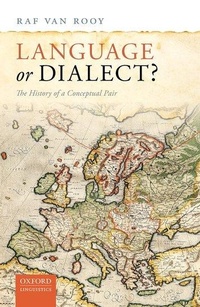
Language or Dialect?
The History of a Conceptual Pair
Published on 1. November 2020
Book
Hardback
370 pages
978-0-19-884571-3 (ISBN)
Description
This is an open access title available under the terms of a CC BY-NC-ND 4.0 International licence. It is free to read on the Oxford Academic platform and offered as a free PDF download from OUP and selected open access locations.
This book provides a historiographic study of the distinction between language and dialect, a puzzle which has long fascinated linguists and laypeople alike. It offers a comprehensive account of the intriguing and complex history of the language-dialect pair, and shows that its real origins can be found in sixteenth-century humanist scholarship. The book begins with a survey of the prehistory of the language/dialect distinction in antiquity and the Middle Ages. Raf Van Rooy then provides a detailed investigation of the emergence, establishment, and development of the conceptual pair during the early modern period, from the Renaissance to the Enlightenment, when linguistic diversity was first studied in depth. Finally, the much-debated and ambiguous fate of the language/dialect opposition in modern linguistics is explored: although a number of earlier ideas were adopted by later scholars, many linguists today question the notion of a seemingly arbitrary and subjective distinction between language and dialect.
This book provides a historiographic study of the distinction between language and dialect, a puzzle which has long fascinated linguists and laypeople alike. It offers a comprehensive account of the intriguing and complex history of the language-dialect pair, and shows that its real origins can be found in sixteenth-century humanist scholarship. The book begins with a survey of the prehistory of the language/dialect distinction in antiquity and the Middle Ages. Raf Van Rooy then provides a detailed investigation of the emergence, establishment, and development of the conceptual pair during the early modern period, from the Renaissance to the Enlightenment, when linguistic diversity was first studied in depth. Finally, the much-debated and ambiguous fate of the language/dialect opposition in modern linguistics is explored: although a number of earlier ideas were adopted by later scholars, many linguists today question the notion of a seemingly arbitrary and subjective distinction between language and dialect.
Reviews / Votes
Van Rooy's masterful and eminently readable study explores this topic across more than two millennia. Filled with a breadth of historiographic detail, the book's 24 well-sequenced chapters consider the conceptual pair language and dialect against the backdrop of successive stages of Western intellectual development ... This tour-de-force of erudition will interest linguists and the general public alike. * E. J. Vajda, CHOICE * This is a bold, enjoyable and enriching conceptual history, warmly recommended both to historians of linguistics and to anyone who uses the terminology of dialect, language, variety and the like today. * Nicola McLelland, Journal of Historical Sociolinguistics *More details
Language
English
Place of publication
Oxford
United Kingdom
Target group
Professional and scholarly
Product notice
sewn/stitched
Cloth over boards
Dimensions
Height: 236 mm
Width: 155 mm
Thickness: 30 mm
Weight
739 gr
ISBN-13
978-0-19-884571-3 (9780198845713)
Copyright in bibliographic data and cover images is held by Nielsen Book Services Limited or by the publishers or by their respective licensors: all rights reserved.
Schweitzer Classification
Other editions
Additional editions
E-Book
11/2020
1st Edition
OUP eBook
€98.99
Available for download
Person
Raf Van Rooy is affiliated with KU Leuven as a postdoctoral fellow of the Research Foundation - Flanders (FWO). He was educated at Leuven, Thessaloniki, Louvain-la-Neuve, and Ghent, and obtained his PhD in Linguistics in May 2017 from KU Leuven and the FWO. His research focuses on the early modern study of the Ancient Greek language and on the reception of key linguistic concepts of Greek origin. He has been awarded a number of grants and prizes for his research, which has been published in journals such as Language & Communication, Glotta, and Journal of Greek Linguistics.
Content
1: Introduction
Part I: Prehistory, 500 BC-1500
2: A dive into the prehistory of the conceptual pair
3: The exception to the rule: Lingua and idioma in Roger Bacon's thought
Part II: The origin of the conceptual pair, 1500-1550
4: From dogs and hounds to languages and dialects: The conceptual pair in Conrad Gessner's work
5: Lingua and dialectus: From synonymy to contrast
6: Hellenism, standardization, and info-lust: The genesis of the conceptual pair in context
Part III: Consolidation by elaboration, 1550-1650
7: Space and nation: Greek definitions transformed
8: Aristotle's legacy: Substance, accidents, and mutual intelligibility
9: A subjective touch: Language beats dialect
10: The conceptual pair and language history: Language generates dialects
11: Consolidation by elaboration: Drawing the balance
12: The conceptual pair in transition: The case of Georg Stiernhielm
Part IV: Systematization and rationalization, 1650-1800
13: Putting the conceptual pair on the scholarly agenda: The orientalist Albert Schultens
14: Lexicostatistics avant la lettre: The historian Johann Christoph Gatterer and the conceptual pair
15: Classes of variation: How do languages and dialects differ?
16: Between systematization and rationalization: The conceptual pair through the Enlightenment lens
Part V: From silent adoption to outspoken abandonment, after 1800
17: From Jones to Gabelentz: Silent adoption and renewed suspicion
18: Schuchardt the iconoclast
19: From Saussure to 1954: Structuralism and the language/dialect distinction
20: Mutual intelligibility: The number one criterion?
21: Between two extremes: Generative and sociolinguistic interpretations
22: A gentle goodbye? Dialect stripped for parts
23: Language, dialect, and the general public-or how not to popularize knowledge
24: Language and dialect between past and future: Terminological success, conceptual failure
Part I: Prehistory, 500 BC-1500
2: A dive into the prehistory of the conceptual pair
3: The exception to the rule: Lingua and idioma in Roger Bacon's thought
Part II: The origin of the conceptual pair, 1500-1550
4: From dogs and hounds to languages and dialects: The conceptual pair in Conrad Gessner's work
5: Lingua and dialectus: From synonymy to contrast
6: Hellenism, standardization, and info-lust: The genesis of the conceptual pair in context
Part III: Consolidation by elaboration, 1550-1650
7: Space and nation: Greek definitions transformed
8: Aristotle's legacy: Substance, accidents, and mutual intelligibility
9: A subjective touch: Language beats dialect
10: The conceptual pair and language history: Language generates dialects
11: Consolidation by elaboration: Drawing the balance
12: The conceptual pair in transition: The case of Georg Stiernhielm
Part IV: Systematization and rationalization, 1650-1800
13: Putting the conceptual pair on the scholarly agenda: The orientalist Albert Schultens
14: Lexicostatistics avant la lettre: The historian Johann Christoph Gatterer and the conceptual pair
15: Classes of variation: How do languages and dialects differ?
16: Between systematization and rationalization: The conceptual pair through the Enlightenment lens
Part V: From silent adoption to outspoken abandonment, after 1800
17: From Jones to Gabelentz: Silent adoption and renewed suspicion
18: Schuchardt the iconoclast
19: From Saussure to 1954: Structuralism and the language/dialect distinction
20: Mutual intelligibility: The number one criterion?
21: Between two extremes: Generative and sociolinguistic interpretations
22: A gentle goodbye? Dialect stripped for parts
23: Language, dialect, and the general public-or how not to popularize knowledge
24: Language and dialect between past and future: Terminological success, conceptual failure