

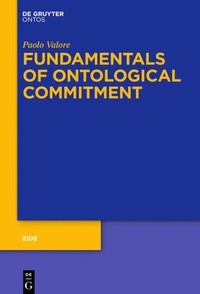
Fundamentals of Ontological Commitment
Description

Scientific literature on particular themes in ontology is extremely abundant, but it is often very hard for freshmen or sophomores to find a red thread between the various proposals.
This text is an opinionated introduction, a preliminary text to research in ontology from the so called standard approach to ontological commitment, that is from the particular point of view that connects ontological questions to quantificational questions. It offers a survey of this viewpoint in ontology together with their possible applications through a broad array of examples and open problems and, at the same time, essential references to the classics of philosophy, so as to allow non-specialists to understand the terms and analysis procedures characterizing the discipline. Its result is a wide-ranging overview of the issued tackled by ontology, with a particular focus on the most relevant problems of contemporary debate (categorial taxonomies, nonexistent objects, case studies of ontological debates in specific fields of knowledge).
More details
Other editions
Additional editions
Person
Content
- Intro
- Preface
- Contents
- Part I: The Task and Scope of Ontology
- 1 Ontology as a Philosophical Discipline
- 1.1 The Idea of Inventory
- 1.2 A Typological Characterization
- 1.3 Applied Ontology
- 2 Ontology in Its Different Varieties
- 2.1 Formal Ontology
- 2.2 Regional Ontology
- 2.3 Ontology and Meta-ontology
- 3 Logical Tools for Ontological Analysis
- 3.1 Consistency
- 3.2 Thought Experiments
- 3.3 Quantifiers
- 3.4 The Existential Import of Quanti cation
- 3.5 The Meaning of "Being"
- 4 Mereological Tools of Ontological Analysis
- 4.1 Parts and Proper Parts
- 4.2 Atoms and Wholes
- 4.3 Universe
- 4.4 Atomless Universe
- Part II: Ontological Categories
- 5 Categories as Uppermost Kinds
- 5.1 A Simpli ed Universe
- 5.2 The Diairetic Procedure
- 6 Categorial Realism
- 6.1 Two Kinds of Predication
- 6.2 Substance and Accident
- 6.3 Kinds and Species
- 6.4 Properties of Substance
- 7 Modalities
- 7.1 Four Modes of Being
- 7.2 De dicto and De re Modality
- 7.3 Possible Worlds
- 7.4 The Ontology of Possible Worlds
- 8 Categorial Conceptualism
- 8.1 Categories as Uppermost Concepts
- 8.2 Schematized Categories
- 8.3 Meanings and Objects
- 9 Parts and Wholes
- 9.1 Essentialism
- 9.2 Universalism
- 9.3 Nihilism
- 10 Natural Kinds and Ordering Strategies
- 10.1 Examples
- 10.2 Categorial Relativity
- 10.3 Categorial Frameworks
- Part III: The Nature of Existence
- 11 Non-being
- 11.1 The Impossibility of Non-being
- 11.2 Being Di erently
- 11.3 A Case for Ontological Disagreement
- 12 Being and Existence
- 12.1 Nuclear and Extra-Nuclear Properties
- 12.2 Objections
- 12.3 Possible Objects
- 13 Ontological Commitment
- 13.1 Existence and Quanti cation
- 13.2 Real and Unreal Individuals
- 13.3 A Suggestion from Semantics
- 13.4 Ontological Questions as Quanti cational Questions
- 13.5 Applications and Challenges
- 14 Identity
- 14.1 Indiscernibility of the Identicals
- 14.2 Identity of Indiscernibles
- 14.3 Identi cation of Indiscernibles
- Part IV: Ontological Proofs
- 15 The Existence of God
- 15.1 The Classical Ontological Proof
- 15.2 Existence as a Positive Predicate (I)
- 15.3 The Meaning of "God"
- 15.4 A Formalization of the Ontological Proof
- 15.5 Informal Evaluation of the Proof
- 16 God as an A Priori Idea
- 16.1 Existence as Implied by a Concept's Origin
- 16.2 God as a Guarantee for Itself
- 16.3 Possibility and Actuality of God
- 17 Gödel's Proof
- 17.1 Existence as a Positive Predicate (II)
- 17.2 The Proof
- 17.3 Remarks on the Proof
- Part V: Kinds of Being
- 18 Three Classical Views about Universals
- 18.1 Realism
- 18.2 Challenges to Realism
- 18.3 Conceptualism
- 18.4 Challenges to Conceptualism
- 18.5 Nominalism
- 18.6 Challenges to Nominalism
- 19 The Standard Approaches to Concrete Entities
- 19.1 Two Thought Experiments
- 19.2 Three-dimensional Entities
- 19.3 Tropes
- 19.4 Entia Successiva
- 19.5 Four-dimensional Entities
- 20 The Ontological Import of Mathematics
- 20.1 No Mathematical Entities
- 20.2 Naturalism
- 20.3 Platonism
- 20.4 Constructivism
- 21 Elements of Social Ontology
- 21.1 Ontological Commitment in Ordinary Language
- 21.2 Moderate Realism: Brute and Institutional Facts
- 21.3 Moderate Realism: Assignment of Function
- 21.4 An Ontological Underpinning
- Relativism and Ontological Relativity
- Bibliography
- Index
