

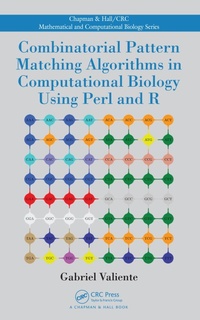
Combinatorial Pattern Matching Algorithms in Computational Biology Using Perl and R
Published on 8. April 2009
368 pages
978-1-4200-6974-7 (ISBN)
Description

Emphasizing the search for patterns within and between biological sequences, trees, and graphs, Combinatorial Pattern Matching Algorithms in Computational Biology Using Perl and R shows how combinatorial pattern matching algorithms can solve computational biology problems that arise in the analysis of genomic, transcriptomic, proteomic, metabolomic
Reviews / Votes
I like the hands-on approach this book offers, and the very pedagogical structure it follows ... . The book also has tons of examples, thoughtfully chosen and beautifully laid out ... the book is very well-written and accessible, undoubtedly written by an author who takes great care in preparing his manuscripts and teaching about an area he enjoys working on.-Anthony Labarre, SIGACT News, July 2012
This text provides a solid foundation to the field. It will work as a practical handbook for pattern matching applications in computational biology.
-Michael Goldberg, Computing Reviews, February 2010
... the book makes a clear distinction between problems that emerge in the analysis of the structure and in the comparative analysis of two or more structures. ... Well-known computational biology tools that allow searching nucleotide and protein databases for local sequence alignment are based on CPM algorithms only. The techniques presented in this book go beyond that. ... detailed algorithm solutions in pseudocode, full Perl and R implementation, and pointers to software and implementation are presented. This ... is what makes Valiente's effort unique. ...
-Ernesto D'Avanzo, Computing Reviews, February 2010
... It is a well-sorted collection of pattern matching algorithms that are used to work with problems in computational biology. ... You can find all of the sources on the author's website, which come in handy when you actually want to use them, since you do not have to retype them. And there is an introduction to Perl as well as to R, showing how to decode DNA/RNA-triplets to amino acids and giving some basic overview over standard functions. ... I certainly recommend this as an introduction and reference to some algorithms of pattern matching in computational biology. You actually learn how algorithms over the most important data types are designed in a straightforward, logical way. ...
-Jannik Pewny, IACR Book Reviews, 2009
...after a few minutes of random browsing, I was left with a feeling of total appreciation of the book, admiration for Prof. Gabriel Valiente, and a realization that this book will be part of my fundamental library for me and my group from the moment it is published. There are so many good things to say that I do not know where to start. The organization is straightforward with major sections that extend from simple sequences to trees to graphs. ... This parallel structure makes it easy to apply lessons used on the simplest object (sequences) to objects of medium (trees) and significant (graphs) difficulty. ...a wonderful way to learn leveraging ... The Perl is beautifully clear and the examples have already taught me how to improve my own code.
-Michael Levitt, Professor and Chair, Department of Structural Biology, Stanford University, California, USA
...Balancing a careful mixture of formal methods, programming, and examples, Gabriel Valiente has managed to harmoniously bridge languages and contents into a self-contained source of lasting influence. It is not difficult to predict that this book will be studied indifferently by the specialist of biology and computer science, helping each to walk a few steps toward the other. It will entice new generations of scholars to engage in its beautiful subject.
-From the Foreword, Alberto Apostolico, Professor, College of Computing, Georgia Tech, Atlanta, USA
Unlocks the power for R for Perl programmers, and vice versa. Reveals R to be a powerful and accessible tool for bioinformatics. The title is a mouthful, but the use of both R and Perl for bioinformatics is revealing.
-Steven Skiena, Professor, Department of Computer Science, Stony Brook University, New York, USA I like the hands-on approach this book offers, and the very pedagogical structure it follows ... . The book also has tons of examples, thoughtfully chosen and beautifully laid out ... the book is very well-written and accessible, undoubtedly written by an author who takes great care in preparing his manuscripts and teaching about an area he enjoys working on.
-Anthony Labarre, SIGACT News, July 2012
This text provides a solid foundation to the field. It will work as a practical handbook for pattern matching applications in computational biology.
-Michael Goldberg, Computing Reviews, February 2010
... the book makes a clear distinction between problems that emerge in the analysis of the structure and in the comparative analysis of two or more structures. ... Well-known computational biology tools that allow searching nucleotide and protein databases for local sequence alignment are based on CPM algorithms only. The techniques presented in this book go beyond that. ... detailed algorithm solutions in pseudocode, full Perl and R implementation, and pointers to software and implementation are presented. This ... is what makes Valiente's effort unique. ...
-Ernesto D'Avanzo, Computing Reviews, February 2010
... It is a well-sorted collection of pattern matching algorithms that are used to work with problems in computational biology. ... You can find all of the sources on the author's website, which come in handy when you actually want to use them, since you do not have to retype them. And there is an introduction to Perl as well as to R, showing how to decode DNA/RNA-triplets to amino acids and giving some basic overview over standard functions. ... I certainly recommend this as an introduction and reference to some algorithms of pattern matching in computational biology. You actually learn how algorithms over the most important data types are designed in a straightforward, logical way. ...
-Jannik Pewny, IACR Book Reviews, 2009
...after a few minutes of random browsing, I was left with a feeling of total appreciation of the book, admiration for Prof. Gabriel Valiente, and a realization that this book will be part of my fundamental library for me and my group from the moment it is published. There are so many good things to say that I do not know where to start. The organization is straightforward with major sections that extend from simple sequences to trees to graphs. ... This parallel structure makes it easy to apply lessons used on the simplest object (sequences) to objects of medium (trees) and significant (graphs) difficulty. ...a wonderful way to learn leveraging ... The Perl is beautifully clear and the examples have already taught me how to improve my own code.
-Michael Levitt, Professor and Chair, Department of Structural Biology, Stanford University, California, USA
...Balancing a careful mixture of formal methods, programming, and examples, Gabriel Valiente has managed to harmoniously bridge languages and contents into a self-contained source of lasting influence. It is not difficult to predict that this book will be studied indifferently by the specialist of biology and computer science, helping each to walk a few steps toward the other. It will entice new generations of scholars to engage in its beautiful subject.
-From the Foreword, Alberto Apostolico, Professor, College of Computing, Georgia Tech, Atlanta, USA
Unlocks the power for R for Perl programmers, and vice versa. Reveals R to be a powerful and accessible tool for bioinformatics. The title is a mouthful, but the use of both R and Perl for bioinformatics is revealing.
-Steven Skiena, Professor, Department of Computer Science, Stony Brook University, New York, USA
More details
Series
Language
English
Place of publication
London
United Kingdom
Publishing group
Taylor & Francis Ltd
Target group
Professional and scholarly
Computer scientists, mathematicians, statisticians, and biologists; advanced undergraduate and graduate students in computational biology.
Illustrations
89 s/w Abbildungen
89 b/w images
File size
4,05 MB
ISBN-13
978-1-4200-6974-7 (9781420069747)
Copyright in bibliographic data and cover images is held by Nielsen Book Services Limited or by the publishers or by their respective licensors: all rights reserved.
Schweitzer Classification
Other editions
Additional editions
Gabriel Valiente
Combinatorial Pattern Matching Algorithms in Computational Biology Using Perl and R
Book
06/2017
1st Edition
CRC Press
€137.70
Shipment within 10-20 days
Gabriel Valiente
Combinatorial Pattern Matching Algorithms in Computational Biology Using Perl and R
Book
04/2009
1st Edition
Chapman & Hall/CRC
€311.98
Shipment within 15-20 days
Person
Gabriel Valiente is Associate Professor in the Department of Software at the Technical University of Catalonia. His research interests include computational biology, bioinformatics, exact and approximate matching in graphs and patterns, and graph transformation.
Content
Introduction. SEQUENCE PATTERN MATCHING: Sequences. Simple Pattern Matching in Sequences. General Pattern Matching in Sequences. TREE PATTERN MATCHING: Trees. Simple Pattern Matching in Trees. General Pattern Matching in Trees. GRAPH PATTERN MATCHING: Graphs. Simple Pattern Matching in Graphs. General Pattern Matching in Graphs. Appendices. References. Index.
