

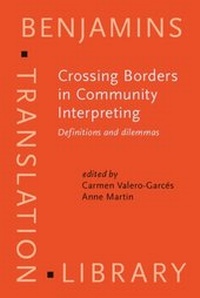
Crossing Borders in Community Interpreting
Definitions and dilemmas
1st Edition
Published on 9. May 2008
XII, 291 pages
978-90-272-9112-7 (ISBN)
Description

At conferences and in the literature on community interpreting there is one burning issue that reappears constantly: the interpreter's role. What are the norms by which the facilitators of communication shape their role? Is there indeed only one role for the community interpreter or are there several? Is community interpreting aimed at facilitating communication, empowering individuals by giving them a voice or, in wider terms, at redressing the power balance in society? In this volume scholars and practitioners from different countries address these questions, offering a representative sample of ongoing research into community interpreting in the Western world, of interest to all who have a stake in this form of interpreting. The opening chapter establishes the wider contextual and theoretical framework for the debate. It is followed by a section dealing with codes and standards and then moves on to explore the interpreter's role in various different settings: courts and police, healthcare, schools, occupational settings and social services.
More details
Other editions
Additional editions
Carmen Valero Garces | Anne Martin
Crossing Borders in Community Interpreting
Definitions and dilemmas
Book
05/2008
John Benjamins Publishing Co
€111.30
Shipment within 10-15 days
Persons
Content
- Crossing Borders in Community Interpreting
- Editorial page
- Title page
- LCC data
- Table of contents
- List of contributors
- Introduction
- References
- 1. Interpreting as mediation
- Introduction
- Mediation
- Linguistic/cultural mediation
- The interpersonal mediator
- Cognitive mediation
- 'Triangulating' mediation
- . . . or interpreting?
- Sprachmittler
- Mediazione linguistica
- Bridging the gap?
- References
- 2. The role of the interpreter in the governance of sixteenth- and seventeenth-century Spanish colonies in the "New World": Lessons from the past for the present
- Introduction
- A brief overview of the role of interpreters throughout history
- Interpreters in the "New World"
- The New Law of the Indies (Las Leyes de las Indias)
- Book Two, Title 29: De los intérpretes
- Terminology
- Conclusion
- References
- Further reading
- 3. Role definition: A perspective on forty years of professionalism in Sign Language interpreting
- Introduction
- The challenge of role definition
- Taking a systems approach to analyzing role development and clarity for Sign Language interpreters in the U. S.
- Legislation, professionalism and role of the interpreter
- Role, decision-making and ethics: From a Code of Ethics to a Code of Professional Conduct
- Measuring the effectiveness of codes
- Teaching role: Interpreter education
- Implications
- Conclusion
- References
- 4. Evolving views of the court interpreter's role: Between Scylla and Charybdis
- 1. Current definitions of the court interpreter's role
- 2. Interpreting research: The visible interpreter
- 3. Interpreters as advocates, cultural intermediaries, allies?
- 4. Evolving standards
- 5. Implications for interpreter education
- 6. Handrails for the slippery slope
- 7. Conclusions
- References
- 5. Controversies over the role of the court interpreter
- 1. Introduction
- 2. Reasons for the confusion over role
- 3. Current roles prescribed or adopted by interpreters
- 3.1 Role number 1: Advocate for the minority language speaker
- 3.2 Role number 2: Advocate for the institution or the service provider
- 3.3 Role number 3: the gatekeeper role
- 3.4 Role number 4: Facilitator of communication
- 3.5 Role number 5: Faithful renderer of others' utterances
- 4. Conclusion
- Acknowledgement
- References
- 6. Interpreting in police settings in Spain: Service providers' and interpreters' perspectives
- Introduction
- Legal background
- The provision of police interpreting services in Spain
- Full-time staff interpreter/translators
- Part-time, seasonal staff interpreter/translators
- Freelance interpreter/translators
- Other ad hoc solutions: Drawings, miming and volunteers
- Descriptive research
- Questionnaire design and content
- Administration of the questionnaires
- Target population and sampling technique
- Results of the research
- Police forces
- Interpreters
- Profile of respondents
- Specific working settings and tasks carried out by the interpreters
- Instructions from the agents on how to interpret
- Use of first or third person
- Modification of language register
- Explanations by the interpreter
- Summarising and omitting information
- Ways of making the information explicit
- Advice to the foreigner given by the interpreter
- Solutions to non-comprehension by one of the parties
- Non-verbal information
- Racist or discriminatory attitudes
- Identification of the interpreter with the interlocutor
- Change in interpreter's behaviour depending on the situation of the person being interpreted and influence of previous knowledge about the case
- Three qualities essential to act as interpreter
- Conclusions
- Acknowledgements
- References
- 7. The role of the interpreter in the healthcare setting: A plea for a dialogue between research and practice
- 1. Introduction
- 2. Overview of interpreter's role
- 3. Review of the literature on the role of the interpreter
- 4. Possible causes
- 4.1 Blind transfer of standards across settings
- 4.2 The dearth of empirical research
- 5. Key participants in encouraging deeper dialogue
- 5.1 Educational institutions
- 5.2 Professional organizations
- 6. Conclusions and implications
- 6.1 Responsibilities of researchers
- 6.2 Responsibilities of professional associations
- 6.3 Implications for the education of healthcare interpreters
- 6.4 Implications for assessment of healthcare interpreters
- References
- 8. Hospital interpreting practice in the classroom and the workplace
- 1. Introduction
- 2. Purpose and design of the study
- 3. The corpus
- 4. Analysing the interpreter's role in class: Patterns of interaction
- 5. Putting together theory and practice: Comments from the workplace
- 5.1 Introducing the interpreter's role
- 5.2 Seating arrangements
- 5.3 First- versus third-person debate
- 5.4 Language and terminology difficulties
- 5.5 Impartiality
- 5.6 Training in psychological effects
- 5.7 Widening the interpreter's role: Moving closer to mediation?
- 5.8 Students' reactions about the training program
- 6. Main findings
- 7. Conclusion
- References
- 9. Intercultural mediation: An answer to health care disparities?
- Introduction
- The tasks of the intercultural mediator
- Intercultural mediation: Results of two evaluation studies
- Intercultural mediation: Its effects on the quality of care
- Problems associated with the introduction of intercultural mediation in hospitals (2000)
- Quality improvement and assurance program
- Monitoring of intercultural mediation at the hospitals
- Additional training and supervision for the intercultural mediators
- Training sessions for health professionals
- Indicators of change
- Conclusion
- Our webpages
- References
- 10. Community interpreter self-perception: A Spanish case study
- Introduction
- Background
- Design of the study
- Results
- Language combination, academic qualifications and professional profile of the respondents (questions 1-8)
- The interpreted interview: dynamics, perceptions and attitudes (questions 9-24)
- Conclusions
- References
- 11. Sign Language interpreters and role conflict in the workplace
- Introduction
- Deaf people in the workplace
- Sign Language interpreters in the workplace
- Studying Sign Language interpreting in workplace settings
- Differences in the perception of the SLI's role
- What's in a name? Interpreter, Personal Assistant or Helper
- Visibility versus invisibility
- Tracing the source of the conflict: Positionality and positioning
- Concluding thoughts
- References
- 12. Migration, ideology and the interpreter-mediator: The role of the language mediator in educational and medical settings in Italy
- Introduction
- 1. Language mediation and migration in Italy
- Data and research methodology
- Who are the mediators?
- Data from the report on cultural mediators in the Province of Bologna - Osservatorio delle immigrazioni
- 2. Role differentiation in the education and health sectors
- 2.1 Schools
- 2.2 Hospitals
- Conclusions
- References
- 13. Perceptions of a profession
- Purpose and scope
- Methodology and context
- Sample
- Perception of the role and image of the community interpreter
- Perception of quality
- In conclusion
- References
- Index
- The series Benjamins Translation Library
