

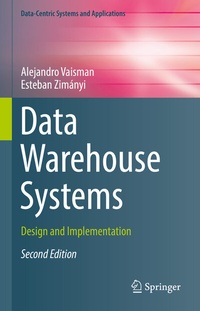
Data Warehouse Systems
Description

With this textbook, Vaisman and Zimányi deliver excellent coverage of data warehousing and business intelligence technologies ranging from the most basic principles to recent findings and applications. To this end, their work is structured into three parts. Part I describes "Fundamental Concepts" including conceptual and logical data warehouse design, as well as querying using MDX, DAX and SQL/OLAP. This part also covers data analytics using Power BI and Analysis Services. Part II details "Implementation and Deployment," including physical design, ETL and data warehouse design methodologies. Part III covers "Advanced Topics" and it is almost completely new in this second edition. This part includes chapters with an in-depth coverage of temporal, spatial, and mobility data warehousing. Graph data warehouses are also covered in detail using Neo4j. The last chapter extensively studies big data management and the usage of Hadoop, Spark, distributed, in-memory, columnar, NoSQL and NewSQLdatabase systems, and data lakes in the context of analytical data processing.
As a key characteristic of the book, most of the topics are presented and illustrated using application tools. Specifically, a case study based on the well-known Northwind database illustrates how the concepts presented in the book can be implemented using Microsoft Analysis Services and Power BI. All chapters have been revised and updated to the latest versions of the software tools used. KPIs and Dashboards are now also developed using DAX and Power BI, and the chapter on ETL has been expanded with the implementation of ETL processes in PostgreSQL. Review questions and exercises complement each chapter to support comprehensive student learning. Supplemental material to assist instructors using this book as a course text is available online and includes electronic versions of the figures, solutions to all exercises, and a set of slides accompanying each chapter.
Overall, students, practitioners and researchers alike will find this book the most comprehensive reference work on data warehouses, with key topics described in a clear and educational style.
" I can only invite you to dive into the contents of the book, feeling certain that once you have completed its reading (or maybe, targeted parts of it), you will join me in expressing our gratitude to Alejandro and Esteban, for providing such a comprehensive textbook for the field of data warehousing in the first place, and for keeping it up to date with the recent developments, in this current second edition. "
From the foreword by Panos Vassiliadis, University of Ioannina, Greece.
More details
Other editions
Additional editions
Previous edition
Persons
Alejandro Vaisman is a professor at the Instituto Tecnológico de Buenos Aires, where he also chairs the graduate program in data science. He has been a professor and chair of the master's program in data mining at the University of Buenos Aires (UBA) and professor at Universidad de la República in Uruguay. His research interests are in the fields of relational databases, graph databases, business intelligence, and geographic information systems.
Esteban Zimányi is a professor and Director of the Department of Computer and Decision Engineering at the Université Libre de Bruxelles. His current research interests include data warehouses and business intelligence, spatio-temporal and mobility databases, as well as the semantic Web. He coordinated the Erasmus Mundus master's and doctorate programmes "Information Technologies for Business Intelligence" (IT4BI) and "Big Data Management and Analytics" (BDMA) as well as the Marie Sklodowska-Curie doctorate programme "DataEngineering for Data Science" (DEDS).
Content
Part I: Fundamental Concepts.- 1. Introduction.- 2. Database Concepts.- 3. Data Warehouse Concepts.- 4. Conceptual Data Warehouse Design.- 5. Logical Data Warehouse Design.- 6. Data Analysis in Data Warehouses.- 7. Data Analysis in the Northwind Data Warehouse.- Part II: Implementation and Deployment.- 9. Physical Data Warehouse Design.- 9. Extraction, Transformation, and Loading.- 10. A Method for Data Warehouse Design.- Part III: Advanced Topics.- 11. Temporal and Multiversion Data Warehouses.- 12. Spatial and Mobility Data Warehouses.- 13. Graph Data Warehouses.- 14. Semantic Web Data Warehouses.- 15. Recent Developments in Big Data Warehouses.
