

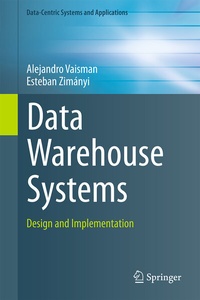
Data Warehouse Systems
Description

With this textbook, Vaisman and Zimányi deliver excellent coverage of data warehousing and business intelligence technologies ranging from the most basic principles to recent findings and applications. To this end, their work is structured into three parts. Part I describes "Fundamental Concepts" including multi-dimensional models; conceptual and logical data warehouse design and MDX and SQL/OLAP. Subsequently, Part II details "Implementation and Deployment," which includes physical data warehouse design; data extraction, transformation, and loading (ETL) and data analytics. Lastly, Part III covers "Advanced Topics" such as spatial data warehouses; trajectory data warehouses; semantic technologies in data warehouses and novel technologies like Map Reduce, column-store databases and in-memory databases.
As a key characteristic of the book, most of the topics are presented and illustrated using application tools. Specifically, a case study based on the well-known Northwind database illustrates how the concepts presented in the book can be implemented using Microsoft Analysis Services and Pentaho Business Analytics. All chapters are summarized using review questions and exercises to support comprehensive student learning. Supplemental material to assist instructors using this book as a course text is available at http://cs.ulb.ac.be/DWSDIbook/, including electronic versions of the figures, solutions to all exercises, and a set of slides accompanying each chapter.
Overall, students, practitioners and researchers alike will find this book the most comprehensive reference work on data warehouses, with key topics described in a clear and educational style.
Reviews / Votes
"The book is very well suited for one or more data warehouse courses, ranging from the most basic to the most advanced. It has all the features that are necessary to make a good textbook. (.) The one thing which really set this book apart from its peers is the coverage of advanced data warehouse topics (.) The book also provides a useful overview of novel "Big Data" technologies like Hadoop, and novel database and data warehouse architectures like in-memory databases, column stores, and right-time data warehouses." from the foreword by Torben Bach Pedersen, Aalborg Universiteit, Denmark
More details
Other editions
New editions
Additional editions
Persons
Alejandro A. Vaisman is a professor at the Buenos Aires Institute of Technology (ITBA). He was previously professor at the University of Buenos Aires where he co-founded and chaired the Masters program in Data Mining. His research interests are in the field of databases, particularly in data warehousing and OLAP, business intelligence, spatiotemporal databases and the semantic web.
Esteban Zimányi is a professor and Director of the Department of Computer and Decision Engineering at the Université Libre de Bruxelles. His current research interests include data warehouses and business intelligence, geographical information systems and spatio-temporal databases. He is Editor-in-Chief of the Journal on Data Semantics. He is coordinator of the Erasmus Mundus Master and Doctorate on "Information Technologies for Business Intelligence" (IT4BI).
