

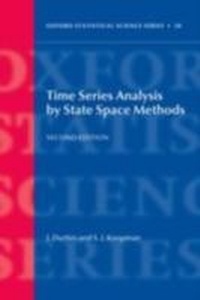
Time Series Analysis by State Space Methods:Second Edition
1st Edition
Published on 3. May 2012
369 pages
978-0-19-162718-7 (ISBN)
Description

This new edition updates Durbin & Koopman's important text on the state space approach to time series analysis. The distinguishing feature of state space time series models is that observations are regarded as made up of distinct components such as trend, seasonal, regression elements and disturbance terms, each of which is modelled separately. The techniques that emerge from this approach are very flexible and are capable of handling a much wider range of problems than themain analytical system currently in use for time series analysis, the Box-Jenkins ARIMA system. Additions to this second edition include the filtering of nonlinear and non-Gaussian series.Part I of the book obtains the mean and variance of the state, of a variable intended to measure the effect of an interaction and of regression coefficients, in terms of the observations.Part II extends the treatment to nonlinear and non-normal models. For these, analytical solutions are not available so methods are based on simulation.
More details
Other editions
Additional editions
James Durbin | Siem Jan Koopman
Time Series Analysis by State Space Methods
Book
05/2012
2nd Edition
Oxford University Press
€135.50
Shipment within 15-20 days
Content
- Cover
- Contents
- 1. Introduction
- 1.1 Basic ideas of state space analysis
- 1.2 Linear models
- 1.3 Non-Gaussian and nonlinear models
- 1.4 Prior knowledge
- 1.5 Notation
- 1.6 Other books on state space methods
- 1.7 Website for the book
- PART I: THE LINEAR STATE SPACE MODEL
- 2. Local level model
- 2.1 Introduction
- 2.2 Filtering
- 2.3 Forecast errors
- 2.4 State smoothing
- 2.5 Disturbance smoothing
- 2.6 Simulation
- 2.7 Missing observations
- 2.8 Forecasting
- 2.9 Initialisation
- 2.10 Parameter estimation
- 2.11 Steady state
- 2.12 Diagnostic checking
- 2.13 Exercises
- 3. Linear state space models
- 3.1 Introduction
- 3.2 Univariate structural time series models
- 3.3 Multivariate structural time series models
- 3.4 ARMA models and ARIMA models
- 3.5 Exponential smoothing
- 3.6 Regression models
- 3.7 Dynamic factor models
- 3.8 State space models in continuous time
- 3.9 Spline smoothing
- 3.10 Further comments on state space analysis
- 3.11 Exercises
- 4. Filtering, smoothing and forecasting
- 4.1 Introduction
- 4.2 Basic results in multivariate regression theory
- 4.3 Filtering
- 4.4 State smoothing
- 4.5 Disturbance smoothing
- 4.6 Other state smoothing algorithms
- 4.7 Covariance matrices of smoothed estimators
- 4.8 Weight functions
- 4.9 Simulation smoothing
- 4.10 Missing observations
- 4.11 Forecasting
- 4.12 Dimensionality of observational vector
- 4.13 Matrix formulations of basic results
- 4.14 Exercises
- 5. Initialisation of filter and smoother
- 5.1 Introduction
- 5.2 The exact initial Kalman filter
- 5.3 Exact initial state smoothing
- 5.4 Exact initial disturbance smoothing
- 5.5 Exact initial simulation smoothing
- 5.6 Examples of initial conditions for some models
- 5.7 Augmented Kalman filter and smoother
- 6. Further computational aspects
- 6.1 Introduction
- 6.2 Regression estimation
- 6.3 Square root filter and smoother
- 6.4 Univariate treatment of multivariate series
- 6.5 Collapsing large observation vectors
- 6.6 Filtering and smoothing under linear restrictions
- 6.7 Computer packages for state space methods
- 7. Maximum likelihood estimation of parameters
- 7.1 Introduction
- 7.2 Likelihood evaluation
- 7.3 Parameter estimation
- 7.4 Goodness of fit
- 7.5 Diagnostic checking
- 8. Illustrations of the use of the linear model
- 8.1 Introduction
- 8.2 Structural time series models
- 8.3 Bivariate structural time series analysis
- 8.4 Box-Jenkins analysis
- 8.5 Spline smoothing
- 8.6 Dynamic factor analysis
- PART II: NON-GAUSSIAN AND NONLINEAR STATE SPACE MODELS
- 9. Special cases of nonlinear and non-Gaussian models
- 9.1 Introduction
- 9.2 Models with a linear Gaussian signal
- 9.3 Exponential family models
- 9.4 Heavy-tailed distributions
- 9.5 Stochastic volatility models
- 9.6 Other financial models
- 9.7 Nonlinear models
- 10. Approximate filtering and smoothing
- 10.1 Introduction
- 10.2 The extended Kalman filter
- 10.3 The unscented Kalman filter
- 10.4 Nonlinear smoothing
- 10.5 Approximation via data transformation
- 10.6 Approximation via mode estimation
- 10.7 Further advances in mode estimation
- 10.8 Treatments for heavy-tailed distributions
- 11. Importance sampling for smoothing
- 11.1 Introduction
- 11.2 Basic ideas of importance sampling
- 11.3 Choice of an importance density
- 11.4 Implementation details of importance sampling
- 11.5 Estimating functions of the state vector
- 11.6 Estimating loglikelihood and parameters
- 11.7 Importance sampling weights and diagnostics
- 12. Particle filtering
- 12.1 Introduction
- 12.2 Filtering by importance sampling
- 12.3 Sequential importance sampling
- 12.4 The bootstrap particle filter
- 12.5 The auxiliary particle filter
- 12.6 Other implementations of particle filtering
- 12.7 Rao-Blackwellisation
- 13. Bayesian estimation of parameters
- 13.1 Introduction
- 13.2 Posterior analysis for linear Gaussian model
- 13.3 Posterior analysis for a nonlinear non-Gaussian model
- 13.4 Markov chain Monte Carlo methods
- 14. Non-Gaussian and nonlinear illustrations
- 14.1 Introduction
- 14.2 Nonlinear decomposition: UK visits abroad
- 14.3 Poisson density: van drivers killed in Great Britain
- 14.4 Heavy-tailed density: outlier in gas consumption
- 14.5 Volatility: pound/dollar daily exchange rates
- 14.6 Binary density: Oxford-Cambridge boat race
- References
- Author Index
- A
- B
- C
- D
- E
- F
- G
- H
- J
- K
- L
- M
- N
- O
- P
- Q
- R
- S
- T
- U
- V
- W
- Y
- Z
- Subject Index
- A
- B
- C
- D
- E
- F
- G
- H
- I
- K
- L
- M
- N
- O
- P
- Q
- R
- S
- T
- U
- V
- W
