

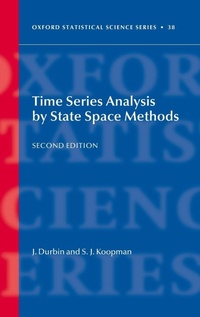
Time Series Analysis by State Space Methods
2nd Edition
Published on 3. May 2012
Book
Hardback
368 pages
978-0-19-964117-8 (ISBN)
Description
This new edition updates Durbin & Koopman's important text on the state space approach to time series analysis. The distinguishing feature of state space time series models is that observations are regarded as made up of distinct components such as trend, seasonal, regression elements and disturbance terms, each of which is modelled separately. The techniques that emerge from this approach are very flexible and are capable of handling a much wider range of problems than the main analytical system currently in use for time series analysis, the Box-Jenkins ARIMA system. Additions to this second edition include the filtering of nonlinear and non-Gaussian series.
Part I of the book obtains the mean and variance of the state, of a variable intended to measure the effect of an interaction and of regression coefficients, in terms of the observations.
Part II extends the treatment to nonlinear and non-normal models. For these, analytical solutions are not available so methods are based on simulation.
Part I of the book obtains the mean and variance of the state, of a variable intended to measure the effect of an interaction and of regression coefficients, in terms of the observations.
Part II extends the treatment to nonlinear and non-normal models. For these, analytical solutions are not available so methods are based on simulation.
Reviews / Votes
Review from previous edition ...provides an up-to-date exposition and comprehensive treatment of state space models in time series analysis...This book will be helpful to graduate students and applied statisticians working in the area of econometric modelling as well as researchers in the areas of engineering, medicine and biology where state space models are used. * Journal of the Royal Statistical Society *More details
Series
Edition
2nd Revised edition
Language
English
Place of publication
Oxford
United Kingdom
Target group
College/higher education
Professional and scholarly
Researchers in statistics, econometrics, biometrics, environmetrics, engineering, system theory and physics. Financial analysts in banking and other financial institutions.
Edition type
Revised edition
Illustrations
34 b/w illustrations
Dimensions
Height: 240 mm
Width: 161 mm
Thickness: 24 mm
Weight
719 gr
ISBN-13
978-0-19-964117-8 (9780199641178)
Copyright in bibliographic data and cover images is held by Nielsen Book Services Limited or by the publishers or by their respective licensors: all rights reserved.
Schweitzer Classification
Other editions
Additional editions
E-Book
05/2012
1st Edition
OUP Oxford
€30.19
Available for download
E-Book
05/2012
2nd Edition
OUP eBook
€103.99
Available for download
Previous edition
James Durbin | Siem Jan Koopman
Time Series Analysis by State Space Methods
Book
06/2001
Clarendon Press
€74.28
Article exhausted; check for reprint
Persons
The late James Durbin was Professor of Statistics at the London School of Economics, President of the Royal Statistical Society and President of the International Statistical Institute. He was awarded the society's bronze, silver and gold medals for his contribution to statistics. He was a fellow of the British Academy.
Siem Jan Koopman has been Professor of Econometrics at the Free University in Amsterdam and research fellow at the Tinbergen Institute since 1999. He fullfills editorial duties at the Journal of Applied Econometrics, the Journal of Forecasting, the Journal of Multivariate Analysis and Statistica Sinica.
Siem Jan Koopman has been Professor of Econometrics at the Free University in Amsterdam and research fellow at the Tinbergen Institute since 1999. He fullfills editorial duties at the Journal of Applied Econometrics, the Journal of Forecasting, the Journal of Multivariate Analysis and Statistica Sinica.
Content
PART I: THE LINEAR STATE SPACE MODEL; PART II: NON-GAUSSIAN AND NONLINEAR STATE SPACE MODELS