

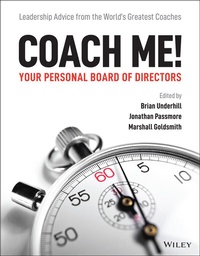
Coach Me! Your Personal Board of Directors
Description

An indispensable wellspring of advice from the world's foremost leadership experts
In Coach Me! Your Personal Board of Directors: Leadership Advice from the World's Greatest Coaches, a team of world-renowned executive coaches and leadership experts delivers a revolutionary collection of contributions from 52 of the globe's leading management thinkers. Each curated piece explores a critical issue in leadership, covering topics like self-awareness, communication, interpersonal relationships, emotional intelligence, delegation, coaching, change management, transition management, execution, and career development.
Among the 50 stories included within, readers will find inspirational and practical advice based on real-world leaders who were forced to transform their company's business model, their organization, or themselves to achieve success. Each concise, actionable chapter lets you be a fly on the wall of a successful leader demonstrating a solution to a commonly encountered leadership problem.
Coach Me! Your Personal Board of Directors also provides:
* Thorough introductions to self-examination and self-awareness, including maximizing the impact of feedback and proven techniques to ensure your leadership measures up
* Comprehensive explorations of communication and interpersonal relationship skills, including treatments of authenticity and cultural fluency
* Practical discussions of emotional intelligence, including the management of out-of-control feelings and conflict management
* In-depth examinations of change and transition management, including explorations of the first 100 days as a new leader and how to lead teams through crises
Perfect for managers, executives, and business leaders of all kinds, Coach Me! Your Personal Board of Directors: Leadership Advice from the World's Greatest Coaches will also earn a place in the libraries of the coaches, consultants, and other professionals who work with leaders in government, business, and the nonprofit sectors.
More details
Other editions
Additional editions
Persons
Brian Underhill, PhD, is the Founder and CEO of CoachSource, the world's largest executive coaching provider. He received his doctorate in organizational psychology from the California School of Professional Psychology in Los Angeles.
Jonathan Passmore is Senior Vice President, CoachHub, the digital coaching platform, professor of coaching and behavioural change at Henley Business School, licensed psychologist, an award-winning coach, researcher, and author. He is the editor of the eight volume Wiley Blackwell Series on Industrial Psychology.
Marshall Goldsmith, PhD, is a celebrated executive and leadership coach and author of the New York Times Bestsellers MOJO, What Got You Here Won't Get You There, and Triggers.
Content
Foreword: A CEO's Journey through Coaching x
Aicha Evans with Mark Thompson
Acknowledgments xii
About the Editors xiii
Introduction xv
Part I Self-Insight 1
1 Great Leaders Are Confident, Connected, Committed, and Courageous 3
Peter Bregman
2 Six Interconnected Perspectives for Coaching 6
Philippe Rosinski
3 Dealing with Your Demons as a Startup Founder 10
Alisa Cohn
4 Crafting a Grow-Forward Development Pathway 12
Didem Tekay
5 In Pursuit of Identity and Inclusion 15
Priscilla Gill
6 Making the Most of Feedback 19
Scott Eblin
7 A Proven Technique to Ensure Your Leadership Measures Up 21
Lisa Ann Edwards
Part II Communication Skills 25
8 The Highs and Lows of Communication 27
Hortense Le Gentil
9 How to Develop the Authentic Leader in You 29
Nicole Heimann
10 The Culturally Fluent Leader: When Leading Across Differences, Your Style May Need to Change 32
Jane Hyun
Part III Interpersonal Relationships 35
11 The Five Basic Needs of Employees. How Leaders Can Recognize and Use Them 37
Christopher Rauen
12 Steve: The Smartest Guy in the Room 40
Philippe Grall
13 How Powerful Leaders Create Safety: View from Both Sides of the Desk 43
Carol Kauffman
14 How "Face" Can Help You Manage Up 46
Maya Hu-Chan
15 "The Payoff from Listening" 49
Frank Wagner
16 The Necessary Reckoning of Corporate America 52
Terry Jackson
Part IV Emotional Intelligence 55
17 Managing Our Out of Control Feelings 57
Jonathan Passmore
18 How to Deal with Deeper, Coaching-Resistant Behaviors 60
Ron Carucci
19 Coaching for Conflict Management 63
Gary Wang
20 The Cavalry Isn't Coming 66
Caroline Stokes
Part V Empowering Others / Delegation 69
21 The Importance of Leadership Agility 71
Brenda Bence
22 Coaching Perfectionists 74
Sally Helgesen
23 Coaching an Executive Client Out of Micromanagement 77
Tom Kolditz
24 Establishing Overwhelming Presence as a Managing Director 79
Takahiro Honda
25 Letting Go: One Founder's Journey From Doing to Dreaming 83
Magdalena Nowicka Mook
Part VI Coaching Others 87
26 Motivating Others to Learn and Change 89
Richard E. Boyatzis
27 The Leader as Coach 92
Lance Secretan
28 The Five Most Important Qualities in Coaching Your Employees: Anywhere in the World 96
Howard J. Morgan & Ben Croft
29 The S Curve of Learning 99
Whitney Johnson
Part VII Managing Change 103
30 Leading in Times of Change 105
Atchara Juicharern
31 Coaching the Team Leader 108
Peter Hawkins
32 Coaching and Culture Transformation for Sustainable Results 111
Peter Chee & Aaron Ngui
33 Agile Servant Leadership Is Not Fluffy 114
Jennifer Paylor
34 Leading Teams through Crisis 117
Karen Yanqun Wu
35 Letting Go of Certainty 121
David Clutterbuck
Part VIII Transition Management 125
36 Your First Hundred Days 127
Abdallah Aljurf
37 Managing Self Doubt After a Promotion 130
Nihar Chhaya
38 Self as Leader 133
Pamela McLean
39 Executive Transition 136
Cathleen Wu
Part IX Execution 139
40 Objectives and Key Results 141
Patti P. Phillips
41 Identifying and Approaching Different Types of Problems 145
Nankhonde Kasonde-van den Broek
42 A Leader's Courage for a Team's Success 148
Oleg Konovalov
43 The Pause for Progress 151
Bill Carrier
44 There Is No Such Thing as Work/Life Balance 154
Brian O. Underhill
45 The Leadership Success Definition Should Include Impact (and Maybe ROI) 157
Jack J. Phillips
Part X Career Development 161
46 From C-Suite to CEO: How to Get Promoted & Survive the Leap 163
Mark C. Thompson
47 Personal Leadership Brand: How to Take Control of How You "Show Up'' 166
Mongezi C. Makhalima
48 Decision-Making - Cutting Through the Fog of Shoulds and Fears 169
Marcia Reynolds
49 Future-Proof Yourself for Complex, Disruptive Times: Learning Faster Than the Pace of Change 172
David B. Peterson
50 How to Select a Coach 175
CB Bowman-Ottomanelli
Further Resources 179
Your Personal Board of Directors: Contributor Biographies 180
Index 197
1
Great Leaders Are Confident, Connected, Committed, and Courageous
Peter Bregman
Peter Bregman is the CEO of Bregman Partners. He coaches, writes, teaches, and speaks mostly about leadership. His sweet spot is as a strategic thought partner to successful people who care about being exceptional leaders and stellar human beings. He is recognized as the #1 executive coach in the world.
Sanjay (I have changed his name and some details to protect privacy) was founder and CEO of a technology startup that grew rapidly to $50 million.
Then it stalled out.
Sanjay had not previously grown a company past that stage, and he was unsure what was wrong. He was hoping his team would pull together and figure it out but that had not happened yet.
"I think I need to change out my leadership team," he said to me, in anger and frustration.
"Or," I countered, "maybe you need to scale your leadership in order to scale the company."
Sanjay had not, to this point, done much leadership development work. He had ideas, told people what to do, and micromanaged the execution. He was impatient, angered quickly, and not very trusting. Turnover was high, employees felt unappreciated, and even the leadership team was unwilling to take risks for fear of the consequences.
Which meant that Sanjay was out of the communication loop (nobody was willing to disagree with him or bring him bad news for fear of his reaction).
In order to lead, you have to get your most important work done, have hard conversations, create accountability, and inspire action. Sometimes - especially at smaller companies - leaders can do that in very autocratic ways. But that's poor leadership, and poor leadership does not scale.
To scale, you need to show up powerfully and magnetically in a way that attracts people to trust you, follow you, and commit to putting 100% of their effort into a larger purpose, something bigger than all of you. You need to care about others and connect with them in such a way that they feel your care. You need to speak persuasively - in a way that is clear, direct, and honest and that reflects your care - while listening with openness, compassion, and love. Even when being challenged.
In 30 years of working with leaders to do all of the above, I have found a pattern that I share in Leading with Emotional Courage (Wiley, 2018 Peter Bregman), consisting of four essential elements that all great leaders rely on to rally people to accomplish what is important to them. To lead effectively - really, to live effectively - you must be confident in yourself, connected to others, committed to purpose, and emotionally courageous.
Most of us are great at only one of the four or maybe two. But to be a powerful presence - to inspire action - you need to excel at all four simultaneously.
If you are confident in yourself but disconnected from others, everything will be about you and you will alienate the people around you. If you are connected to others but lack confidence in yourself, you will betray your own needs and perspectives in order to please everyone else. If you are not committed to a purpose, something bigger than yourself and others, you will flounder, losing the respect of those around you as you act aimlessly, failing to make an impact on what matters most. And if you fail to act powerfully, decisively, and boldly - with emotional courage - your ideas will remain idle thoughts and your goals will remain unfulfilled fantasies.
Let's apply this to Sanjay and identify precisely where and how he was getting stuck.
Confident in Yourself. Strange as this may seem given how Sanjay presents, he actually struggled with this element. This might feel surprising since he seemed clear about what he wanted, micromanaged, and used intimidation to ensure his ideas were followed. But those things are not confidence, they're arrogance. Confidence is being secure enough to be wrong, to listen to other's opinions, and to be open to how others approach things. People who lack confidence always have to have their way. People who are confident can let others win and prioritize the best idea over their own idea. Sanjay obviously believed in himself - that's also part of confidence - but he wasn't confident enough to be vulnerable. He definitely had room to grow here.
Connected to Others. This was Sanjay's greatest weakness. He did not trust people enough to give them space to own things fully, and people did not trust him enough to tell him things straight. He showed little curiosity and quickly drew conclusions about others; once he made up his mind about someone, they would not get a second chance. He did have some strengths here: he was direct with people and did not procrastinate on difficult conversations. People knew where they stood with him. But he communicated so harshly that those attributes that could be strengths became weaknesses.
Committed to Purpose. This was Sanjay's greatest strength. He was clear about what needed to get done, and he was completely focused on the strategy and plan. He was clear about the small number of things that would move the needle and he was undistractable. And he had a reliable process for staying focused on the most important things, ensuring accountability and driving follow-through.
Emotionally Courageous. Sanjay had room to grow here, and it turned out to be an important element for growing his strength in the elements where he was weaker. Risks, by definition, make us feel vulnerable, and Sanjay avoided that feeling. He resisted the unknown and intentionally avoided uncomfortable situations. This made it hard for him to be open to other people's ideas and listen to their perspectives, especially when those perspectives differed from his. How could others feel ownership and risk offering innovative ideas when their leader was not courageous enough to listen and consider them?
So Sanjay's strongest element was "committed to purpose," which got him admirably far. But his weaknesses in "confident in yourself," "connected to others," and "emotionally courageous" were holding him, his team, and the entire company from achieving their ambitious objectives.
What we're seeing in Sanjay is actually fairly typical for aggressive and successful entrepreneurs. His commitment to purpose is inspiring to investors, employees, and other stakeholders. And it fuels his persistence through the inevitable obstacles every founder faces. Meanwhile, that irrepressible drive and focus prevent him from listening to others in a way that truly engages them, and his fear of failure (which is one psychological element that drives his commitment to purpose) diminishes his confidence. It takes tremendous emotional courage to let other people - and their ideas, perspectives, and disagreements - impact the baby to which Sanjay has given everything.
So I shared all of this with Sanjay.
Just knowing what was happening helped him immediately. We spent some time strengthening his emotional courage by taking small risks while feeling the emotions he had been trying to keep at bay. Each time he followed through, regardless of whether he succeeded, he obviously survived and also felt the accomplishment of addressing the risk itself, which, of course, built his confidence and helped him take bigger risks.
In a short time, he felt prepared (even though he may never have felt "ready") to be vulnerable with his team, apologize for the way he had been leading, and ask for their help in becoming a different type of leader so that they could become a different kind of team and, finally, scale their venture.
So Sanjay brought the team together. He was extremely uncomfortable going into the conversation - that's almost always the feeling you'll have when you do anything that requires emotional courage.
But using emotional courage builds your emotional courage. Sanjay emerged from the conversation with the team stronger in all four elements: he was more confident in himself, more connected to his team (as he listened to them without interrupting and without interrogating them), just as committed to purpose, and more emotionally courageous.
What's most important is how developing his own leadership impacted his team's leadership. They became more connected to each other (as well as to him) and far more committed to purpose than before. Their confidence and emotional courage grew as they brought challenges and obstacles to the team in a way that they were hesitant to do before. Which, of course, enabled them to address those challenges, as a team.
That is how you scale leadership. And that is how you scale a company.
Want to develop your own capability in each of the four areas? Here are four quick activities you can do - one for each element - that will have an immediate, positive impact and help you lead with emotional courage.
Confidence in Yourself. This is about staying grounded in the face of success, failure, ambiguity, complexity, or anything really. One of the best tools for growing your confidence is meditation - even just 30 seconds of it. Sit comfortably, close your eyes, take a deep breath, hold it for a second, and then exhale slowly, relaxing every muscle as you do. Repeat even for just a few breaths, and you will feel yourself more grounded. Try it now.
Connection to Others. People feel...
