

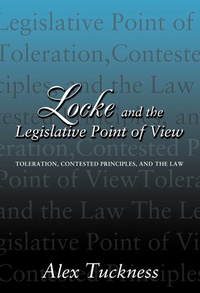
Locke and the Legislative Point of View
Toleration, Contested Principles, and the Law
1st Edition
Published on 9. February 2009
224 pages
978-1-4008-2539-4 (ISBN)
Description

Determining which moral principles should guide political action is a vexing question in political theory. This is especially true when faced with the "toleration paradox": believing that something is morally wrong but also believing that it is wrong to suppress it. In this book, Alex Tuckness argues that John Locke's potential contribution to this debate--what Tuckness terms the "legislative point of view"--has long been obscured by overemphasis on his doctrine of consent. Building on a line of reasoning Locke made explicit in his later writings on religious toleration, Tuckness explores the idea that we should act politically only on those moral principles that a reasonable legislator would endorse; someone, that is, who would avoid enacting measures that could be self-defeating when applied by fallible human beings.
Tuckness argues that the legislative point of view has implications that go far beyond the question of religious toleration. Locke suggests an approach to political justification that is a provocative alternative to the utilitarian, contractualist, and perfectionist approaches dominating contemporary liberalism. The legislative point of view is relevant to our thinking about many types of disputed principles, Tuckness writes. He examines claims of moral wrong, invocations of the public good, and contested political roles with emphasis on the roles of legislators and judges. This book is must reading not only for students and scholars of Locke but all those interested in liberalism, toleration, and constitutional theory.
Tuckness argues that the legislative point of view has implications that go far beyond the question of religious toleration. Locke suggests an approach to political justification that is a provocative alternative to the utilitarian, contractualist, and perfectionist approaches dominating contemporary liberalism. The legislative point of view is relevant to our thinking about many types of disputed principles, Tuckness writes. He examines claims of moral wrong, invocations of the public good, and contested political roles with emphasis on the roles of legislators and judges. This book is must reading not only for students and scholars of Locke but all those interested in liberalism, toleration, and constitutional theory.
More details
Other editions
Additional editions
Book
09/2002
Princeton University Press
€55.80
Article exhausted; check different version
Book
09/2002
Princeton University Press
€35.80
Article not available at the moment
Person
Alex Tuckness is Assistant Professor of Political Science at Iowa State University.
Content
ACKNOWLEDGMENTS xi
ABBREVIATED REFERENCES xiii
Introduction 1
PART I
The Legislative Point of View and the Ends of Government 15
CHAPTER 1
Contested Laws and Principles 17
Contested Principles and the Legislative Point of View 25
The Analogy between Laws and Moral Principles 31
CHAPTER 2
Contested Principles and the Legislative Point of View 36
Rule-Utilitarianism and Contested Principles 36
Locke, Proast, and Contested Principles 39
The Secular Analogue of the Lockean Argument 46
Two Illustrations 51
CHAPTER 3
Legislative Consent and the Public Good 57
Problems with Contractual Consent 66
Locke's Legislative Consent and the Public Good 74
CHAPTER 4
Beyond Neutrality and Perfectionism 85
Two Liberal Approaches 85
Rawls and Reasonable Agreement 88
Raz and Human Well-Being 101
Beyond Neutrality and Perfectionism 110
PART II
The Legislative Point of View and Constitutional Roles 115
CHAPTER 5
Institutional Roles and the Legislative Point of View 117
Locke on Legislative and Executive Powers 121
Locke and the Missing Judicial Power 127
Judges as Legislators: Functions versus Institutions 132
Implications for Contested Roles 135
CHAPTER 6
Contested Roles, Interpretation, and the Framer's Point of View 137
Contested Jurisdiction and the "Framer's Point of View" 140
Contested Constitutional Jurisdiction in the United States 143
Dworkin and the Legislative Point of View 147
Originalism and the Nature of Law and Legislation 159
Boerne v. Flores 166
Contested Roles and the State of Nature 172
Conclusion 174
APPENDIX I
Textual Support for the Legislative Point of View 179
APPENDIX 2
Locke's Theory of Consent and the Ends of Government 181
BIBLIOGRAPHY 191
COURT CASES CITED 199
INDEX 201
ABBREVIATED REFERENCES xiii
Introduction 1
PART I
The Legislative Point of View and the Ends of Government 15
CHAPTER 1
Contested Laws and Principles 17
Contested Principles and the Legislative Point of View 25
The Analogy between Laws and Moral Principles 31
CHAPTER 2
Contested Principles and the Legislative Point of View 36
Rule-Utilitarianism and Contested Principles 36
Locke, Proast, and Contested Principles 39
The Secular Analogue of the Lockean Argument 46
Two Illustrations 51
CHAPTER 3
Legislative Consent and the Public Good 57
Problems with Contractual Consent 66
Locke's Legislative Consent and the Public Good 74
CHAPTER 4
Beyond Neutrality and Perfectionism 85
Two Liberal Approaches 85
Rawls and Reasonable Agreement 88
Raz and Human Well-Being 101
Beyond Neutrality and Perfectionism 110
PART II
The Legislative Point of View and Constitutional Roles 115
CHAPTER 5
Institutional Roles and the Legislative Point of View 117
Locke on Legislative and Executive Powers 121
Locke and the Missing Judicial Power 127
Judges as Legislators: Functions versus Institutions 132
Implications for Contested Roles 135
CHAPTER 6
Contested Roles, Interpretation, and the Framer's Point of View 137
Contested Jurisdiction and the "Framer's Point of View" 140
Contested Constitutional Jurisdiction in the United States 143
Dworkin and the Legislative Point of View 147
Originalism and the Nature of Law and Legislation 159
Boerne v. Flores 166
Contested Roles and the State of Nature 172
Conclusion 174
APPENDIX I
Textual Support for the Legislative Point of View 179
APPENDIX 2
Locke's Theory of Consent and the Ends of Government 181
BIBLIOGRAPHY 191
COURT CASES CITED 199
INDEX 201
