

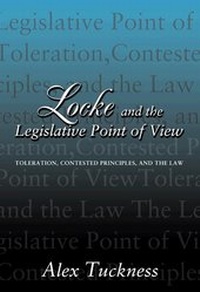
Locke and the Legislative Point of View
Toleration, Contested Principles, and the Law
Published on 15. September 2002
Book
Hardback
224 pages
978-0-691-09503-5 (ISBN)
Description
Determining which moral principles should guide political action is a vexing question in political theory. This is especially true when faced with the "toleration paradox": believing that something is morally wrong but also believing that it is wrong to suppress it. In this book, Alex Tuckness argues that John Locke's potential contribution to this debate - what Tuckness terms the "legislative point of view" - has long been obscured by overemphasis on his doctrine of consent. Building on a line of reasoning Locke made explicit in his later writings on religious toleration, Tuckness explores the idea that we should act politically only on those moral principles that a reasonable legislator would endorse; someone, that is, who would avoid enacting measures that could be self-defeating when applied by fallible human beings. Tuckness argues that the legislative point of view has implications that go far beyond the question of religious toleration. Locke suggests an approach to political justification that is a provocative alternative to the utilitarian, contractualist and perfectionist approaches dominating contemporary liberalism.
The legislative point of view is relevant to our think
The legislative point of view is relevant to our think
Reviews / Votes
The clarity of the writing and the seriousness with which it entertains objections make this a model of fair-minded and thorough scholarship... [Readers] should come away from Tuckness's broad and generous reading of Locke with an enhanced understanding of the potential of Locke's legislative metaphor to shed light on contemporary issues of morality and politics. -- Andrew Murphy Review of PoliticsMore details
Language
English
Place of publication
New Jersey
United States
Target group
Professional and scholarly
College/higher education
Product notice
Trade binding
Dimensions
Height: 229 mm
Width: 152 mm
Weight
454 gr
ISBN-13
978-0-691-09503-5 (9780691095035)
Copyright in bibliographic data and cover images is held by Nielsen Book Services Limited or by the publishers or by their respective licensors: all rights reserved.
Schweitzer Classification
Other editions
Additional editions
E-Book
02/2009
1st Edition
Princeton University Press
€161.95
Available for download
Person
Alex Tuckness is Assistant Professor of Political Science at Iowa State University.
Content
ACKNOWLEDGMENTS xi ABBREVIATED REFERENCES xiii Introduction 1 PART I The Legislative Point of View and the Ends of Government 15 CHAPTER 1 Contested Laws and Principles 17 Contested Principles and the Legislative Point of View 25 The Analogy between Laws and Moral Principles 31 CHAPTER 2 Contested Principles and the Legislative Point of View 36 Rule-Utilitarianism and Contested Principles 36 Locke, Proast, and Contested Principles 39 The Secular Analogue of the Lockean Argument 46 Two Illustrations 51 CHAPTER 3 Legislative Consent and the Public Good 57 Problems with Contractual Consent 66 Locke's Legislative Consent and the Public Good 74 CHAPTER 4 Beyond Neutrality and Perfectionism 85 Two Liberal Approaches 85 Rawls and Reasonable Agreement 88 Raz and Human Well-Being 101 Beyond Neutrality and Perfectionism 110 PART II The Legislative Point of View and Constitutional Roles 115 CHAPTER 5 Institutional Roles and the Legislative Point of View 117 Locke on Legislative and Executive Powers 121 Locke and the Missing Judicial Power 127 Judges as Legislators: Functions versus Institutions 132 Implications for Contested Roles 135 CHAPTER 6 Contested Roles, Interpretation, and the Framer's Point of View 137 Contested Jurisdiction and the "Framer's Point of View" 140 Contested Constitutional Jurisdiction in the United States 143 Dworkin and the Legislative Point of View 147 Originalism and the Nature of Law and Legislation 159 Boerne v. Flores 166 Contested Roles and the State of Nature 172 Conclusion 174 APPENDIX I Textual Support for the Legislative Point of View 179 APPENDIX 2 Locke's Theory of Consent and the Ends of Government 181 BIBLIOGRAPHY 191 COURT CASES CITED 199 INDEX 201