

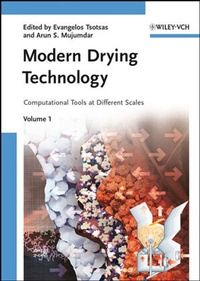
Modern Drying Technology
Volume 1: Computational Tools at Different Scales
1st Edition
Published on 20. January 2011
XXXVIII, 321 pages
978-3-527-63163-6 (ISBN)
Description

This five-volume handbook provides a comprehensive overview of all important aspects of modern drying technology, including only advanced results.
In this first volume diverse model types for the drying of products and the design of drying processes (short-cut methods, homogenized, pore network, and continuous thermo-mechanical approaches) are treated, along with computational fluid dynamics, population balances, and process systems simulation tools. Emphasis is put on scale transitions.
In this first volume diverse model types for the drying of products and the design of drying processes (short-cut methods, homogenized, pore network, and continuous thermo-mechanical approaches) are treated, along with computational fluid dynamics, population balances, and process systems simulation tools. Emphasis is put on scale transitions.
More details
Other editions
Additional editions
Software
01/2011
Wiley-VCH
€346.96
No shipping information available
Evangelos Tsotsas | Arun S. Mujumdar
Modern Drying Technology
Volume 1: Computational Tools at Different Scales
Book
09/2007
1st Edition
Wiley-VCH
€249.00
Article exhausted; check different version
Persons
Professor Dr. Ing. Evangelos Tsotsas holds the Chair of Thermal Process Engineering at Otto von Guericke University Magdeburg (Germany) since 1994. Prior to this, he was a Senior Process Specialist at the Dow Chemical Company. He has authored about 250 papers in refereed journals and conference proceedings, and is the recipient of the Hosokawa Award for Innovation and the ProcessNet Award for Excellence in Drying Research. He serves in various functions in organizations such as the German Research Foundation (DFG), the Alexander von Humboldt Foundation, and the European and German Working Party on Drying.
Professor Arun S. Mujumdar has been Professor of Chemical and Mechanical Engineering at the McGill University, Canada, and at the National University of Singapore. He has authored 2 books and over 60 book chapters, edited or co-edited over 50 books including the Handbook of Industrial Drying.Member of various professional and scientific associations, he was recently conferred Doctor Honoris Causa by the Technical University of Lodz, Poland, and the University of Lyon, France.
Professor Arun S. Mujumdar has been Professor of Chemical and Mechanical Engineering at the McGill University, Canada, and at the National University of Singapore. He has authored 2 books and over 60 book chapters, edited or co-edited over 50 books including the Handbook of Industrial Drying.Member of various professional and scientific associations, he was recently conferred Doctor Honoris Causa by the Technical University of Lodz, Poland, and the University of Lyon, France.
Content
COMPREHENSIVE DRYING MODELS BASED ON VOLUME AVERAGING. BACKGROUND, APPLICATION AND PERSPECTIVE
Microscopic Foundations of the Macroscopic Formulation
The Macroscopic Set of Equations
Physical Phenomena Embedded in the Equations
Computational Strategy to Solve the Comprehensive Set of Macroscopic Equations
Possibilities Offered by this Modeling Approach: Convective Drying
Possibilities Offered by this Modeling Approach: Less-Common Drying Configurations
Homogenization as a Way to Supply the Code with Physical Parameters
The Multiscale Approach
PORE-NETWORK MODELS: A POWERFUL TOOL TO STUDY DRYING AT THE PORE LEVEL AND UNDERSTAND THE INFLUENCE OF STRUCTURE ON DRYING KINETICS
Introduction
Isothermal Drying Model
Model Extensions
Influence of Pore Structure
Towards an Assessment of Continuous Models
CONTINUOUS THERMOMECHANICAL MODELS USING VOLUME-AVERAGING THEORY
Introduction
Modeling
Simulation
Liquid Pressure as Driving Force
Conclusions
CONTINUOUS THERMOHYDROMECHANICAL MODEL USING THE THEORY OF MIXTURES
Preliminaries
Global Balance Equations
Constitutive Equations in the Skeletal Frame of Reference
Rate Equations for Heat and Mass Transfer
Differential Equations for Heat and Mass Transfer
Thermomechanical Equations for a Drying Body
Drying of a Cylindrical Sample made of Kaolin
Final Remarks
CFD IN DRYING TECHNOLOGY - SPRAY-DRYER SIMULATION
Introduction
The Euler-Lagrange Approach: An Extended Model for Spray-Dryer Calculations
Droplet-Drying Models
Collisions of Particles
Example of a Spray-Dryer Calculation
Prediction of Product Properties
Summary
NUMERICAL METHODS ON POPULATION BALANCES
Introduction
Pure Breakage
Pure Aggregation
Pure Growth
Combined Aggregation and Breakage
Combined Aggregation and Nucleation
Combined Growth and Aggregation
Combined Growth and Nucleation
Multidimensional Population Balances
PROCESS-SYSTEMS SIMULATION TOOLS
Introduction
Numerical Calculation Procedures
Heat and Mass Balances
Scoping Design Methods
Scaling Methods
Detailed Design Models
Ancillary Calculations
Process Simulators
Expert Systems and Decision-Making Tools
Knowledge Bases and Qualitative Information
Commercialization of Drying Software
Conclusions
Microscopic Foundations of the Macroscopic Formulation
The Macroscopic Set of Equations
Physical Phenomena Embedded in the Equations
Computational Strategy to Solve the Comprehensive Set of Macroscopic Equations
Possibilities Offered by this Modeling Approach: Convective Drying
Possibilities Offered by this Modeling Approach: Less-Common Drying Configurations
Homogenization as a Way to Supply the Code with Physical Parameters
The Multiscale Approach
PORE-NETWORK MODELS: A POWERFUL TOOL TO STUDY DRYING AT THE PORE LEVEL AND UNDERSTAND THE INFLUENCE OF STRUCTURE ON DRYING KINETICS
Introduction
Isothermal Drying Model
Model Extensions
Influence of Pore Structure
Towards an Assessment of Continuous Models
CONTINUOUS THERMOMECHANICAL MODELS USING VOLUME-AVERAGING THEORY
Introduction
Modeling
Simulation
Liquid Pressure as Driving Force
Conclusions
CONTINUOUS THERMOHYDROMECHANICAL MODEL USING THE THEORY OF MIXTURES
Preliminaries
Global Balance Equations
Constitutive Equations in the Skeletal Frame of Reference
Rate Equations for Heat and Mass Transfer
Differential Equations for Heat and Mass Transfer
Thermomechanical Equations for a Drying Body
Drying of a Cylindrical Sample made of Kaolin
Final Remarks
CFD IN DRYING TECHNOLOGY - SPRAY-DRYER SIMULATION
Introduction
The Euler-Lagrange Approach: An Extended Model for Spray-Dryer Calculations
Droplet-Drying Models
Collisions of Particles
Example of a Spray-Dryer Calculation
Prediction of Product Properties
Summary
NUMERICAL METHODS ON POPULATION BALANCES
Introduction
Pure Breakage
Pure Aggregation
Pure Growth
Combined Aggregation and Breakage
Combined Aggregation and Nucleation
Combined Growth and Aggregation
Combined Growth and Nucleation
Multidimensional Population Balances
PROCESS-SYSTEMS SIMULATION TOOLS
Introduction
Numerical Calculation Procedures
Heat and Mass Balances
Scoping Design Methods
Scaling Methods
Detailed Design Models
Ancillary Calculations
Process Simulators
Expert Systems and Decision-Making Tools
Knowledge Bases and Qualitative Information
Commercialization of Drying Software
Conclusions
