

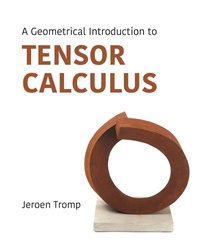
A Geometrical Introduction to Tensor Calculus
Description

An authoritative, self-contained introduction to geometrical tensor calculus for scientists and engineers Tensors are widely used in physics and engineering to describe physical properties that have multiple dimensions and magnitudes. In recent years, they have become increasingly important for data analytics and machine learning, allowing for the representation and processing of data in neural networks and the modeling of complex relationships in multidimensional spaces. This incisive book provides a geometrical understanding of tensors and their calculus from the point of view of a physicist. With a wealth of examples presented in visually engaging boxes, it takes readers through all aspects of geometrical continuum mechanics and the field and dynamic equations of Einstein, Einstein-Cartan, and metric-affine theories of general relativity. A Geometrical Introduction to Tensor Calculus gives graduate students, advanced undergraduates, and researchers a powerful and mathematically elegant tool for comprehending the behavior and applications of tensors across an array of fields.
- Offers a physicist's perspective on geometrical tensor calculus
- Includes dozens of examples that illustrate the geometrical use of tensors in continuum mechanics and general relativity
- Can serve as the basis for a course in tensor calculus for physicists and engineers
- Invaluable as a supplementary guide for anyone studying areas of physics that rely on tensor calculus, such as electrodynamics, geophysics, fluid and continuum mechanics, and general relativity
More details
Other editions
Additional editions
Person
Content
- Cover
- Contents
- List of Examples
- Preface
- 1. Introduction
- 2. Linear Spaces and Transformations
- 2.1. Properties of Linear Spaces
- 2.2. Vector Spaces
- 2.3. Linear Transformations
- 3. Differentiable Manifolds
- 3.1. Charts and Coordinates
- 3.2. Definition
- 3.3. Local Coordinate Changes
- 3.4. Functions on Manifolds
- 3.5. Orientable Manifolds
- 4. Vectors and One-Forms
- 4.1. Vectors
- 4.1.1. Vectors as Tangents to Curves
- 4.1.2. Bases and Coordinates
- 4.1.3. Vector Field
- 4.1.4. Transformations
- 4.2 One-Forms
- 4.2.1. Duality
- 4.2.2. Bases
- 4.2.3. Transformations
- 4.3. Alternative Perspective
- 4.4. Lie Bracket
- 5. Tensors
- 5.1. Definition
- 5.2. Operations on Tensors
- 5.2.1. Addition
- 5.2.2. Tensor Product
- 5.2.3. Contraction
- 5.2.4. Transpose of (2,0) and (0,2) Tensors
- 5.2.5. Transpose of a (1,1) Tensor
- 5.3. Transformations
- 5.3.1. Tetrad Formalism
- 5.3.2. Pseudotensors
- 5.4. Kronecker or Identity Tensor
- 5.5. Logarithms and Exponentials of (1,1) Tensors
- 5.6. Tensor Densities and Capacities
- 5.6.1. Pseudotensor Densities and Capacities
- 5.7. Levi-Civita Density and Capacity
- 5.8. Determinant of Rank-2 Tensors
- 5.9. Inverse of Rank-2 Tensors
- 5.10. Metric Tensor
- 5.10.1. Formulation
- 5.10.2. Geometrical Meaning
- 5.10.3. Norm of Vectors and One-Forms
- 5.10.4. Metric in Tetrads
- 5.11. Adjoint of a (1,1) Tensor
- 5.12. Tensor Densities and Capacities Revisited
- 5.13. Levi-Civita Pseudotensor
- 5.14. Kronecker Determinants
- 5.15. Rotations
- 5.15.1. Euler Angles
- 5.15.2. Rodrigues's Formula
- 6. Maps between Manifolds
- 6.1. Maps
- 6.2. Maps between Manifolds of Different Dimensions
- 6.2.1. Pullback
- 6.2.2. Pushforward
- 6.3 Maps between Manifolds of the Same Dimensions
- 7. Differentiation on Manifolds
- 7.1. Covariant Derivative
- 7.1.1. Formulation
- 7.1.2. Transformation of Connection Coefficients
- 7.1.3. Divergence
- 7.1.4. Parallel Transport
- 7.1.5. Torsion and Curvature Tensors
- 7.1.6. Bianchi Identities
- 7.1.7. Torsion-Free Connection
- 7.1.8. Covariant Derivative of the Metric Tensor
- 7.1.9. Mixed Covariant Derivative in Tetrad Basis
- 7.1.10. Spin Connection
- 7.1.11. Contracted Bianchi Identities
- 7.1.12. Covariant Derivative of Tensor Densities and Capacities
- 7.1.13. Nonmetricity
- 7.2. Euler Derivative
- 7.3. Lie Derivative
- 7.3.1. Lie Derivative of Vectors
- 7.3.2. Geometrical Interpretation
- 7.3.3. Autonomous Lie Derivative
- 7.3.4. Lie Derivative of One-Forms
- 7.3.5. Lie Derivative of (p,q) Tensors
- 7.3.6. Lie Derivative of Functions
- 7.3.7. Lie Derivative of Metric Tensors
- 7.3.8. Lie Derivative of Levi-Civita Tensor
- 8. Differential Forms
- 8.1. Definition
- 8.2. Operations on Forms
- 8.2.1. Addition
- 8.2.2. Exterior Product
- 8.2.3. Interior Product
- 8.3. k-Vectors
- 8.4. Hodge Dual
- 8.5. Volumes
- 8.5.1. Properties
- 8.6. Surfaces
- 8.7. Exterior Derivative
- 8.7.1. Coordinate-Free Definition
- 8.7.2. Exact Forms
- 8.7.3. Commutativity with Pullback and Pushforward
- 8.8. Lie Derivative of a Form
- 8.9. Vector-and Tensor-Valued Forms
- 8.9.1. Transformations of Tensor- Valued Forms
- 8.9.2. Operations on Tensor-Valued Forms
- 8.9.3. Connection One-Forms
- 8.9.4. Torsion Two-Forms
- 8.9.5. Exterior Covariant Derivative
- 8.9.6. Covariant Lie Derivative
- 8.9.7. Curvature Two-Forms
- 8.9.8. Commutator of Covariant Lie and Exterior Covariant Derivatives
- 8.9.9. Bianchi Identities Revisited
- 8.9.10. Nonmetricity Revisited
- 8.10. Integration of Forms
- 8.10.1. Line Integrals
- 8.10.2. Surface Integrals
- 8.10.3. Volume Integrals
- 8.11. Stokes's Theorem
- 8.11.1. Fundamental Theorem of Calculus
- 8.11.2. Green's Theorem
- 8.11.3. Gauss's Theorem
- 8.11.4. Stokes's Theorem
- 8.11.5. Variational Principles
- 8.11.6. Noether's Theorem
- 8.11.7. Applications
- Glossary
- Bibliography
- Author Index
- General Index
