

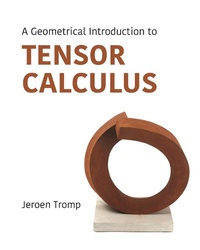
A Geometrical Introduction to Tensor Calculus
Published on 4. March 2025
Book
Hardback
248 pages
978-0-691-26797-5 (ISBN)
Description
An authoritative, self-contained introduction to geometrical tensor calculus for scientists and engineers
Tensors are widely used in physics and engineering to describe physical properties that have multiple dimensions and magnitudes. In recent years, they have become increasingly important for data analytics and machine learning, allowing for the representation and processing of data in neural networks and the modeling of complex relationships in multidimensional spaces. This incisive book provides a geometrical understanding of tensors and their calculus from the point of view of a physicist. With a wealth of examples presented in visually engaging boxes, it takes readers through all aspects of geometrical continuum mechanics and the field and dynamic equations of Einstein, Einstein-Cartan, and metric-affine theories of general relativity. A Geometrical Introduction to Tensor Calculus gives graduate students, advanced undergraduates, and researchers a powerful and mathematically elegant tool for comprehending the behavior and applications of tensors across an array of fields.
Offers a physicist's perspective on geometrical tensor calculus
Includes dozens of examples that illustrate the geometrical use of tensors in continuum mechanics and general relativity
Can serve as the basis for a course in tensor calculus for physicists and engineers
Invaluable as a supplementary guide for anyone studying areas of physics that rely on tensor calculus, such as electrodynamics, geophysics, fluid and continuum mechanics, and general relativity
Tensors are widely used in physics and engineering to describe physical properties that have multiple dimensions and magnitudes. In recent years, they have become increasingly important for data analytics and machine learning, allowing for the representation and processing of data in neural networks and the modeling of complex relationships in multidimensional spaces. This incisive book provides a geometrical understanding of tensors and their calculus from the point of view of a physicist. With a wealth of examples presented in visually engaging boxes, it takes readers through all aspects of geometrical continuum mechanics and the field and dynamic equations of Einstein, Einstein-Cartan, and metric-affine theories of general relativity. A Geometrical Introduction to Tensor Calculus gives graduate students, advanced undergraduates, and researchers a powerful and mathematically elegant tool for comprehending the behavior and applications of tensors across an array of fields.
Offers a physicist's perspective on geometrical tensor calculus
Includes dozens of examples that illustrate the geometrical use of tensors in continuum mechanics and general relativity
Can serve as the basis for a course in tensor calculus for physicists and engineers
Invaluable as a supplementary guide for anyone studying areas of physics that rely on tensor calculus, such as electrodynamics, geophysics, fluid and continuum mechanics, and general relativity
Reviews / Votes
"A refreshing exploration of both the theory and . . . application of tensor calculus."---Kymani Tieral Keden Armstrong-Williams, Physics Book ReviewsMore details
Language
English
Place of publication
New Jersey
United States
Target group
College/higher education
Professional and scholarly
Product notice
Trade binding
Illustrations
40 b/w illus.
Dimensions
Height: 254 mm
Width: 200 mm
Thickness: 20 mm
Weight
885 gr
ISBN-13
978-0-691-26797-5 (9780691267975)
Copyright in bibliographic data and cover images is held by Nielsen Book Services Limited or by the publishers or by their respective licensors: all rights reserved.
Schweitzer Classification
Other editions
Additional editions
Jeroen Tromp
A Geometrical Introduction to Tensor Calculus
E-Book
03/2025
Princeton University Press
€48.99
Available for download
Person
Jeroen Tromp is the Blair Professor of Geology and Professor of Applied and Computational Mathematics at Princeton University. His books include Theoretical and Computational Seismology and (with F. A. Dahlen) Theoretical Global Seismology (both Princeton).