

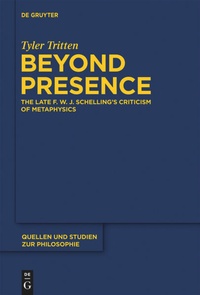
Beyond Presence
Description

This book provides the English-speaking world with a comprehensive account of the still largely unknown work of Schelling's philosophy of mythology and revelation. Its achievement, however, is not archival but philosophical, elucidating the relation between Schelling and onto-theology. It explains how Schelling dealt with the problem of nihilism and onto-theology well before Nietzsche and Heidegger, arguing that Schelling surpasses onto-theology or the philosophy of presence a century prior to Heidegger. Overall, the author provocatively suggests that Heidegger is perhaps Schelling's genuine heir and by comprehensively interpreting Schelling's multifaceted late lectures he analyzes issues as diverse as the Ancient relation between thinking and Being, the Medieval debate between voluntarism and intellectualism, the overcoming of modern subjectivism and German Idealism as well as many themes in contemporary philosophy.
The presentation is systematic rather than thematic, following Schelling's ages of the world through the Past, Present and Future. The results are daring, departing from the half-century long canonical reading of the late Schelling since Walter Schulz. This book is valuable for Schelling-scholars, historians of philosophy and theologians alike.
More details
Other editions
Additional editions
Person
Content
2 - Abbreviations Used in References and Notes on Translations [Seite 7]
3 - Part I. Crisis and Method [Seite 15]
3.1 - Chapter 1. The Contemporary Crisis of Meaning [Seite 17]
3.1.1 - 1 The Crisis: Meaning and Presence [Seite 17]
3.1.2 - 2 The Crisis and Contemporary Culture [Seite 23]
3.1.3 - 3 The Crisis and Schelling [Seite 30]
3.1.4 - 4 Structure of the Text Arranged According to Epochs [Seite 40]
3.2 - Chapter 2. Positive Philosophy as Both Method and Object: A Methodological Analysis [Seite 42]
3.2.1 - 1 The Phenomenological Criterion [Seite 43]
3.2.2 - 2 Denken and Nachdenken [Seite 47]
3.2.3 - 3 Daß Es Ist and Was Es Ist [Seite 52]
3.2.4 - 4 Positive and Negative Philosophy: Progression and Regression [Seite 59]
3.2.5 - 5 Wanting, Believing and Knowing [Seite 64]
3.2.6 - 6 Empiricism: Subjective, Objective and Scientific (Abduction) [Seite 66]
3.2.7 - 7 The Prior and the Posterior [Seite 76]
3.2.8 - 8 Historical Philosophy: Truth and Falsification [Seite 78]
3.2.9 - 9 Freedom: Novelty, Difference and Presence [Seite 87]
3.2.10 - 10 Experience: Aesthesis [Seite 93]
4 - Part II. The Past: Eternity [Seite 101]
4.1 - Chapter 3. Timelessness: The Potencies at Rest [Seite 103]
4.1.1 - 1 Parmenides' Statement [Seite 104]
4.1.2 - 2 The Different and the Identical: Duas and Monas [Seite 106]
4.1.3 - 3 Copulation [Seite 115]
4.1.4 - 4 The Potencies [Seite 126]
4.1.4.1 - 4.1 The First Potency [Seite 128]
4.1.4.2 - 4.2 The Second Potency [Seite 130]
4.1.4.3 - 4.3 The Third Potency [Seite 131]
4.1.4.4 - 4.4 The Concatenation and Simplicity of the Three [Seite 133]
4.1.5 - 5 Who Is das Seinkönnende, the Effusive One? [Seite 138]
4.1.6 - 6 Who is God? [Seite 140]
4.1.7 - 7 The Law of Decisiveness and the Interstice [Seite 149]
4.2 - Chapter 4. The Time of Eternity: The Potencies in Act [Seite 164]
4.2.1 - 1 Generation and Creation [Seite 164]
4.2.2 - 2 The Act of Creation [Seite 177]
4.2.3 - 3 The Causes [Seite 189]
4.2.4 - 4 The Holy or God's Withdrawal from the Created [Seite 200]
4.2.5 - 5 The Ideas as Visions [Seite 211]
4.2.6 - 6 The Idea [Seite 217]
4.3 - Chapter 5. Intermittence [Seite 229]
4.3.1 - 1 The Separation of Times [Seite 230]
4.3.2 - 2 Aesthesis, Memory and History [Seite 233]
4.3.3 - 3 Historical Time as Contemporaneity or Simultaneity [Seite 236]
5 - Part III. The Present: Historical Time [Seite 239]
5.1 - Chapter 6. The Philosophy of Mythology [Seite 241]
5.1.1 - 1 From Lordship to Divine Sufferance [Seite 241]
5.1.2 - 2 What are Myths? [Seite 244]
5.1.3 - 3 The Co-Originality of the Myth and the Consciousness Thereof [Seite 254]
5.1.4 - 4 Polytheism and Monotheism [Seite 263]
5.1.5 - 5 The Types of Monotheism [Seite 267]
5.1.6 - 6 Schelling's Historiography of Mythology [Seite 277]
5.1.7 - 7 Tautegory [Seite 286]
5.1.8 - 8 The Objective Meaning of the History of Mythology [Seite 296]
5.1.9 - 9 Considerations of the Philosophy of Mythology for the Philosophies of History and Religion [Seite 305]
5.1.10 - 10 Ruminations on a Future Mythology [Seite 309]
5.2 - Chapter 7. Language is Faded Mythology: On the Origin and Essence of Language [Seite 311]
5.2.1 - 1 Language is not an Invention of Consciousness [Seite 311]
5.2.2 - 2 The Tower of Babel [Seite 312]
5.2.3 - 3 The Case of China [Seite 314]
5.2.4 - 4 China and the Language of Humanity [Seite 320]
5.2.5 - 5 Music and Causal Efficacy [Seite 328]
5.2.6 - 6 The Copula Revisited in Light of Supplementation [Seite 332]
6 - Part IV. The Future: Advent [Seite 335]
6.1 - Chapter 8. Intimations of the Future and Concluding Remarks [Seite 337]
6.1.1 - 1 The Man-God as Exemplary Repetition/Copulation [Seite 339]
6.1.2 - 2 Difference and Identity [Seite 344]
6.1.3 - 3 The World Law Revisited in Light of the Transcendentals [Seite 349]
6.1.4 - 4 Time and the End of History [Seite 353]
7 - Schema of the Doubled Temporal Relations of the Creation and Mythology with Reference to the Corresponding Gods and Peoples [Seite 363]
8 - References [Seite 367]
9 - Author Index [Seite 377]
10 - Subject Index [Seite 379]
