

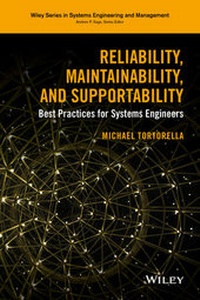
Reliability, Maintainability, and Supportability
Description

More details
Other editions
Additional editions
Person
Content
Foreword xviii
Acknowledgments xxii
Part I Reliability Engineering
1. Systems Engineering and the Sustainability Disciplines 3
1.1 Purpose of this Book 3
1.1.1 Systems Engineers Create and Monitor Requirements 3
1.1.2 Good Requirements are a Key to Success 4
1.1.3 Sustainability Requirements are Important Too 6
1.1.4 Focused Action is Needed to Achieve the Goals Expressed by the Requirements 7
1.2 Goals 8
1.3 Scope 10
1.3.1 Reliability Engineering 10
1.3.2 Maintainability Engineering 11
1.3.3 Supportability Engineering 12
1.4 Audience 12
1.4.1 Who Should Read This Book? 12
1.4.2 Prerequisites 13
1.4.3 Postrequisites 13
1.5 Getting Started 14
1.6 Key Success Factors for Systems Engineers in Reliability, Maintainability, and Supportability Engineering 15
1.6.1 Customer-Supplier Relationships 15
1.6.2 Language and Clarity of Communication 16
1.6.3 Statistical Thinking 17
1.7 Organizing a Course Using this Book 17
1.7.1 Examples 18
1.7.2 Exercises 18
1.7.3 References 18
1.8 Chapter Summary 19
References 19
2. Reliability Requirements 20
2.1 What to Expect from this Chapter 20
2.2 Reliability for Systems Engineers 21
2.2.1 "Reliability" in Conversation 21
2.2.2 "Reliability" in Engineering 21
2.2.3 Foundational Concepts 21
2.2.4 Reliability Concepts for Systems Engineers 25
2.2.5 Definition of Reliability 28
2.2.6 Failure Modes, Failure Mechanisms, and Failure Causes 32
2.2.7 The Stress-Strength Model 34
2.2.8 The Competing Risk Model 35
2.3 Reliability, Maintainability, and Supportability are Mutually Reinforcing 36
2.3.1 Introduction 36
2.3.2 Mutual Reinforcement 40
2.4 The Structure of Reliability Requirements 41
2.4.1 Reliability Effectiveness Criteria 41
2.4.2 Reliability Figures of Merit 43
2.4.3 Quantitative Reliability Requirements Frameworks 44
2.5 Examples of Reliability Requirements 46
2.5.1 Reliability Requirements for a Product 46
2.5.2 Reliability Requirements for a Flow Network 48
2.5.3 Reliability Requirements for a Standing Service 50
2.5.4 Reliability Requirements for an On-Demand Service 51
2.6 Interpretation of Reliability Requirements 53
2.6.1 Introduction 53
2.6.2 Stakeholders 54
2.6.3 Interpretation of Requirements Based on Effectiveness Criteria 55
2.6.4 Interpretation of Requirements Based on Figures of Merit 58
2.6.5 Models and Predictions 62
2.6.6 What Happens When a Requirement is Not Met? 63
2.7 Some Additional Figures of Merit 65
2.7.1 Cumulative Distribution Function 65
2.7.2 Measures of Central Tendency 65
2.7.3 Measures of Dispersion 69
2.7.4 Percentiles 70
2.7.5 The Central Limit Theorem and Confidence Intervals 71
2.8 Current Best Practices in Developing Reliability Requirements 73
2.8.1 Determination of Failure Modes 74
2.8.2 Determination of Customer Needs and Desires for Reliability and Economic Balance with Reliability Requirements 74
2.8.3 Review All Reliability Requirements for Completeness 76
2.8.4 Allocation of System Reliability Requirements to System Components 76
2.8.5 Document Reliability Requirements 79
2.9 Chapter Summary 79
2.10 Exercises 81
References 82
3. Reliability Modeling for Systems Engineers 84
3.1 What to Expect from this Chapter 84
3.2 Introduction 85
3.3 Reliability Effectiveness Criteria and Figures of Merit for Nonmaintained Units 87
3.3.1 Introduction 87
3.3.2 The Life Distribution and the Survivor Function 90
3.3.3 Other Quantities Related to the Life Distribution and Survivor Function 95
3.3.4 Some Commonly Used Life Distributions 102
3.3.5 Quantitative Incorporation of Environmental Stresses 111
3.3.6 Quantitative Incorporation of Manufacturing Process Quality 116
3.3.7 Operational Time and Calendar Time 118
3.3.8 Summary 120
3.4 Ensembles of Nonmaintained Components 120
3.4.1 System Functional Decomposition 120
3.4.2 Some Examples of System and Service Functional Decompositions 121
3.4.3 Reliability Block Diagram 124
3.4.4 Ensembles of Single-Point-of-Failure Units: Series Systems 125
3.4.5 Ensembles Containing Redundant Elements: Parallel Systems 131
3.4.6 Structure Functions 138
3.4.7 Path Set and Cut Set Methods 139
3.4.8 Reliability Importance 144
3.4.9 Non-Service-Affecting Parts 145
3.5 Reliability Modeling Best Practices for Systems Engineers 146
3.6 Chapter Summary 146
3.7 Exercises 146
References 149
4. Reliability Modeling for Systems Engineers 153
4.1 What to Expect from this Chapter 153
4.2 Introduction 154
4.3 Reliability Effectiveness Criteria and Figures of Merit for Maintained Systems 154
4.3.1 Introduction 154
4.3.2 System Reliability Process 155
4.3.3 Reliability Effectiveness Criteria and Figures of Merit Connected with the System Reliability Process 156
4.3.4 When is a Maintainable System Not a Maintained System? 161
4.4 Maintained System Reliability Models 162
4.4.1 Types of Repair and Service Restoration Models 162
4.4.2 Systems with Renewal Repair 163
4.4.3 Systems with Revival Repair 166
4.4.4 More-General Repair Models 171
4.4.5 The Separate Maintenance Model 172
4.4.6 Superpositions of Point Processes and Systems with Many Single Points of Failure 177
4.4.7 State Diagram Reliability Models 179
4.5 Stability of Reliability Models 181
4.6 Software Resources 182
4.7 Reliability Modeling Best Practices for Systems Engineers 182
4.7.1 Develop and Use a Reliability Model 183
4.7.2 Develop the Reliability-Profitability Curve 183
4.7.3 Budget for Reliability 184
4.7.4 Design for Reliability 186
4.8 Chapter Summary 186
4.9 Exercises 187
References 188
5. Comparing Predicted and Realized Reliability with Requirements 190
5.1 What to Expect from this Chapter 190
5.2 Introduction 190
5.3 Effectiveness Criteria, Figures of Merit, Metrics, and Predictions 191
5.3.1 Review 191
5.3.2 Example 192
5.3.3 Reliability Predictions 193
5.4 Statistical Comparison Overview 194
5.4.1 Quality of Knowledge 194
5.4.2 Three Comparisons 195
5.4.3 Count Data from Aggregates of Systems 198
5.4.4 Environmental Conditions 198
5.5 Statistical Comparison Techniques 199
5.5.1 Duration Requirements 199
5.5.2 Count Requirements 208
5.6 Failure Reporting and Corrective Action System 212
5.7 Reliability Testing 214
5.7.1 Component Life Testing 214
5.7.2 Reliability Growth Testing 215
5.7.3 Software Reliability Modeling 216
5.8 Best Practices in Reliability Requirements Comparisons 216
5.8.1 Track Achievement of Reliability Requirements 216
5.8.2 Institute a FRACAS 216
5.9 Chapter Summary 216
5.10 Exercises 217
References 218
6. Design for Reliability 219
6.1 What to Expect from this Chapter 219
6.2 Introduction 220
6.3 Techniques for Reliability Assessment 221
6.3.1 Quantitative Reliability Modeling 221
6.3.2 Reliability Testing 223
6.4 The Design for Reliability Process 224
6.4.1 Information Sources 226
6.5 Hardware Design for Reliability 228
6.5.1 Printed Wiring Boards 228
6.5.2 Design for Reliability in Complex Systems 235
6.6 Qualitative Design for Reliability Techniques 236
6.6.1 Fault Tree Analysis 236
6.6.2 Failure Modes, Effects, and Criticality Analysis 243
6.7 Design for Reliability for Software Products 251
6.8 Robust Design 252
6.9 Design for Reliability Best Practices for Systems Engineers 257
6.9.1 Reliability Requirements 257
6.9.2 Reliability Assessment 258
6.9.3 Reliability Testing 258
6.9.4 DFR Practices 258
6.10 Software Resources 258
6.11 Chapter Summary 259
6.12 Exercises 259
References 260
7. Reliability Engineering for High-Consequence Systems 262
7.1 What to Expect from this Chapter 262
7.2 Definition and Examples of High-Consequence Systems 262
7.2.1 What is a High-Consequence System? 262
7.2.2 Examples of High-Consequence Systems 263
7.3 Reliability Requirements for High-Consequence Systems 265
7.4 Strategies for Meeting Reliability Requirements in High-Consequence Systems 267
7.4.1 Redundancy 267
7.4.2 Network Resiliency 269
7.4.3 Component Qualification and Certification 270
7.4.4 Failure Isolation 277
7.5 Current Best Practices in Reliability Engineering for High-Consequence Systems 278
7.6 Chapter Summary 279
7.7 Exercises 280
References 280
8. Reliability Engineering for Services 282
8.1 What to Expect from this Chapter 282
8.2 Introduction 282
8.2.1 On-Demand Services 283
8.2.2 Always-On Services 284
8.3 Service Functional Decomposition 285
8.4 Service Failure Modes and Failure Mechanisms 286
8.4.1 Introduction 286
8.4.2 Service Failure Modes 288
8.4.3 Service Failure Mechanisms 290
8.5 Service Reliability Requirements 294
8.5.1 Examples of Service Reliability Requirements 294
8.5.2 Interpretation of Service Reliability Requirements 295
8.6 Service-Level Agreements 296
8.7 SDI Reliability Requirements 297
8.8 Design for Reliability Techniques for Services 298
8.8.1 Service Fault Tree Analysis 299
8.8.2 Service FME(C)A 299
8.9 Current Best Practices in Service Reliability Engineering 299
8.9.1 Set Reliability Requirements for the Service 299
8.9.2 Determine Infrastructure Reliability Requirements from Service Reliability Requirements 300
8.9.3 Monitor Achievement of Service Reliability Requirements 300
8.10 Chapter Summary 300
8.11 Exercises 301
References 302
9. Reliability Engineering for the Software Component of Systems and Services 303
9.1 What to Expect from this Chapter 303
9.2 Introduction 304
9.3 Reliability Requirements for the Software Component of Systems and Services 305
9.3.1 Allocation of System Reliability Requirements to the Software Component 305
9.3.2 Reliability Requirements for Security and Other Novel Areas 308
9.3.3 Operational Time and Calendar Time 309
9.4 Reliability Modeling for Software 310
9.4.1 Reliability Growth Modeling for the Sequence of Failure Times 310
9.4.2 Other Approaches 312
9.5 Software Failure Modes and Failure Mechanisms 312
9.5.1 Software Failure Modes 312
9.5.2 Software Failure Mechanisms 313
9.6 Design for Reliability in Software 315
9.6.1 Software Fault Tree Analysis 316
9.6.2 Software FME(C)A 317
9.6.3 Some Software Failure Prevention Strategies 317
9.7 Current Best Practices in Reliability Engineering for Software 318
9.7.1 Follow Good Software Engineering Practices 318
9.7.2 Conduct Design Reviews Focused on Reliability 318
9.7.3 Reuse Known Good Software 319
9.7.4 Encourage a Prevention Mindset 319
9.8 Chapter Summary 319
9.9 Exercises 320
References 320
Part II Maintainability Engineering
10. Maintainability Requirements 325
10.1 What to Expect from this Chapter 325
10.2 Maintainability for Systems Engineers 326
10.2.1 Definitions 326
10.2.2 System Maintenance Concept 327
10.2.3 Use of Maintainability Effectiveness Criteria and Requirements 329
10.2.4 Use of Preventive Maintenance 331
10.2.5 Levels of Maintenance 331
10.2.6 Organizational Responsibilities 332
10.2.7 Design Features 333
10.2.8 Maintenance Environment 333
10.2.9 Warranties 334
10.2.10 Preventive Maintenance and Corrective Maintenance 334
10.2.11 Maintainability for Services 335
10.3 Maintainability Effectiveness Criteria and Figures of Merit 337
10.3.1 Products and Systems 337
10.3.2 Services 340
10.4 Examples of Maintainability Requirements 340
10.5 Maintainability Modeling 342
10.5.1 Duration and Labor-Hour Effectiveness Criteria and Figures of Merit 342
10.5.2 Count Effectiveness Criteria and Figures of Merit 344
10.6 Interpreting and Verifying Maintainability Requirements 344
10.6.1 Duration Effectiveness Criteria and Figures of Merit 344
10.6.2 Count Effectiveness Criteria and Figures of Merit 346
10.6.3 Cost and Labor-Hour Effectiveness Criteria and Figures of Merit 348
10.6.4 Three Availability Figures of Merit 348
10.7 Maintainability Engineering for High-Consequence Systems 349
10.8 Current Best Practices in Maintainability Requirements Development 351
10.8.1 Determine Customer Needs for Maintainability 351
10.8.2 Balance Maintenance with Economics 351
10.8.3 Use Quantitative Maintainability Modeling to Ensure Support for Maintainability Requirements 352
10.8.4 Manage Maintainability by Fact 352
10.9 Chapter Summary 353
10.10 Exercises 354
References 355
11. Design for Maintainability 356
11.1 What to Expect from this Chapter 356
11.2 System or Service Maintenance Concept 356
11.3 Maintainability Assessment 358
11.3.1 Maintenance Functional Decomposition and Maintainability Block Diagram 358
11.3.2 Quantitative Maintainability Modeling 360
11.4 Design for Maintainability Techniques 362
11.4.1 System Maintenance Concept 362
11.4.2 Level of Repair Analysis 363
11.4.3 Preventive Maintenance 369
11.4.4 Reliability-Centered Maintenance (RCM) 369
11.5 Current Best Practices in Design for Maintainability 372
11.5.1 Make a Deliberate Maintainability Plan 372
11.5.2 Determine Which Design for Maintainability Techniques to Use 372
11.5.3 Integration 373
11.5.4 Organizational Factors 373
11.6 Chapter Summary 374
11.7 Exercises 374
References 374
Part III Supportability Engineering
12. Support Requirements 379
12.1 What to Expect from this Chapter 379
12.2 Supportability for Systems Engineers 380
12.2.1 Supportability as a System Property 380
12.2.2 Factors Promoting Supportability 382
12.2.3 Activities Included in Supportability Engineering 382
12.2.4 Measuring and Monitoring Supportability 383
12.2.5 Developing and Interpreting Support Requirements 383
12.3 System or Service Support Concept 383
12.4 Support Effectiveness Criteria and Figures of Merit 384
12.5 Examples of Support Requirements 387
12.5.1 Support Elapsed Time (Duration) Requirements 387
12.5.2 Support Count Requirements 388
12.6 Interpreting and Verifying Support Requirements 389
12.7 Supportability Engineering for High-Consequence Systems 391
12.8 Current Best Practices in Support Requirements Development 391
12.8.1 Identify Support Needs 392
12.8.2 Balance Support with Economics 393
12.8.3 Use Quantitative Modeling to Promote Rationally Based Support Requirements 393
12.8.4 Manage Supportability by Fact 394
12.9 Chapter Summary 394
12.10 Exercises 395
References 395
13. Design for Supportability 396
13.1 What to Expect from this Chapter 396
13.2 Supportability Assessment 397
13.2.1 Quantitative Supportability Assessment 397
13.2.2 Qualitative Supportability Assessment 400
13.3 Implementation of Factors Promoting Supportability 401
13.3.1 Diagnostics and Fault Location 401
13.3.2 Tools and Equipment 402
13.3.3 Documentation and Workflow Management 402
13.3.4 Staff Training 403
13.3.5 Layout of Repair Facility and Workstation Design 403
13.3.6 Design of Maintenance Procedures 404
13.3.7 Spare Parts, Repair Parts, and Consumables Inventory 404
13.3.8 Transportation and Logistics 406
13.4 Quantitative Design for Supportability Techniques 406
13.4.1 Performance Analysis of a Maintenance Facility 406
13.4.2 Staff Sizing: The Machine Servicing Model 412
13.5 Current Best Practices in Design for Supportability 414
13.5.1 Customer Needs and Supportability Requirements 414
13.5.2 Team Integration 415
13.5.3 Modeling and Optimization 415
13.5.4 Continual Improvement 415
13.6 Chapter Summary 416
13.7 Exercises 416
References 417
Index 419
Foreword
PURPOSE AND RATIONALE
Students and professionals have many choices of text and reference books for the sustainability engineering disciplines: reliability, maintainability, and supportability. Available books range from theoretical treatises on the mathematical theory of reliability, applied maintainability and logistics modeling, studies in reliability physics, and books devoted to systems management. But there's still something missing: there is a need for an exposition of the sustainability engineering activities that systems engineers need to carry out, which explains the purposes and benefits of the activities without necessarily explaining how to do them all in detail. This book fills that need.
Several decades of experience in sustainability engineering and management in the telecommunications industry and additional experience in research and teaching have led me to these relevant observations.
- Few publications in the sustainability disciplines focus on the core systems engineering tasks of creating, managing, and tracking requirements for these disciplines specifically.
- The small number of degree-granting programs in sustainability engineering means that many systems engineers have no exposure to these ideas until they are assigned to deal with them in the work environment.
- The gap between what is known and available in the research literature and what is routinely practiced in day-to-day sustainability engineering is large and growing. Many sustainability engineers use oversimplified models and tools to deal with sustainability engineering tasks and consequently miss opportunities to develop more thorough and informative product management and improvement plans at lower cost.
- Systems engineers, in particular, because of the broad scope of their responsibilities, need support from those with specialized expertise to write good sustainability requirements, understand the results provided to them by sustainability engineering specialists, and track compliance with stated sustainability requirements. Consequently, they need enough background knowledge in these areas to be good suppliers and customers for the specialist teams.
- Many software tools essential for executing complex sustainability engineering tasks often (silently) incorporate simplifying assumptions, rely on the user to discern when results are reasonable or not, and do not give the user good insight into what to expect from the tool and what not to expect from the tool.
Sustainability engineering and management is not an obscure, arcane branch of knowledge. It is a human endeavor that can readily be carried out systematically and on the basis of a manageable number of principles. The purpose of this book is to provide that basis for systems engineers in particular. Certainly, few have as much influence on a product's design as do systems engineers. The creation of appropriate sustainability requirements is a key step to developing a system whose realized reliability, maintainability, and supportability meet the needs and desires of the system's customers while promoting success and profit to the vendor. Conversely, incomplete, unfocused, or inappropriate requirements lead to customer dissatisfaction with the system they purchase and use and cost the vendor more in warranty costs, maintenance of an extensive repair business, and lost goodwill. Our purpose here is to provide systems engineers with the principles and tools needed to craft sustainability requirements that make the product or system successful in satisfying the customers' needs and desires for reliability, maintainability, and supportability while keeping costs manageable. Our purpose is also to provide methods and tools systems engineers can use to determine whether sustainability requirements are being met satisfactorily by understanding and analysis of data from field installations. Finally, the book discusses enough quantitative modeling for reliability, maintainability, and supportability to support systems engineers in their engineering, management, validation, and communication tasks.
It is important to note that this book is not intended as a textbook in the mathematical theory of reliability (or the mathematical underpinnings of maintainability or supportability). Rather, our intention is to provide systems engineers with knowledge about the results of these theories so that, while they may sometimes construct needed reliability, maintainability, and supportability models on their own, it is more important that they be able to successfully acquire and use information provided to them by specialist engineers in these disciplines. The customer-supplier model provides a useful context for this interaction:
- Systems engineers act as suppliers in providing specialist engineers with clear and effective reliability, maintainability, and supportability requirements for the product.
- Systems engineers act as customers for the reliability, maintainability, and supportability models, data analysis, and so on, provided by specialist engineering teams during development.
Therefore, systems engineers need a good grasp of the language and concepts used in these areas, while not necessarily needing to be able to carry out extensive modeling or data analysis themselves. While this book is careful to describe the necessary language and concepts correctly and in appropriate contexts, it makes no attempt to provide mathematical proofs for the results cited. References are provided for those interested in pursuing details of the mathematical theory of reliability, but those details are not within the scope or purpose of this book.
GOALS
I hope this book will enable systems engineers to lead the development of systems (which we will interpret broadly in this book as encompassing products and services) whose reliability, maintainability, and supportability meet and exceed the expectations of their customers and provide success and profit to their employers. My intention is that systems engineers will themselves be able to employ, and encourage their sustainability engineering specialists to employ, the best practices discussed here in an orderly, systematic fashion guided by customer needs. I recognize that systems engineers have a very broad range of responsibilities, and it may not be possible for them to deal with every responsibility at equal depth. Therefore, it is important that their sustainability engineering and management responsibilities be supported by as straightforward and systematic a program as possible. I emphasize the thought processes underlying all the activities a systems engineer may have to undertake to ensure successful product or system sustainability. To avoid losing sight of the forest for the trees, we repeatedly return to the basic questions and first principles of the field in all the applications we cover, including hardware products, software-intensive systems, services, and high-consequence systems. My intention in doing this is to help systems engineers choose appropriate methods and tools to accomplish their purposes, and thereby create the most suitable sustainability requirements consistent with fulfilling customer needs and expectations and supplier success.
ORGANIZATION OF THIS BOOK
Every author likes to think that he brings to the reader a uniquely formative experience through the superior organization of topics and methods in his book. If only it were that simple. Success in learning depends primarily on student commitment. I can only try to make that job easier. I hope that the devices I use in this book will fulfill that wish.
- The book is organized into three major divisions, one corresponding to each of reliability, maintainability, and supportability engineering. Within each division, there is material on
- Requirements development,
- Quantitative modeling sufficient for understanding, developing, and interpreting requirements,
- Statistical analysis for checking whether systems in operation meet or do not meet requirements, and
- Best practices in each of these areas.
- I place a lot of emphasis on correct use of language. As discussed at length in Chapter 1, the language we use in the formal system that constitutes sustainability engineering contains many of the same words we use in ordinary discourse. It is vital to keep in mind which context you are operating in at all times. To help you do this in places where I think there is more than the usual possibility for confusion, I will point out in the text information you need to dispel that confusion. These instances are introduced by the header "Language tip" and they appear in many places in the text.
- This book is primarily for systems engineers whose main concern is the determination and development of appropriate requirements so that designers may fulfill the intent of the customer. Accordingly, the book emphasizes the use of various sustainability engineering methods and techniques in crafting requirements that are
- Focused on the customers' needs,
- Unambiguous,
- Easily understood by the requirements' stakeholders (customers, designers, and management), and
- Verifiable through collection and analysis of data from system operation.
The device employed in the book to promote this goal is the frequent interjection of "Requirements tips" that appear when needed and of most benefit.
- An equally important concern of systems engineers is determining when requirements are being met by systems operating in...
