

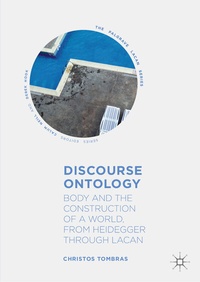
Discourse Ontology
Description

This book is informed by the terminology, insights, concepts, hypotheses, and conclusions of both thinkers. It discusses time and the body in jouissance; the emergence of the divided subject and signifierness; truth, agency and the event; and being and mathematical formalisation. Tombras describes the ontological recursive construction of a shared ontic world and discusses the limits and historicity of this world.
Reviews / Votes
"This novel and ambitious book is the result of decades of commitment to the study of Freud, Heidegger, and Lacan. . This book leaves room for further research at the interface between ontology and psychoanalysis and between Heidegger and Lacan." (Andrew Hodgkiss, Theory & Psychology, Vol. 32 (3), 2022)More details
Other editions
Additional editions
Person
Christos Tombras is a supervising psychoanalyst with a Lacanian orientation, practicing in London, UK. Dr. Tombras is a member of the Centre for Freudian Analysis and Research, UK, and lectures, runs workshops and facilitates reading groups. His main research interest is in a dialogue between continental philosophy and psychoanalysis. He has published in both English and Greek.
Content
Chapter 1: Introduction.- Chapter 2: Heidegger's question of being.- Chapter 3: A critique of science and psychoanalysis.- Chapter 4: Back to Freud, and beyond.- Chapter 5: Lacanian metapsychology.- Chapter 6: An Ontology from Discourse.- Chapter 7: Conclusion: Psychoanalysis as a cause.
