

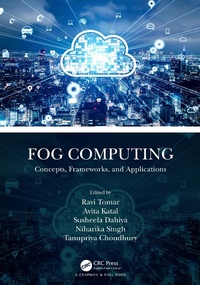
Fog Computing
Concepts, Frameworks, and Applications
1st Edition
Published on 11. July 2022
234 pages
978-1-000-61302-5 (ISBN)
Description

Fog Computing: Concepts, Frameworks, and Applications is arranged in such a way that readers with no prior experience in Fog Computing may explore this domain. It is an accessible source of information for distributed computing researchers as well as professionals looking to improve their security and connectivity understanding in Internet of Things (IoT) devices. This book is also useful for researchers and professionals working in the field of wireless communication security and privacy research. This book is intended for students, professionals, researchers, and developers who are working in or interested in the field of Fog Computing. One of the book's distinguishing aspects is that it covers a variety of case studies and future possibilities in the field of Fog Computing.
This book:
Begins by covering the fundamental notions of Fog Computing to help readers grasp the technology, starting from the basics
Explains Fog Computing architecture as well as the convergence of Fog, IoT, and Cloud Computing
Provides an assessment of Fog Computing and its applications in the field of IoT
Discusses the usage of software defined networking and machine learning algorithms as they apply to Fog Computing
Describes the different security and privacy issues with Fog Computing and explores single point control systems for consumer devices using Edge-Fog Computing
Outlines in detail how to leverage Blockchain technology in Fog Computing, as well as how to use Fog Computing in telemedicine and healthcare applications
Examines the usage of communication protocols, simulation tools for Fog Computing implementation, and case studies in the fields of bioinformatics, disaster control, and IoT
This book:
Begins by covering the fundamental notions of Fog Computing to help readers grasp the technology, starting from the basics
Explains Fog Computing architecture as well as the convergence of Fog, IoT, and Cloud Computing
Provides an assessment of Fog Computing and its applications in the field of IoT
Discusses the usage of software defined networking and machine learning algorithms as they apply to Fog Computing
Describes the different security and privacy issues with Fog Computing and explores single point control systems for consumer devices using Edge-Fog Computing
Outlines in detail how to leverage Blockchain technology in Fog Computing, as well as how to use Fog Computing in telemedicine and healthcare applications
Examines the usage of communication protocols, simulation tools for Fog Computing implementation, and case studies in the fields of bioinformatics, disaster control, and IoT
More details
Edition
1. Auflage
Language
English
Place of publication
London
United Kingdom
Publishing group
Taylor & Francis Ltd
Target group
College/higher education
Professional and scholarly
Illustrations
16 Tables, black and white; 40 Line drawings, black and white; 17 Halftones, black and white; 57 Illustrations, black and white
ISBN-13
978-1-000-61302-5 (9781000613025)
Copyright in bibliographic data and cover images is held by Nielsen Book Services Limited or by the publishers or by their respective licensors: all rights reserved.
Schweitzer Classification
Other editions
Additional editions
Book
10/2024
1st Edition
Chapman & Hall/CRC
€77.60
Shipment within 10-20 days
Book
07/2022
1st Edition
Chapman & Hall/CRC
€204.20
Shipment within 10-20 days
Persons
Dr Ravi Tomar is currently working as Associate Professor in the School of Computer Science at the University of Petroleum & Energy Studies, Dehradun, India. He is an experienced academician with a demonstrated history of working in the higher education industry. Skilled in Programming, Computer Networking, Stream processing, Python, Oracle Database, C++, Core Java, J2EE, RPA and CorDApp. His research interests include Wireless Sensor Networks, Image Processing, Data Mining and Warehousing, Computer Networks, big data technologies and VANET. He has authored 51+ papers in different research areas, filled four Indian patent, edited 5 books and have authored 4 books. He has delivered Training to corporates nationally and internationally on Confluent Apache Kafka, Stream Processing, RPA, CordaApp, J2EE and IoT to clients like KeyBank, Accenture, Union Bank of Philippines, Ernst and Young and Deloitte. Dr Tomar is officially recognized as Instructor for Confluent and CordApp. He has conducted various International conferences in India, France and Nepal. He has been awarded a young researcher in Computer Science and Engineering by RedInno, India in 2018, Academic Excellence and Research ExcellenceaAward by UPES in 2021.
Ms. Avita Katal is working as an Assistant Professor in Department of Systemics, School of Computer Science, Dehradun, Uttarakhand. She has received her B. E degree from University of Jammu in Computer Science Engineering in 2010 and M. Tech?degree in the year 2013. She is currently pursuing her Ph.D. in the area of Cloud Computing. Her research interest is in the area of Cloud Computing, Mobile Ad hoc Networks, IOT, and Artificial Intelligence etc. Prior to this, she has worked has an Assistant professor in Department of Computer Science and Information Technology in Graphic Era Hill University, Dehradun from 2013 to 2016. She joined School of Computer Science and Engineering, University of Petroleum and Energy Studies in 2016 as an Assistant Professor. She has published various research papers in renowned conferences and journals and has served as a reviewer in various conferences.
Niharika Singh received her Doctorate degree in CSE from University of Petroleum and Energy Studies. Also, Master's degree in CSE from University of Petroleum and Energy Studies and Bachelor's Degree in ECE from Uttar Pradesh technical University. She has more than seven years of experience in teaching and research. Currently, working as Assistant Professor in School of Computer Science, University of Petroleum and Energy Studies (UPES) Dehradun. Her area of research is Artificial Intelligence, Machine Learning, Soft Computing and Image Processing. She has authored many research papers in various conferences and journals.
Dr. Susheela Dahiya?is currently working as an Assistant Professor?(Selection Grade) in?the School?of Computer Science?at?the University?of Petroleum & Energy Studies, Dehradun,?Uttarakhand,?India.?She has received her M. Tech. (Computer Science & Engineering) in 2008 and Ph.D. degree in 2015 from the Indian Institute of Technology Roorkee. She had also qualified GATE and NET in?Computer Science. She has more than 9 years of academic/research/industry experience.?Her research interests include?Image & Video Processing, IoT, Cyber Security, Cloud Computing, and Deep Learning.?She has authored?several research papers in?renowned conferences, Scopus & SCI?journals.
Dr. Tanupriya Choudhury received his bachelor's degree in CSE from West Bengal University of Technology, Kolkata, India, and master's Degree in CSE from Dr. M.G.R University, Chennai, India.He has received his PhD degree in the year 2016. He has Ten years' experience in teaching as well as in Research. Currently he is working as an Associate Professor in dept. of CSE at UPES Dehradun. Recently he has received Global Outreach Education Award for Excellence in?best Young researcher Award in GOECA 2018?. His areas of interests include Human computing, Soft computing, Cloud computing, Data Mining etc. He has filed 14 patents till date and received 16 copyrights from MHRD for his own softwares. He has been associated with many conferences in India and abroad. He has authored more than 85 research papers till date. He has delivered invited talk and guest lecture in Jamia Millia Islamia University, Maharaja Agersen College of Delhi University, Duy Tan University?Vietnam etc.??He has been associated with many conferences throughout India as TPC member and session chair etc. He is a lifetime member of IETA, member of IEEE, and member of IET (UK) and other renowned technical societies. He is associated with Corporate and he is Technical Adviser of DeetyaSoft Pvt. Ltd. Noida, IVRGURU, and Mydigital360 etc. He is holding the post of Secretary in IETA (Indian Engineering Teacher's Association-India), He is also holding the Advisor Position in INDO-UK Confederation of Science, Technology and Research Ltd.,London, UK and International Association of Professional and Fellow Engineers-Delaware-USA.
Ms. Avita Katal is working as an Assistant Professor in Department of Systemics, School of Computer Science, Dehradun, Uttarakhand. She has received her B. E degree from University of Jammu in Computer Science Engineering in 2010 and M. Tech?degree in the year 2013. She is currently pursuing her Ph.D. in the area of Cloud Computing. Her research interest is in the area of Cloud Computing, Mobile Ad hoc Networks, IOT, and Artificial Intelligence etc. Prior to this, she has worked has an Assistant professor in Department of Computer Science and Information Technology in Graphic Era Hill University, Dehradun from 2013 to 2016. She joined School of Computer Science and Engineering, University of Petroleum and Energy Studies in 2016 as an Assistant Professor. She has published various research papers in renowned conferences and journals and has served as a reviewer in various conferences.
Niharika Singh received her Doctorate degree in CSE from University of Petroleum and Energy Studies. Also, Master's degree in CSE from University of Petroleum and Energy Studies and Bachelor's Degree in ECE from Uttar Pradesh technical University. She has more than seven years of experience in teaching and research. Currently, working as Assistant Professor in School of Computer Science, University of Petroleum and Energy Studies (UPES) Dehradun. Her area of research is Artificial Intelligence, Machine Learning, Soft Computing and Image Processing. She has authored many research papers in various conferences and journals.
Dr. Susheela Dahiya?is currently working as an Assistant Professor?(Selection Grade) in?the School?of Computer Science?at?the University?of Petroleum & Energy Studies, Dehradun,?Uttarakhand,?India.?She has received her M. Tech. (Computer Science & Engineering) in 2008 and Ph.D. degree in 2015 from the Indian Institute of Technology Roorkee. She had also qualified GATE and NET in?Computer Science. She has more than 9 years of academic/research/industry experience.?Her research interests include?Image & Video Processing, IoT, Cyber Security, Cloud Computing, and Deep Learning.?She has authored?several research papers in?renowned conferences, Scopus & SCI?journals.
Dr. Tanupriya Choudhury received his bachelor's degree in CSE from West Bengal University of Technology, Kolkata, India, and master's Degree in CSE from Dr. M.G.R University, Chennai, India.He has received his PhD degree in the year 2016. He has Ten years' experience in teaching as well as in Research. Currently he is working as an Associate Professor in dept. of CSE at UPES Dehradun. Recently he has received Global Outreach Education Award for Excellence in?best Young researcher Award in GOECA 2018?. His areas of interests include Human computing, Soft computing, Cloud computing, Data Mining etc. He has filed 14 patents till date and received 16 copyrights from MHRD for his own softwares. He has been associated with many conferences in India and abroad. He has authored more than 85 research papers till date. He has delivered invited talk and guest lecture in Jamia Millia Islamia University, Maharaja Agersen College of Delhi University, Duy Tan University?Vietnam etc.??He has been associated with many conferences throughout India as TPC member and session chair etc. He is a lifetime member of IETA, member of IEEE, and member of IET (UK) and other renowned technical societies. He is associated with Corporate and he is Technical Adviser of DeetyaSoft Pvt. Ltd. Noida, IVRGURU, and Mydigital360 etc. He is holding the post of Secretary in IETA (Indian Engineering Teacher's Association-India), He is also holding the Advisor Position in INDO-UK Confederation of Science, Technology and Research Ltd.,London, UK and International Association of Professional and Fellow Engineers-Delaware-USA.
Content
1. Fog Computing: Present and Future
2. Fog Computing: Foundation and Outline
3. The Use of Machine Learning in Fog Computing
4. Application of Machine Learning in Fog Computing
5. Simulation and Modeling Tools for Fog Computing
6. Security and Privacy Issues in Fog Computing
7. Leveraging Fog Computing for the Internet of Medical Things
8. A Single-Point Control System for Consumer Devices Using Edge-Fog Computing
9. Fog Computing: A Peek into Communication Security
10. Fog Computing and Machine Learning
11. Communication Protocols in Fog Computing: A Survey and Challenges
12. Fog Computing, Today and in the Future with IoT
13. Integration and Application of Fog, IoT and Edge Computing
14. The Role of Block Chain in Fog Computing
15. Fog Computing Framework: Mitigating Latency in Supply Chain Management
2. Fog Computing: Foundation and Outline
3. The Use of Machine Learning in Fog Computing
4. Application of Machine Learning in Fog Computing
5. Simulation and Modeling Tools for Fog Computing
6. Security and Privacy Issues in Fog Computing
7. Leveraging Fog Computing for the Internet of Medical Things
8. A Single-Point Control System for Consumer Devices Using Edge-Fog Computing
9. Fog Computing: A Peek into Communication Security
10. Fog Computing and Machine Learning
11. Communication Protocols in Fog Computing: A Survey and Challenges
12. Fog Computing, Today and in the Future with IoT
13. Integration and Application of Fog, IoT and Edge Computing
14. The Role of Block Chain in Fog Computing
15. Fog Computing Framework: Mitigating Latency in Supply Chain Management
