

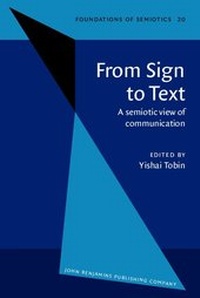
From Sign to Text
A semiotic view of communication
1st Edition
Published on 1. January 1989
XIII, 545 pages
978-90-272-7845-6 (ISBN)
Description

This volume contains selected contributions from the colloquium From Sign to Text' (Ben Gurion University, 1985) and combines the diverse interdisciplinary interests and approaches of the contributors in a fundamentally shared definition of language seen as a flexible and open-ended system of systems' revolving around the notion of signs used by human beings to communicate. The special interrelationship between signs and texts is discussed both theoretically and methodologically. The collection consists of an English and a French section.
More details
Other editions
Additional editions
Book
01/1989
John Benjamins Publishing Co
€169.60
Shipment within 10-15 days
Content
- FROM SIGN TO TEXT A SEMIOTIC VIEW OF COMMUNICATION
- Editorial page
- Title page
- Copyright page
- Dedication
- Table of contents
- Contributors
- From sign to text: A semiotic view of communication
- Introduction
- REFERENCES
- ENGLISH SECTION
- I. SIGN:CONTEXT:TEXT IN LINGUISTIC ANALYSIS
- Why speech seems ungrammatical
- Introduction
- The present problem
- Method
- Discussion
- NOTES
- REFERENCES
- On the role of form in going from sign to text and from text to understanding
- NOTES
- REFERENCES
- Space, time and point-of-view in the Modern Hebrew verb
- 1. Introduction
- 2. The Proposed System
- 3. The data
- 4. The textual use of the present tense
- 4.1 The use of the present tense in the Holocaust memoir
- 4.2 The use of the present tense in the soldiers' war stories
- 4.3 The use of the present tense in the headmaster's view of special education
- 5. Conclusion
- NOTES
- REFERENCES
- APPENDIX
- Verbal aspects and scripts: an example of interaction between grammatical meanings and cognitive models
- NOTE
- REFERENCES
- Syntagmatic relations and paradigms: Tenses and moods in ancient Greek verbal structure A semantic analysis of the ancient Greek verb system
- NOTES
- A study in linguistic sign theory: the suffix -K-A/-KA in modern Russian
- APPENDIX
- NOTES
- REFERENCES
- The challenge of polysemy
- REFERENCES
- Signs from a growing (creole) language
- Conclusion
- NOTES
- REFERENCES
- SOURCES OF DATA
- Does sign-oriented linguistics have a future?: On sign, text, and the falsifiability of theoretical constructs
- 1. Introduction
- 2. The analytical problem
- 2.1 The semantic analysis
- 2.2 On meanings and strategies
- 3. Mechanism I: the Attraction hypothesis
- 4. Mechanism II: the Retrieval Distance hypothesis
- 5. Quantitative testing of the hypotheses
- 6. Conclusion
- NOTES
- REFERENCES
- II. THE TEXT AS SIGN IN LITERATURE
- The sheep in wolf's clothing -thoughts on modern variations of an ancient fable
- NOTES
- Svejk Don Quixote Jesus Christ
- NOTES
- The Agnonian text: A study in polaric semiology
- 1. Introduction
- 2. The concept of word systems
- 3. The analysis
- 5. Conclusion
- NOTES
- REFERENCES
- Open reading of a closed text: Zúñiga's "Puertas abiertas, puertas cerradas
- 1. The story
- 2. Ordering of the narrative
- 3. Spatio-temporal structure
- 4. The characters
- 5. Linguistic structuring
- 6. Conclusions
- 7. Postscript
- NOTES
- REFERENCES
- III. FROM SIGN TO TEXT IN SPECIFIC TEXT GENRES
- From sign to text in mathematical discourse
- Previous attitudes to mathematical discourse
- An overview of the semiotics of mathematical symbols
- How mathematical texts are read
- Two models for analyzing mathematical texts
- Interplays in mathematical texts
- Further means of producing meaning in mathematical texts
- A Look at certain mathematical texts
- Another White Mythology
- Materialistic mathematical texts
- Limit classes of texts
- REFERENCES
- APPENDIX
- Speaker's of commitment and involvement in discourse
- I
- II
- III
- a. Topical involvement
- b. Interactional involvement
- IV
- ACKNOWLEDGEMENT
- REFERENCES
- The sign, its addresser and addressee: Aspects of legal and liturgical texts
- NOTES
- REFERENCES
- The text as referent: an examination of Purim Torah
- NOTES
- From text to sign: Exploring translation strategies
- THE PACIFIC (1921)
- NOTES
- REFERENCES
- IV. SIGNS OF DEVIANCE IN TEXTS
- Normal- deviant - disturbed? The socio-psychological theory of textplanning
- Introduction
- 1. "Normal" - "deviant" - "disturbed" - "ill" - "healthy" - "cured"?
- 2. Summary of assumptions
- 3. A model of sociopsyetiological text-planning (SPTP)
- 4. Illustrative examples
- 5. Summary
- NOTES
- REFERENCES
- On transcribing junkie voices
- I
- II
- III
- Facts of creation
- Transcription rules
- IV
- APPENDIX
- REFERENCES
- Denial and violence: signs of a historical context. A comparison of story-telling in two right-extremist youth groups
- 1. The interview with Norbert, Otto and Peter of the "Young National Democrats
- 1.1 Norbert's stories (The Proponent)
- 1.2 Peter's stories (The Opponent)
- 2. The interview with Claus, Dieter, Thomas and Volker of a neo-Nazi group
- 2.1 Volker's story (The Proponent)
- 2.2 Dieter's story (The Opponent)
- 3. Comparative analysis of the stories in each group
- NOTES
- REFERENCES
- Deviance in the intonation patterns: A contrastive study of the normal hearing vs. hearing impaired Hebrew speaking Israeli children
- Summary
- REFERENCES
- Ethnographic discrepancies in the aesthetic of the Marshfield Paper Boys' voice disguise
- NOTES
- FRENCH SECTION DU SIGNE AU TEXTE EN LINGUISTIQUE, LITTERATURE ET DANS LES ARTS
- I. LE SIGNE LINGUISTIQUE
- Communication: "Le genre des noms de villes comme signe linguistique
- 1. Les noms de villes et la syntaxe
- 2. Les noms de villes et la sémantique
- 2.1 Les groupes réguliers
- 2.1.1 L'évènement
- 2.1.2 L'équipe sportive
- 2.1.3 La personnification
- 2.1.4 Le pronom personnel
- 2.2 Les groupes variables ou l'emploi journalistique
- 3. Conclusion
- BIBLIOGRAPHIE
- Le signe idiomatique et la production textuelle
- 1. De l'idiome
- 2. De Pidiome au texte
- 2.1 Par progression synonymique
- 2.2 Par progression antonymique
- 3. Retour à l'idiome
- NOTES
- BIBLIOGRAPHIE
- Quand le texte ne fait plus signe. Problèmes du Français de France et de l'atlas de l'Ile-de-France
- Le voyage à la Délivrande
- Enfouir et enterrer
- BIBLIOGRAPHIE
- Méthodes et problèmes de la lexicologie comparée appliquée à la traduction
- APPENDIX I
- APPENDIX II
- Relativation et conditions d'énonciation Remarques a propos de certaines relatives "marginales
- 3.1 La relative sans antécédent
- 3.2 La construction clivée
- 3.3 Le décumul du relatif
- NOTES
- BIBLIOGRAPHIE
- II. LE TEXTE COMMUNICATIF
- Entre sens et non-sens dans une perspective textuelle
- 1. Signe et texte
- 1.1 Le signe comme convention et comme intention
- 1.2 La language comme action
- 1.3 La modalité de l'acte illocutoire
- 1.4 Le texte comme équation sémantique à quatre variables
- 2. Questions sur le sens
- 2.1 L'indétermination et l' interprétation
- 2.2 Entre sens et non sens
- 2.3 Non-sens et sens
- 3. Entropie, non-sens et production littéraire
- 3.1 Une anomalie: la coupure du signifié
- 3.2 Un exemple: Hans Arp
- NOTES
- BIBLIOGRAPHIE
- Le sens propre du figuré": Questions sur la "texture" linguistique de l'humour
- NOTES
- A la recherche d'une stéganographie dans l'oeuvre romanesque du XVIIe siècle
- NOTES
- APPENDIX
- L'image-porche ou la première page enluminée dans les romans médiévaux
- Le statut du livre
- La parole sur le seuil
- La mise en récit
- NOTES
- Les marques de l'énonciation dans le vitrail chartrain
- 1. Donateurs/donataires
- 2. Allocuteur et Allocutaire
- Conclusion
- NOTES
- Name index
- Subject index
