

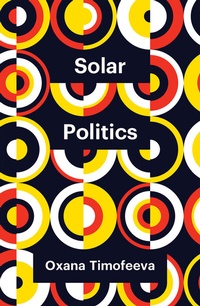
Solar Politics
Description

This book is a philosophical essay on the sun. It draws on Georges Bataille's theories of the solar economy and solar violence and demonstrates their relevance to a world affected by the COVID-19 pandemic and climate change.
The sun, which, since Antiquity, has played an essential role in our utopian imaginations, is the ultimate source of energy, both productive and destructive. According to Georges Bataille, its infinite generosity can be taken as the model for human societies, which suggests an alternative to the capitalist economy with its infinite expansion, colonization, and disastrous consequences on the cosmic scale.
Taking a step from solar economy to solar politics, Timofeeva locates the grounds for it in solidarity with nature, treated neither as a master nor as a slave, but as a comrade.
The book will appeal to students, academics, artists, and other readers interested in the philosophy of nature, ecology, social and political theory, postcolonial and decolonial studies, and the humanities generally.
More details
Other editions
Additional editions
Person
Content
Introduction: Two suns and the city
1. Two kinds of violence
2. General economy
3. Restrictive violence of capital
Conclusion: Sun is a comrade
Notes
1
Two Kinds of Violence
The word "violence" serves as an inflating political currency that can be returned as change for all kinds of symbolic transactions. Coming to ordinary language from public politics and the mass media, it applies to actions and affectations of different degrees of brutality, from terrorism to the violation of someone's privacy and psychological autonomy. Police violence; sexual, physical, and emotional violence; war; gender, domestic, ethnic, and racial violence: all become universal elements of social and private lives, designating either situations that escalate and run out of control, or, on the contrary, those where there is too much control. Anthropogenic factors of climate change and mass extinction can also be discussed in terms of violence: an ecological worldview suggests an image of the human as a sum of technology, as violating the Earth, and of the extractive economy treating it as a collection of usable resources. After all, any kind of activity or inactivity can be qualified as violence over something or somebody. I do violence to myself, too, even by making myself write this book.
Given the variety of word usages, there are general tendencies in thoughts about violence today. First, it is definitely a subject of moral condemnation; second, the discourse of violence penetrates all spheres of social life to such an extent that it becomes hard to find anything that wouldn't fall under this label. There is a moral ban on it: violence is evil. It must be exposed and denounced, precluded, stopped, eliminated, minimized, prevented, or punished. With some exceptions, cultural experiences of modern Western societies are framed by highly developed humanistic values. Addressing violence in some positive context therefore seems to go against common sense.
At the same time, the fact that commonsensical judgments comply with moral evaluations does not automatically make them true. Moreover, truth in the philosophical sense may well confront, directly or indirectly, such judgments and evaluations recognized as doxas, dogmas, ideologies, or nonsense. Thus, in the Phenomenology of Spirit, Hegel emphasizes that good and evil, in their actualization, converge into each other: virtue is a form of consciousness that acts in the name of abstract good and struggles against the way of the world without realizing that it is itself a part of that great mess that it labels as evil.1 Inviting us to reevaluate all values, Nietzsche, in turn, pushes philosophy beyond good and evil and displays violence at the origins of all morals.2 Both Hegel and Nietzsche uncover, in their own way, the hypocrisy and double standards of moralism and suggest alternative ethics that derives from the multidimensionality of the life of Spirit (Hegel) or body (Nietzsche). If Hegel ironically, but gently, turns inside out all evidence of common sense, Nietzsche demolishes it without remorse.
Later, Marxist and leftist tradition radicalizes these antidogmatic tendencies and inscribes the genealogy of moral categories within the history of class struggles. Taking the side of the poor, the wretched, and the oppressed, this tradition is an affront to public morality, which conveys the interests of the ruling classes and privileged groups and represents as good the violence that they commit. It is precisely in the framework of this leftist critic that a very specific apology for violence emerges, but this is not an apology of the violence of the state, of the police, or, generally, of the strongest. What is at stake is not the abuses of power disguised as a common good, but a violent restoration of justice, which is supposed to put an end to social oppression. It is not the field of morality, but a political perspective that generates the new common sense of revolutionary violence, the justifiability of which is debated with regards to historical precedents, from the Paris commune to the recent Black Lives Matter and other popular movements.
Negation of negation
In the twentieth century some bright intellectuals dared to speak up about forms of emancipatory violence - among them, Georges Sorel, Walter Benjamin, and Frantz Fanon. There are grounds for believing, with some reservations, that Bataille too belongs in this category, although his theory of violence falls out of the general line. Here I would like to touch upon these grounds, to juxtapose the conceptions of these thinkers, to expand on the specificities of Bataille's position, and to provide an argument for its relevancy.
There are at least two moments where, on the level of the formal structure, theories of violence, developed by Sorel, Benjamin, Fanon, and Bataille, do have something in common in spite of serious differences. First, there is an idea that there are two antagonistic types of violence. The true violence (Sorel), the divine violence (Benjamin), the absolute violence (Fanon), and the sacred violence (Bataille) are opposed to the actual existing system of legitimate violence, upon which old, exploitative, colonial, or profane regimes of power are based. Sorel opposes a supreme proletarian violence of the general strike to the brutal violence of the capitalist state system; Benjamin introduces divine, or revolutionary, violence contesting the violence of the law; Fanon formulates the idea of the resistance of colonized people that becomes even more violent and brutal than the colonial regime against which it struggles.
Second, there is an explicit asymmetry between these two types of violence. The second type - upright, rebellious, emancipatory, or redemptive - emerges as a response to the violence of the first type, or simply oppression. However, the violence of the oppressed is not a mere fight back, in which case the opposing sides as variables were simply switching places while the entire formula remained the same. It does not equate and does not mirror the actual existing violence that provoked it, and is not translatable to its language, but exceeds it and thus moves to some new level, or plain of possibilities - thus opening up its utopian dimension.
These two moments constitute a dialectical structure of the double negation. The point is not that we run into a brick wall, but that emancipatory violence corresponds to the negation of negation: for instance, police violence negates personal liberty, while the violence of protesters against the police, by negating this negation, affirms true liberty, which previously existed only in the form of an abstract idea, and now became real. Thus, during protests in Moscow against fake elections in August 2019 a number of people were convicted on charges of civil disorder and violence against the police. What they did were actually minor things like throwing an empty paper coffee cup or a plastic bottle in the direction of the group of policemen that were striking people with batons. This gesture seems so inoffensive and incommensurate: what is a weightless paper cup or a plastic bottle against the police truncheon? And yet, according to law enforcement agencies, these gestures were assuredly categorized as violence. Why? Because this was liberty at work. Suddenly, the truth of deliberate action makes the paper cup weigh more than the truncheon. The violence of the police is not absolute; there can be always a response to it, and this response differs from the oppressive act that provoked it.
Indeed, theories, discussed here, emerged from dissimilar historical contexts, and the authors had completely different examples in mind, inscribing distinctions between two kinds of violence in their own larger projects: Sorel in anarcho-syndicalism, Benjamin in political theology, Fanon in decolonization, and Bataille in the general economy. However, a kind of structural homology makes it possible to introduce these theories into a conversation, which resonates in the spirit of today's life. Among contemporary philosophers, the one who dares to continue this tradition is Slavoj Zizek, according to whom the two kinds of violence are objective and subjective.3 Subjective violence includes the most visible things, such as crimes, whereas the first type, objective violence, is invisible, normalized, and itself divides into two kinds - symbolic (the violence of language, or symbolic order) and systemic (the violence of capitalism). It is not tolerance, but the struggle against this violence that unites people and gives them a sense of solidarity. Paradoxically, this second kind of violence is driven by the negativity of love. As Zizek states in the concluding chapter of his book on violence, commenting on Benjamin: "The domain of pure violence, the domain outside law (legal power), the domain of the violence which is neither law-founding nor law-sustaining, is the domain of love."4
General strike
Sorel's Reflections on Violence is one of the major references in any substantial theoretical discussion on the topic. In this book the acts of violence are embedded in the politics of class: "These acts can only have historical value if they are the brutal and clear expression of class struggle."5 Sorel describes class struggle in Marxist terms, as a revolutionary movement of the proletariat against the bourgeoisie; the latter always prefers peace, which means conservation of the status quo. He makes a clear distinction between the two terms "force" and "violence," or, to be more precise, "between bourgeois force and proletarian...
