

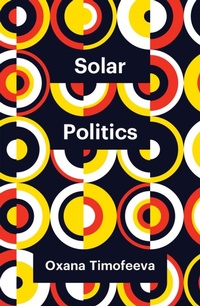
Solar Politics
1st Edition
Published on 3. February 2022
Book
Hardback
140 pages
978-1-5095-4964-1 (ISBN)
Description
This book is a philosophical essay on the sun. It draws on Georges Bataille's theories of the general economy and the violence of the nonhuman and demonstrates their relevance to a world affected by the COVID-19 pandemic and climate change.
Since Antiquity, the sun has played an essential role in our utopian imaginations - either as the ultimate source of energy, or as the symbol of the state sovereignty. The attitude towards the sun has shifted historically, from praising it as a supreme god to exploiting it as the most powerful fuel. In capitalism, both economic growth and green sustainable developments imply infinite expansion and colonization, with disastrous consequences on the cosmic scale. According to Bataille, an alternative is suggested by the sun itself, which gives without reciprocation. Timofeeva argues that this alternative can be taken as the model for human societies, and she locates the grounds for solar politics in solidarity with nature, treated neither as a master nor as a slave, but rather as a comrade.
The book will be appeal to students, academics, artists and other readers interested in the philosophy of nature, ecology, social and political theory, postcolonial and decolonial studies, and the humanities generally.
More details
Series
Language
English
Place of publication
Oxford
United Kingdom
Target group
Professional and scholarly
Dimensions
Height: 194 mm
Width: 121 mm
Thickness: 16 mm
Weight
224 gr
ISBN-13
978-1-5095-4964-1 (9781509549641)
Copyright in bibliographic data and cover images is held by Nielsen Book Services Limited or by the publishers or by their respective licensors: all rights reserved.
Schweitzer Classification
Other editions
Additional editions
Person
Oxana Timofeeva is Professor at the European University at St. Petersburg, a lead researcher at Tyumen State University, and member of the artistic collective ""Chto Delat?"".
Content
Acknowledgements
Introduction: Two suns and the city
1. Two kinds of violence
2. General economy
3. Restrictive violence of capital
Conclusion: Sun is a comrade
Notes