

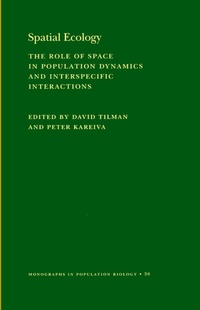
Spatial Ecology
The Role of Space in Population Dynamics and Interspecific Interactions
1st Edition
Published on 19. November 2018
416 pages
978-0-691-18836-2 (ISBN)
Description

Spatial Ecology addresses the fundamental effects of space on the dynamics of individual species and on the structure, dynamics, diversity, and stability of multispecies communities. Although the ecological world is unavoidably spatial, there have been few attempts to determine how explicit considerations of space may alter the predictions of ecological models, or what insights it may give into the causes of broad-scale ecological patterns. As this book demonstrates, the spatial structure of a habitat can fundamentally alter both the qualitative and quantitative dynamics and outcomes of ecological processes.
Spatial Ecology highlights the importance of space to five topical areas: stability, patterns of diversity, invasions, coexistence, and pattern generation. It illustrates both the diversity of approaches used to study spatial ecology and the underlying similarities of these approaches. Over twenty contributors address issues ranging from the persistence of endangered species, to the maintenance of biodiversity, to the dynamics of hosts and their parasitoids, to disease dynamics, multispecies competition, population genetics, and fundamental processes relevant to all these cases. There have been many recent advances in our understanding of the influence of spatially explicit processes on individual species and on multispecies communities. This book synthesizes these advances, shows the limitations of traditional, non-spatial approaches, and offers a variety of new approaches to spatial ecology that should stimulate ecological research.
Spatial Ecology highlights the importance of space to five topical areas: stability, patterns of diversity, invasions, coexistence, and pattern generation. It illustrates both the diversity of approaches used to study spatial ecology and the underlying similarities of these approaches. Over twenty contributors address issues ranging from the persistence of endangered species, to the maintenance of biodiversity, to the dynamics of hosts and their parasitoids, to disease dynamics, multispecies competition, population genetics, and fundamental processes relevant to all these cases. There have been many recent advances in our understanding of the influence of spatially explicit processes on individual species and on multispecies communities. This book synthesizes these advances, shows the limitations of traditional, non-spatial approaches, and offers a variety of new approaches to spatial ecology that should stimulate ecological research.
More details
Other editions
Additional editions
David Tilman | Peter Kareiva
Spatial Ecology
The Role of Space in Population Dynamics and Interspecific Interactions
Book
01/1998
Princeton University Press
€88.70
Article not available at the moment
David Tilman | Peter Kareiva
Spatial Ecology
The Role of Space in Population Dynamics and Interspecific Interactions
Book
12/1997
Princeton University Press
€117.61
Article exhausted; check different version
Persons
David Tilman is the Distinguished McKnight University Professor of Ecology and Director of Cedar Creek Natural History Area at the University of Minnesota. He is the author of Plant Strategies and the Dynamics and Structure of Plant Communities (Princeton). Peter Kareiva is Professor of Zoology at the University of Washington.
Content
- Cover
- Title Page
- Copyright Page
- Contents
- Preface
- List of Contributors
- PART I: SINGLE SPECIES DYNAMICS IN SPATIAL HABITATS
- 1. Population Dynamics in Spatial Habitats
- 2. Predictive and Practical Metapopulation Models: The Incidence Function Approach
- 3. Variability, Patchiness, and Jump Dispersal in the Spread of an Invading Population
- PART II: PARASITES, PATHOGENS, AND PREDATORS IN A SPATIALLY COMPLEX WORLD
- 4. The Dynamics of Spatially Distributed Host-Parasitoid Systems
- 5. Basic Epidemiological Concepts in a Spatial Context
- 6. Measles: Persistence and Synchronicity in Disease Dynamics
- 7. Genetics and the Spatial Ecology of Species Interactions: The Silene-Ustilago System
- PART III: COMPETITION IN A SPATIAL WORLD
- 8. Competition in Spatial Habitats
- 9. Biologically Generated Spatial Pattern and the Coexistence of Competing Species
- 10. Habitat Destruction and Species Extinctions
- 11. Local and Regional Processes as Controls of Species Richness
- PART IV: THE FINAL ANALYSIS: DOES SPACE MATTER OR NOT? AND HOW WILL WE TEST OUR IDEAS?
- 12. Theories of Simplification and Scaling of Spatially Distributed Processes
- 13. Production Functions from Ecological Populations: A Survey with Emphasis on Spatially Implicit Models
- 14. Challenges and Opportunities for Empirical Evaluation of "Spatial Theory
- References
- Index
