

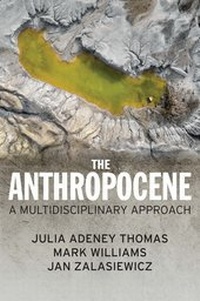
The Anthropocene
Description

The Anthropocene is intriguing scientifically, fascinating intellectually, and deeply disturbing politically, socially, economically, and ethically. We must learn how to co-exist sustainably with the rest of nature in what is emerging as a new planetary state. To do so, we must first understand what "Anthropocene" means in all its dimensions. This book adopts a multidisciplinary approach, starting with an exploration of the Anthropocene as a geological concept: ranging across the physical changes to the landscape, to the rapidly heating climate, to a biosphere undergoing transformation. And what of the "anthropos" in the Anthropocene? While geoscience does not normally address political and ethical issues of justice and equity, or economics and culture, Anthropocene studies in the humanities and social sciences investigate the complexities of the human activity driving global change. Here the book looks at human history, both in the deep past and more recently, the politics and economics of growth spurring the Anthropocene, and potential ways of mitigating its cruel effects. Our fragile, still beautiful, planet is finite. The new realities of the Anthropocene will need our best efforts, across disciplinary divides, at effective hope and action.
More details
Other editions
Additional editions
Persons
Mark Williams is Professor of Palaeobiology at the University of Leicester and co-director of the International Laboratory for Palaeobiology and Palaeoenvironments at Yunnan University.
Jan Zalasiewicz is Professor of Palaeobiology at the University of Leicester and Chair of the Anthropocene Working Group of the International Commission on Stratigraphy.
Content
1. The Multidisciplinary Anthropocene
2. The Geological Context of the Anthropocene
3. The Anthropocene as a Geological Time Unit and the Great Acceleration
4. The Anthropocene and Climate Change
5. The Anthropocene and the Biosphere's Transformation
6. The "Anthropos" of the Anthropocene
7. Economics and Politics of the Anthropocene
8. Existential Challenges in the Anthropocene
1
The Multidisciplinary Anthropocene
Alexander von Humboldt (1769-1859), the great Prussian polymath, exemplifies the mix of scientific and humanistic knowledge required to comprehend the Anthropocene in all its complexity. An intrepid explorer, venturing across Siberia and traveling through South America, Humboldt gathered information on species occurrence, air temperature, ocean salinity, and much else. His goal was to integrate this information into global patterns. Only by uncovering these larger patterns could phenomena such as climate, ocean circulation, earthquakes, volcanism, and geomagnetism be understood - or so he argued. To achieve this global perspective, he mined travelers' accounts, interviewed indigenous people, and collected sailors' anecdotes, ultimately organizing a worldwide network of correspondents providing data. But his interests were also humanistic and political. He was intrigued by cultural differences, fascinated by the variety of ideas and customs, just as he was by the variety of plants and animals. Humboldt even argued that all the diverse peoples of the world were a single species, with no peoples or cultures a priori superior to or dominant over others. Ahead of his time, Humboldt "was a passionate and vocal opponent of imperialism, colonialism, and slavery" (Jackson 2019, p. 1075). On the one hand, he compiled measurements and descriptions of nature that were valuable for their accuracy and their systemic interrelatedness. On the other hand, he appreciated the rich, often incommensurate, ideas about society, gods, and time that give human lives meaning. In short, he wanted both data and stories. His model of genuine, wide-ranging, and generous multidisciplinarity serves today as the best approach to the Anthropocene.
The Anthropocene was born multidisciplinary. Early on, many types of scientists, along with social scientists, humanists, art critics, artists, journalists, and activists, sensed that something outlandish was happening, and then, in their various ways, went to work to try to figure out how and why the planet was changing. From all these perspectives, Earth, which had once seemed boundless and bounteous, began to seem girdled, befouled, and, above all, strange. As subsequent chapters show, progenitors of the idea that human activities have abruptly altered the planetary system include people as different from one another as eighteenth-century French naturalist Georges-Louis Leclerc (the comte de Buffon) (1707-88), nineteenth-century art critic John Ruskin (1819-1900), and Russian scientist Vladimir Vernadsky (1863-1945). More recently, science journalist Andrew Revkin, archeologist Matt Edgeworth, historian of science Naomi Oreskes, activist Greta Thunberg, and historian John McNeill, among many others, have drawn attention to Earth's radical transformation. In journalist Bill McKibben's view, we no longer live on Earth but on a different planet he calls "Eaarth" (McKibben 2010). While assessing the physical evidence of new, geologically significant strata and a shift in the Earth System is the job of geologists and, more broadly, Earth System scientists, the questions of how and why human activities propelled the planet on a dangerous trajectory concern everyone. Likewise, while the decision about adding the Anthropocene Epoch to the Geological Time Scale will be made within the geoscientific community, decisions about how to live in these harsher, unfamiliar conditions fall to us all. Our new Eaarth requires new forms of knowledge, drawing from the widest possible range of sources.
Most of us know something about the unprecedented conditions we face on our transformed planet. The US National Aeronautics and Space Administration (NASA) says that the level of carbon dioxide in the atmosphere is higher than at any time in at least the past 800,000 years - well before our species evolved - and it is causing the atmosphere to warm. Our strangely unfamiliar planet now has more than 193,000 human-made "inorganic crystalline compounds," which vastly outnumber Earth's ~5,000 natural minerals; more than 8.3 billion tonnes of plastics; amounts of fixed nitrogen roughly doubled since 60 years ago, with the nitrogen cycle perhaps more sharply impacted than in the last 2.5 billion years; novel kinds of nuclear radiation from bomb tests and power production; a biosphere undergoing rapid transformation; and much else. So, too, human societies are radically transformed. Our systems of communication, transportation, and manufacturing are global as never before. Never has the planet been so crowded with human beings. In 1900, there were around 1.5 billion of us; in the 1960s, around 3 billion; today, there are upwards of 7.8 billion. Our "anthropomass" (as Vaclav Smil calls it), combined with the mass of our domesticated animals comprise an astounding 97 percent of the total zoomass of terrestrial mammals, leaving wild mammals to make up a miserly 3 percent (Smil 2011, p. 617). Never before have most human beings lived in cities, especially in megacities such as Guangzhou, China, home to 25 million people. Needs multiply; desires grow; the capacity of Earth to renew resources shrinks. Extraordinary as each factor is on its own, the concept of the Anthropocene brings all of them - and others - together. It helps us see Earth as a single reverberating system, made up of feedback loops and tipping points that we cannot yet predict, and of thresholds we cross at our peril.
A Predicament, Not a Problem
No single way of knowing has a monopoly on understanding how and why some human activities coalesced to produce the Anthropocene in the mid twentieth century, or on the best responses to this unprecedented and unpredictable situation. Why is this the case? The reason is that the Anthropocene presents not a problem, but a predicament. The difference is important for our multidisciplinary project. A problem may be solved, sometimes using a single physical or conceptual tool produced by experts in the only appropriate field, but a predicament presents a challenging situation requiring resources of many kinds. We don't solve predicaments; instead, we persevere with more or less grace and decency.
Any hope of persevering with grace and decency on our transformed and increasingly inhospitable planet obliges us to draw on everything that might be useful in humanity's great storehouse of contentious wisdom. "The question," as historian Libby Robin notes, "is how people can take responsibility for and respond to their changed world. And the answer is not simply scientific and technological, but also social, cultural, political and ecological" (2008, p. 291). In the same vein, the historian Sverker Sörlin argues that one of the major problems is that "all relevant knowledge is not sufficiently considered as expertise." The contributions of the humanities and social sciences remain under-acknowledged, even though they should be central to "the sustainability endeavor, since their realm of expertise is precisely about value formation, ethics, concepts, decision-making, and other matters" that are essential to coping with immense global change (Sörlin 2013, p. 22). And social scientists and humanists are not the only people arguing that responding to the transformation of the Earth System requires more than scientific and technological understanding. Earth System scientist Will Steffen and colleagues point to the need for expansive change, including rapid "decarbonization of the global economy, enhancement of biosphere carbon sinks, behavioral changes, technological innovations, new governance arrangements, and transformed social values" (Steffen et al. 2016, p. 324). New economies, politics, and values are at least as important as science and technology.
From its beginning in 2009, the Anthropocene Working Group (AWG), set up to study the potential new geological time unit, included non-geologists among its members. This was an unusual move for a body of the International Commission on Stratigraphy. International governmental organizations, such as the UN's Intergovernmental Science-Policy Platform on Biodiversity and Ecosystem Services (IPBES), are also adopting this multidisciplinary approach (Vadrot et al. 2018). Recent academic initiatives around the world encourage geologists, Earth System scientists, historians, anthropologists, engineers, artists, and literary critics (among others) to talk and work with one another. These include The Anthropocene Project, a collaboration of the Haus der Kulturen der Welt cultural center in Berlin with the Max Planck Institute for the History of Science; the Center for Energy and the Environment in the Human Sciences at Rice University in Texas; the Integrated History and Future of People on Earth (IHOPE) in Sweden; the AURA project at Aarhus; the Vienna Anthropocene Network at Universität Wien; the Quotidian Anthropocene project; RIHN (the Research Institute for Humanity and Nature) in Kyoto; and the Center for Anthropocene Studies at KAIST in South Korea.
This volume also ventures beyond the sciences to some of the many disciplines concerned with humanity, the anthropos of the Anthropocene. Listening and learning across the frontiers of knowledge is far from easy. Each field has its own coherence, its own questions, protocols, genealogies of debate, and modes of argument. Even our citation styles differ. In an ideal world, navigating these differences might take the form imagined by paleobiologist Norman MacLeod,...
